
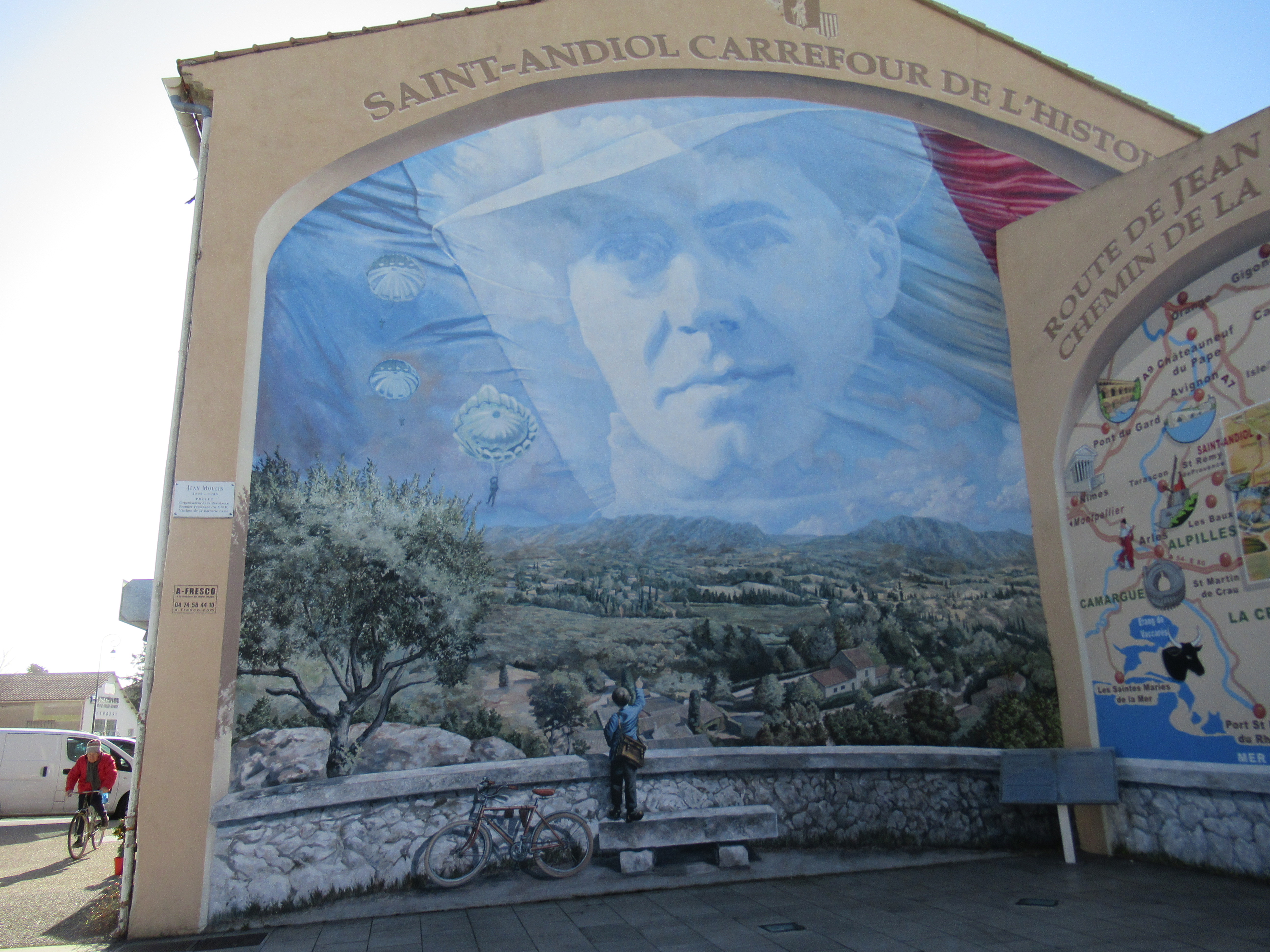
Not too far from my current billet is the commune of St Andiol boasting a population of around 3,500 people. It’s not exactly on the tourist track and in my experience nothing much happens there, with the exception of a large annual boot sale which seems to celebrate the commencement of the hunting season. However, St Andiol is really important in the annals of history for producing a man whom it’s said was the most important figure in the French Resistance.
There’s a bit of a clue to be seen whilst waiting at the village traffic lights. It’s the most wonderful mural depicting Moulin’s handsome but haunting face. At the front of the fresco, a small boy has discarded his bicycle and stands on a stone bench looking at a parachutist descending over Les Alpilles. In an amazing trompe l’oeil, it’s not immediately apparent that the child and his transport are actually part of this superb work of art.
I know people who’ve passed this way and claim not to have noticed the fresco. How can that be? The first time I saw it, I swerved into a handy gap, parked the motor and got out to inspect it. Since then, I’ve read what I think might be the only book translated into English about our hero. And also, since those long-ago days, the commune opened the Jean Moulin Museum, then immediately closed it because of Covid, and has now re-opened their memorial.
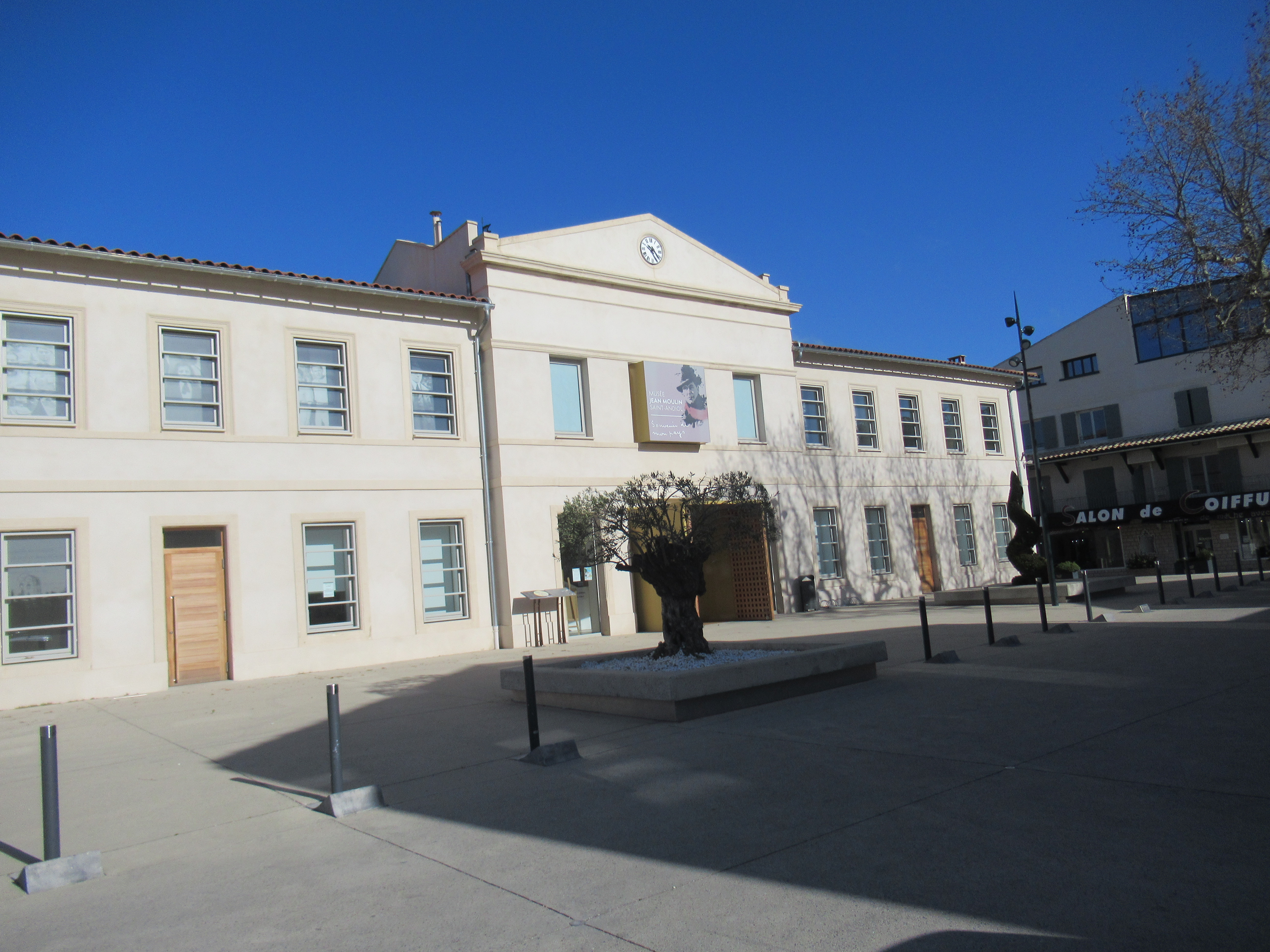
Yesterday, my friend Eleanor and I went to visit the museum which is sited in the old school that Moulin attended as a student. As you can see, it’s not small and St Andiol isn’t big but we did have an initial spot of bother locating it which I feel warrants a mention. Eleanor parked her car somewhere in the back streets. ‘I’ll go and ask that workman for directions. You stay here in the warm’, I said. (The day was sunny with brilliant blue skies but, yet again, the mistral was playing havoc with our hair). Having received helpful instructions I returned to the car, opened the door, and got back in. That’s strange, I thought, where’s she gone? I’d just like to point out that this was the first time I’d been in her car. Anyway, I got back out, had a vague look round for my friend who happened to be waiting in her motor three places along. After that, we made a dash for it but still couldn’t find the joint. Next, I went into the baker’s to ask for further directions. Madame, sensing I was an idiot, found a spare piece of baguette bag on which she drew an illustrated guide replete with lady having her hair done (look for the coiffeur, very busy in the mistral), large square sign with the word ‘Stop’ on it, and an arrow to ‘musee’.

The first thing one sees on entering the museum is this rather decorative container which has clearly been the subject of past abuse. The sign reads: ‘this is not a rubbish bin, this is where you leave your umbrella’.
Anyway, back to more serious things. Jean Moulin became a civil servant, although I feel this was a front to other activities, particularly as to say he was politically active would be an understatement. Quite early in the war, he was arrested in Chartres by the Germans and attempted suicide by cutting his throat with a piece of broken glass. The scars left from this episode explain why he’s subsequently portrayed wearing a scarf around his neck.
Having survived this, he returned to St Andiol where he joined the French Resistance. In October 1941, Moulin travelled to London where he met with de Gaulle and, according to some historians, with Churchill. He was tasked with unifying various resistance groups. On 1 January, 1942, Jean Moulin parachuted into Les Alpilles to meet with the leaders of these groups and achieve successful unification.
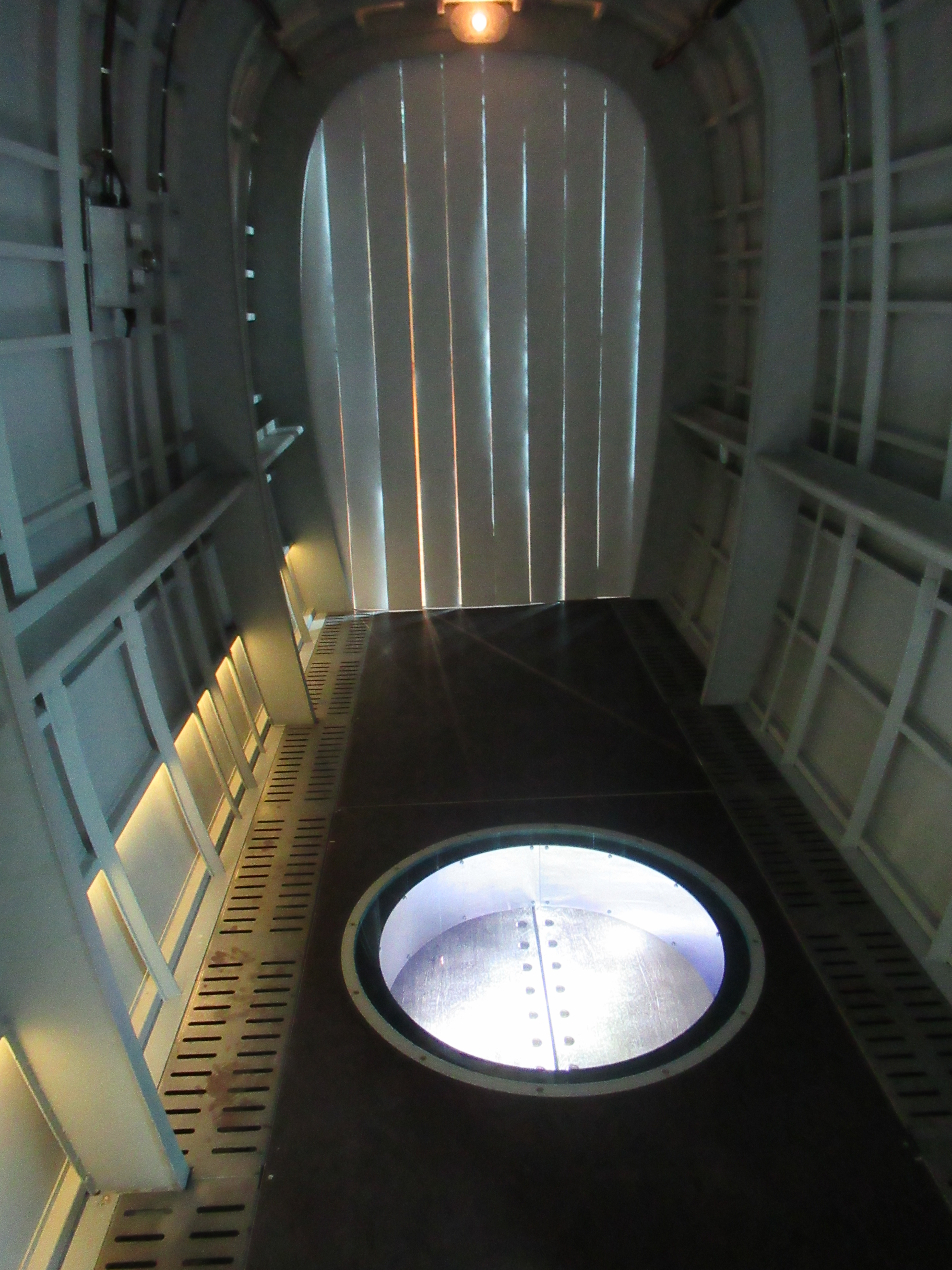
In this most amazing museum is a reproduction of the inside of the aircraft which took Moulin to Les Alpilles. As a visitor, one has to go through in order to progress to the rest of the exhibition. It’s difficult to describe: on entering, we are surrounded by the noise of the plane. Next, the circle on the floor opens, at which point Eleanor and I grabbed each other. The opening then displays the Alpilles coming closer and closer as if we are parachuting down. It’s amazing but very disconcerting.
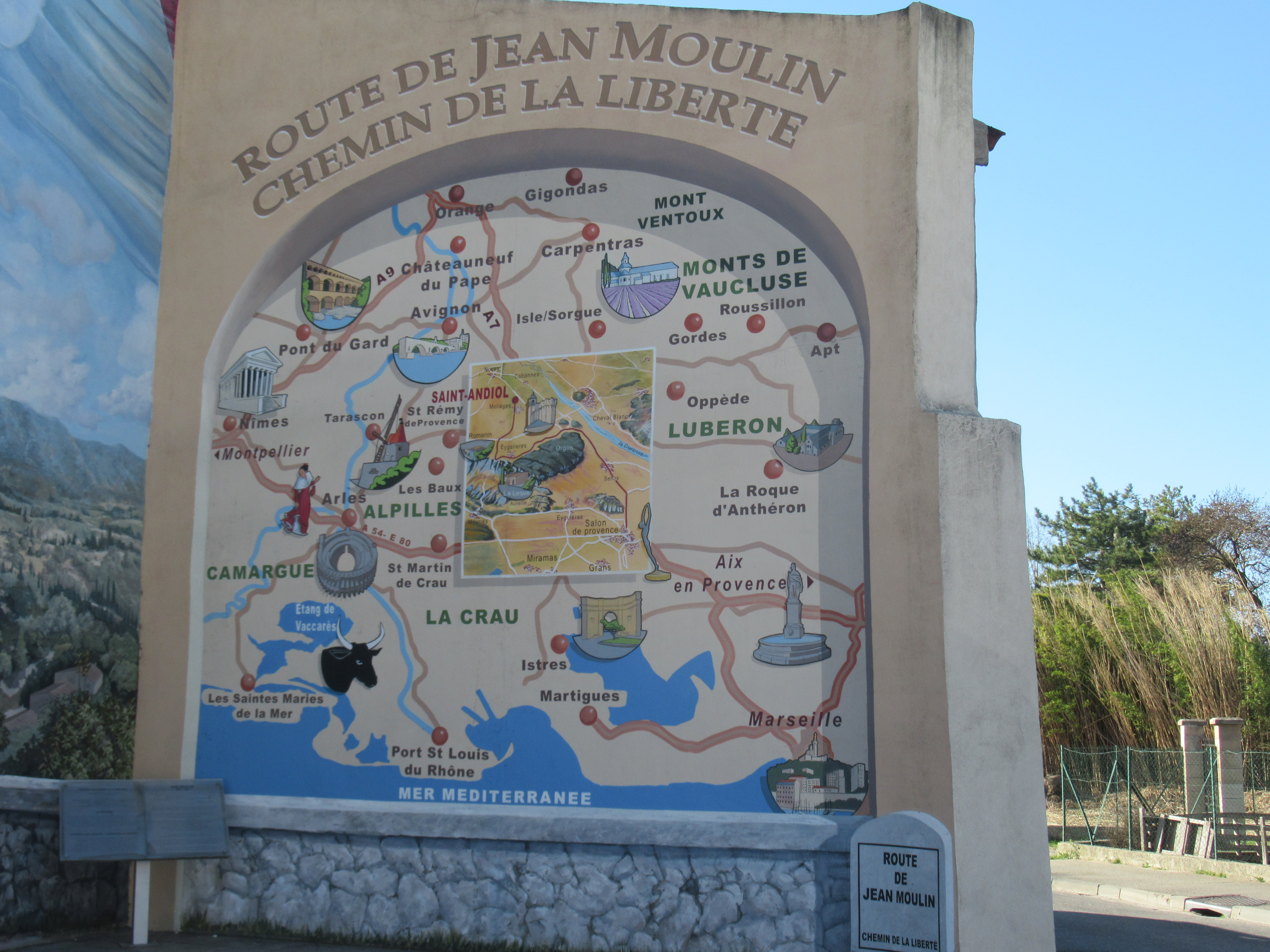
And here’s the second fresco in St Andiol depicting the Chemin de la Liberte. On 21 June, 1943, Jean Moulin was arrested in Lyon by Klaus Barbie, the ‘Butcher of Lyon’. He had been betrayed but by whom is unclear. Moulin was tortured by the Gestapo but never revealed anything of use to the enemy. He failed to survive the barbarity inflicted upon him and died before reaching internment.
In a country that names its streets after distinguished Frenchmen, Rue Jean Moulin is the third most popular and the fifth most popular when naming schools; which is as it should be as long as students recognise his importance. And in a country where museums don’t always do justice to their raison d’etre, I’d like to say that the little commune of St Andiol has done a most excellent job.
 Donald and the Weasels