Donald has been missing in action for so long that he and the weasels have bypassed the last week’s experiences. They don’t know that Cambodia has brought me to my knees emotionally. They’ve no idea that I awoke in tears for two nights from seeing life through the eyes of my last guide, Som, who is probably the kindest and most gentle man I’ve ever met.
I made a deliberate choice before I left home not to visit the Killing Fields because I thought it would be too distressing. How shallow I’ve since felt. Som was six years old when Pol Pot arrived on the scene. For four years, he survived on grass and leaves and bark and never thought about the following day. He lost his mother and father, and his sister died of starvation. In the dark of night, he taught himself English – to be discovered doing so would mean the end, and children were killed by being beaten against trees or simply hacked to death in front of their parents.
In my ignorance, I’d thought that the genocide only happened in and around Phnom Penh. Not so: Sorya, my current guide, today pointed out the Killing Fields of Siem Reap. The terror lived throughout the country and Pol Pot and the Khmer Rouge simply moved to the mountains of the north when their time was up. After it finished, Som went into a monastery for six years to learn how to recover and how to come back to life, with grace and with calm.
Now, here’s the thing with Cambodia: it’s as if the whole country is in a permanent state of recovery from the unspeakable darkness that engulfed them. It’s a recovery that embraces inclusivity and stillness. A place where farmers waiting to harvest their rice happily drive tourists around on cyclos or ox-carts with graciousness. A place that relishes the traditions that Pol Pot tried to erase. A place like a phoenix rising, full of the loveliest people imaginable. It’s inspirational and I am in love.
It’s impossible to be here without reference to the war. Readers might assume I mean the Vietnam War, but I don’t. There’s no such thing in this part of the world – here it’s referred to as the American War. Just about sums it up really doesn’t it. The whole history of the country, especially the last one hundred years or so, is a class in perspective: same facts and content – completely different way of looking at things.
On the bus to the commencement of our Mekong cruise, Khou delivers an absolute belter of a geo-history lesson. Necessarily devoid of emotion or blame because, let’s face it, his captive audience is paying his wages, the tale of how he came to be on this bus, and how some of his cousins are part of a world-wide Vietnamese diaspora, is the result of years of Western transgression in IndoChina. Further, it’s the current conclusion of a story in which communism overcame the political economics of those colonialists who cut up other people’s countries, divvying up the spoils along the way.
So, no Vietnam War and, it transpires, no Vietcong, VC or Charlie. Who knew? Not me. In this neck of the forest, these are derogatory terms employed by those trying to justify the deaths of American boys. Round here, the Vietcong were simply known as Vietnamese soldiers who won the war because they were better at their jobs. And I would say 100% because they knew the land.
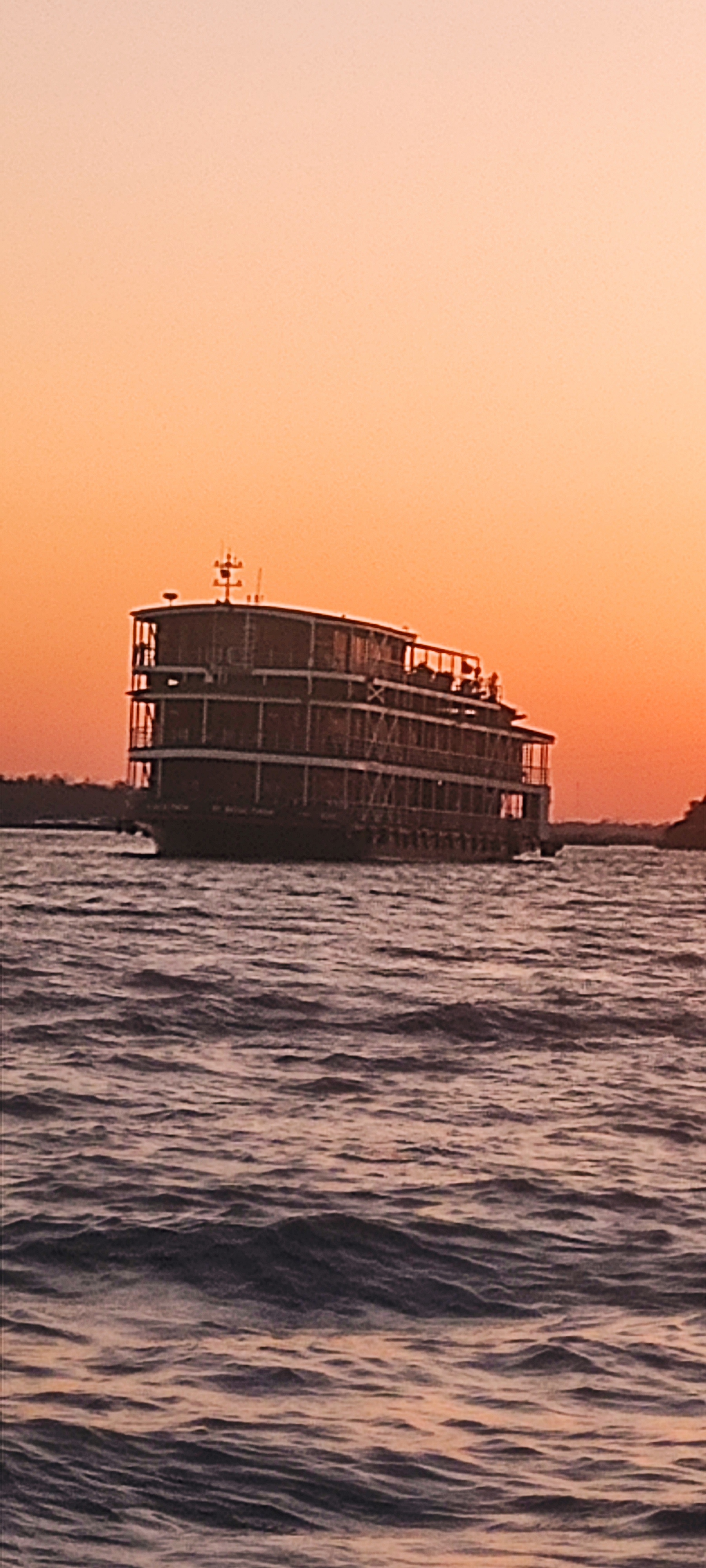
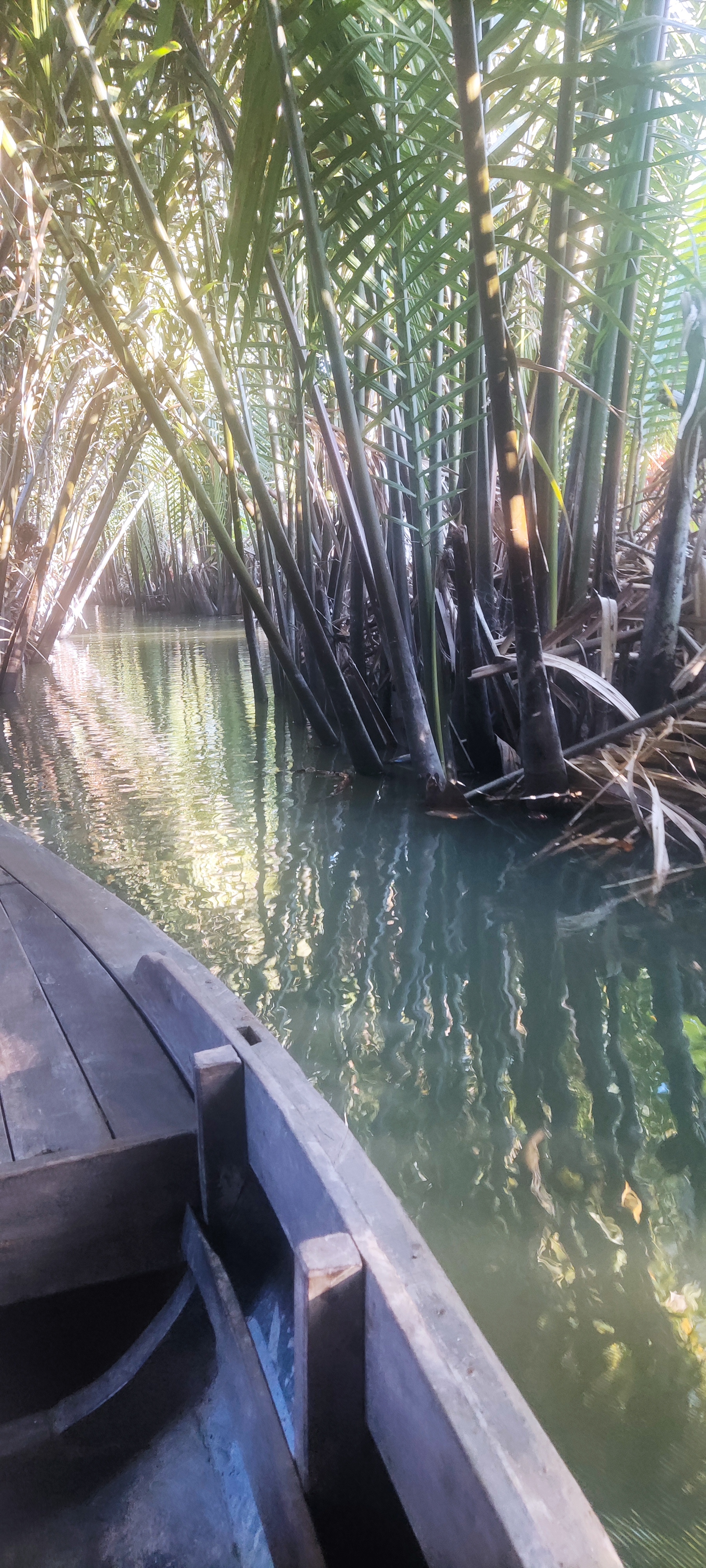
We disembark our beautiful Pandaw ship and journey into the mangroves and bamboo forests of Ben Tre by a smaller boat. It’s immediately thrilling even though the waterway is overhung with thick foliage housing who knows what insects and creatures. Exotic little birds dart across the water but, just as we’re getting acclimatised, we leave our restful mode of transport and begin a long hike through what is, quite frankly, little short of a jungle. Jackfruit, dragonfruit, pomello and coconut abound and form the economic basis for the folk who live here. How do they live here? To my spoilt Western eyes, conditions are inconceivable: scores of apparently related dogs, straggly but perfectly happy chickens and the potential of killer snakes. They’re doing really well says Khou; wifi is almost everywhere now. Small smiling children wave at us.
Later, we take a sampan through the mangroves: four of us at a time in a shaky wooden boat steered, and I use the term loosely, by a fragile looking girl who doesn’t speak. Some fellow travellers found the experience exhilarating…I thought it terrifying. But what I kept imagining was brave little men successfully hiding behind trees.
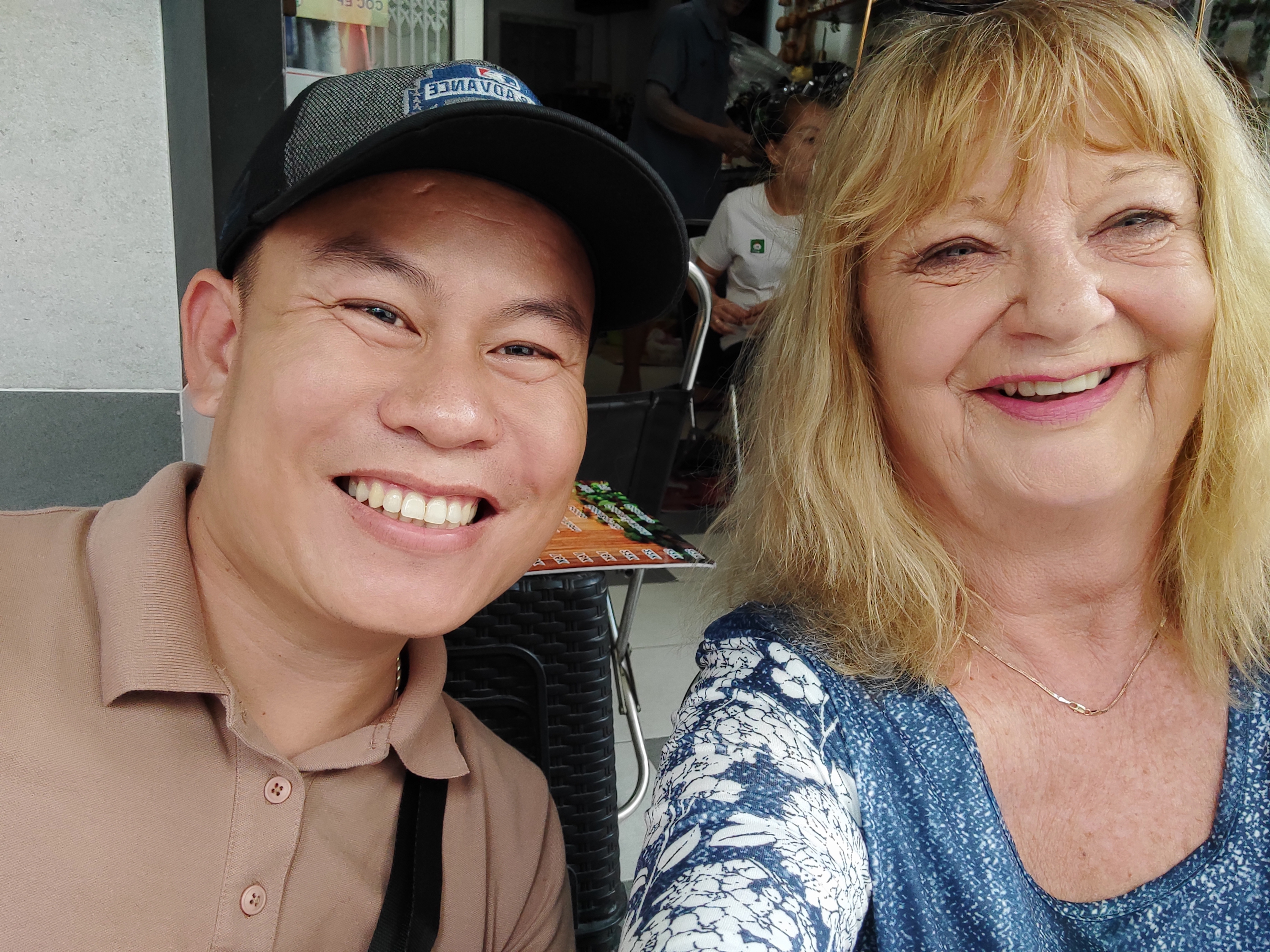
Sonny and I are outside a non-descript cafe along one of the many alleyways in this labyrinth of District 3. Four ladies sit in the doorway laughing like drains. To the Western eye, they look drunk but, as it’s only 10am, I’m certain that they’re just having a good time. What’s unusual is that they’re on chairs: almost every woman I’ve seen selling their wares in this ramshackle market, is seated on the floor. Mind you, my chair is so close to the ground as to be almost non-existent: I had not inconsiderable difficulty lowering myself into position and I’ve no idea how I’ll ever get back up again without the aid of a winch.
Sonny says it’s the best place for coffee – none of your machine concoccted rubbish here. The owner proudly brings one cup with a version of a percolator atop. It took some time as he first had to grind the beans; waiting for anything to trickle through takes around another half an hour, at which point I have about a quarter of an inch of liquid to imbibe. It’s exceedingly bitter and Sonny says I need some tea to accompany it. A tumbler of jasmine and something or other flavoured iced tea is produced.I am dubious: it’s been previously instilled that I must not even clean my teeth in the water of this city, let alone partake of suspect ice cubes. I make the mistake of trying to explain this to my guide but he looks wounded and anyway, the temperature seems to be around 40C, and the coffee is so strong, that I swig back the tea.
He reckons it’s the best coffee available, even though he’s not drinking any himself. Wizzo is the coffee beloved by the Vietnamese I’m told. Wizzo, I query? That sounds fun. Yes, replies Sonny showing me a picture of a small animal on his phone. Oh weasel! How does that work then? Well, the weasels eat the coffee beans and in the ensuing process, something incomprehensible happens involving enzymes. The weasel undertakes evacuation and the weasel owners then ferret around in the droppings to retrieve the beans which they grind into an apparently delicious beverage. He shows me another photo: weasel toilet, he exclaims proudly. Shit, I don’t say.
Saigon is a city of 72 million motor scooters. Crossing the road is terrifying. Sonny started by politely guiding me across with a light-handed touch but it’s not long before he’s grabbing my wrist and dragging me over. The trick is, he informs me, to keep walking despite the traffic having priority on pointless zebra crossings. Want to try it on your own, he asks? No thanks, it’s only Day One and I’d like to see the rest of my holiday. It’s the same down the alleys: people selling all sorts of live and dead-but-kicking goods in areas no more than three feet wide with throngs of local purchasers and scooters in all directions.
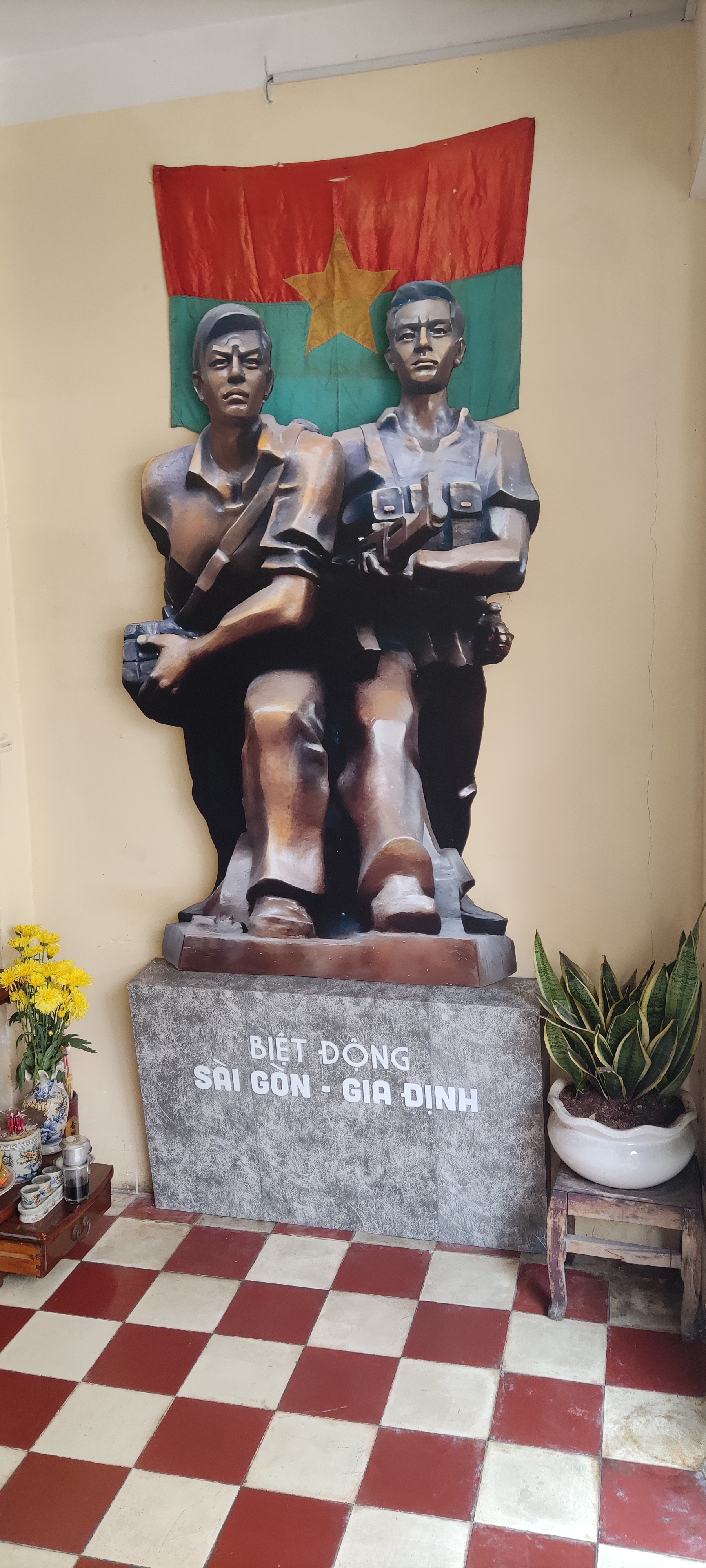
It’s where the Vietcong used to hide themselves and their explosives back in the bad old days. There don’t seem to be any other Western visitors in these parts. It’s not a place for tourists, Sonny says as we pass by veritable packs of stray dogs. That’s another thing: rabies is rife: don’t touch any animals my instructions warned as yet more fur brushes past. I’m not surprised by the lack of visitors – could be the death of the tourist industry.
This is the lovely Anais. Fifteen years ago, when I first discovered Provence on my sabbatical year, Anais was my French teacher…and she was excellent at her job. Now, she’s my dear friend and a tourist guide around Les Apilles, which she’s also top notch at. A woman of the earth, Anais knows everything about flora, fauna and nature in general; being in her company is always super interesting and even a comfortabe walk, such as the one she took me on this morning, is an education in itself, although we must always speak French!
We parked opposite this field. It’s unusual to see cows in Provence, I remark. They’re bulls, she corrects me. It’s a farm that raises bulls for leisure (not so leisurely for the bulls), and for eating (even less enjoyable for those guys). I knew that…just testing.
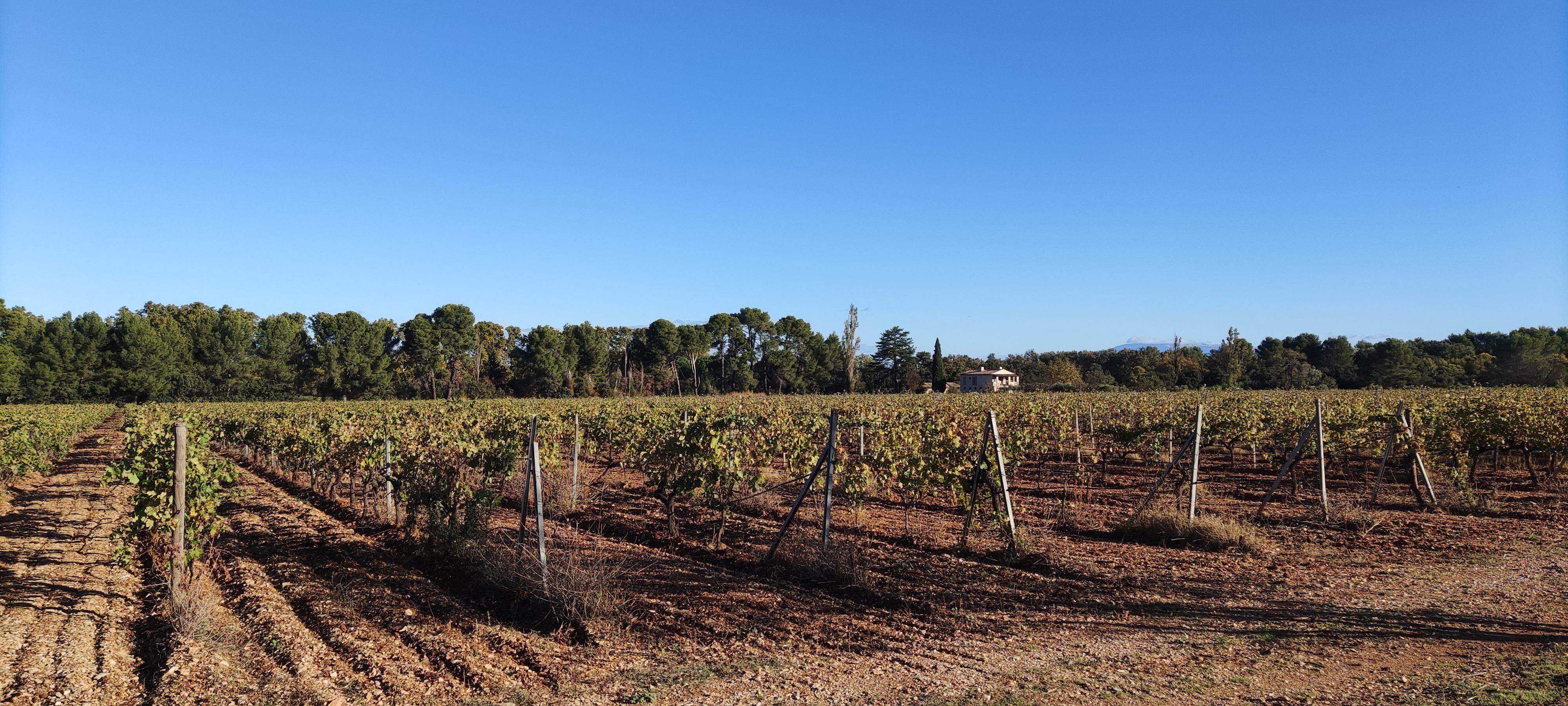
And we’re off, traipsing around vineyards that produce award-winning wine at the foot of the Alpilles. Beaucoup des brownie points for providing a view. I know you don’t like hill walking, she says, so I thought of a walk that woud be flat for you. She’s so kind: will you be ok in those shoes, she asks, inspecting my Clarkes sandals which allow an appealing view of the toes Madame painted the other day? It’s all I have, I tell her. I could mention that I also possess a pair of flip flops, but who knows what that translates as so I keep this information to myself. Anais tells me about the wine and I tell her that, when I’m here, I only buy wine that’s been awarded a medal by some committee or other, and has been bottled by the proprietor of some joint or other. The former condition is pure snobbery on my part; the latter is something I learned some years ago – if it’s not made where the grape is grown, then it’s a mixture.
This is the Northern Canal of the Alpilles. It’s not overly attractive and there’s some tricky footwork to be undertaken in navigation, but it’s nice to see water. Apparently, it’s covered in dragonflies in the spring and the locals used to swim in the water when the summer heat became overbearing. I’m appalled at this news, feeling it doesn’t look too inviting. The practice went on for years until a dreadful accident occurred whereby a small child was sucked into one of the underwater absorbers. No-one swims there now.
This may look like nothing much to you, but the churned up ground shows where wild boar have been roaming. Anais says there are two creatures around here which frighten her: boars and hornets. I recount a story whereby, many years ago, Beverley and I had taken her dog, Hugo, for a walk around the glider aerodrome which is close to hand, and had been chased by a swarm of hornets. Glider is a new word for Anais and she duly locks it away in her brain for another day. Are there wolves here, I ask? Bien sur, my guide replies. And eagles; sometimes, it’s possible to see the eagles flying alongside the gliders. Be fair, this is another world n’est-ce pas?
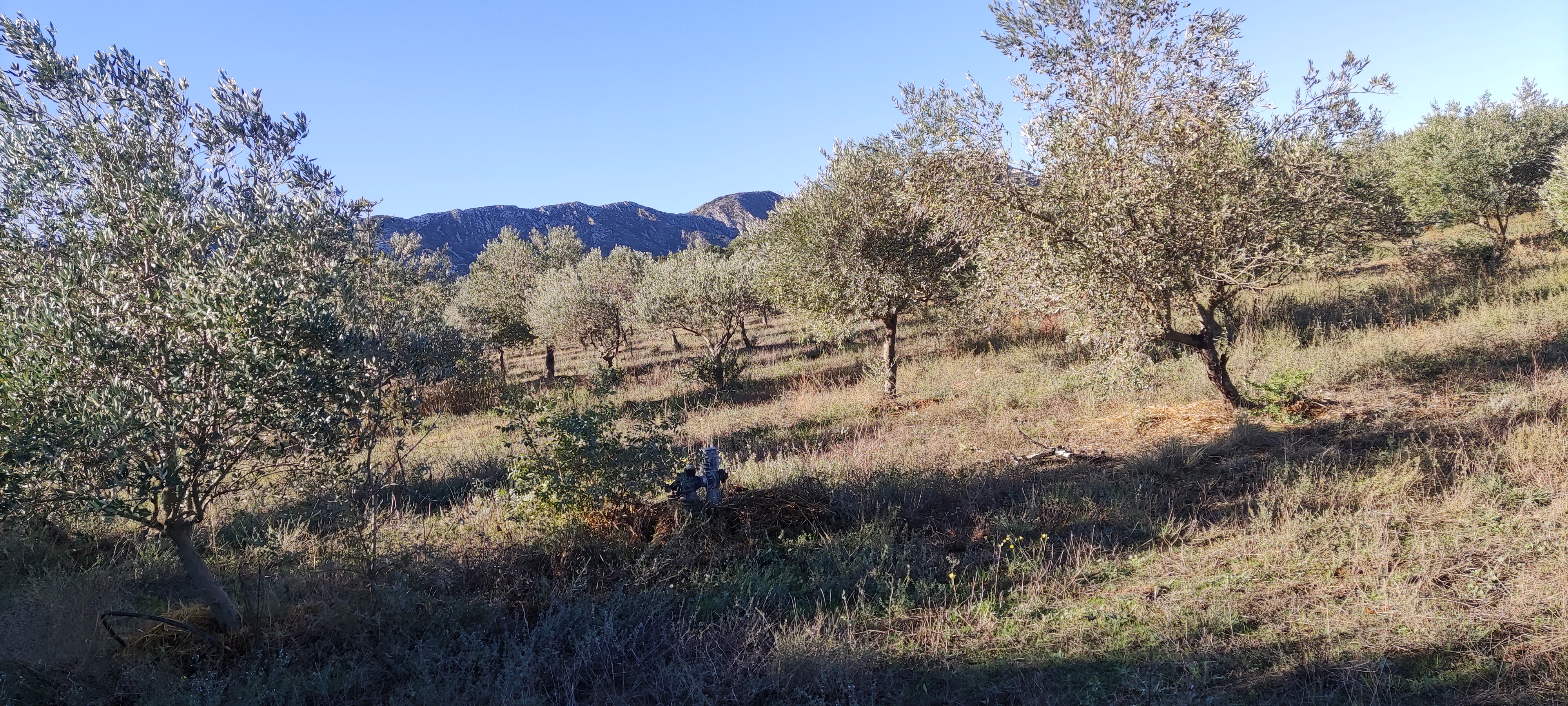
Now, we’re wandering through ancient olives, always with the little mountains in the background. In another weasel, I wrote about Jean Moulin who parachuted into the Alpilles here in order to try to contain the various and disparate groups of men and women fighting in the Resistance during WW2; and who was tortured and murdered for his troubles. Today, whilst turmoil continues in the wider world, it’s hard to reconcile those times with the peacefulness here, broken ony by the noise of a solitary tractor trimming the overgrowth on the side of the canal.
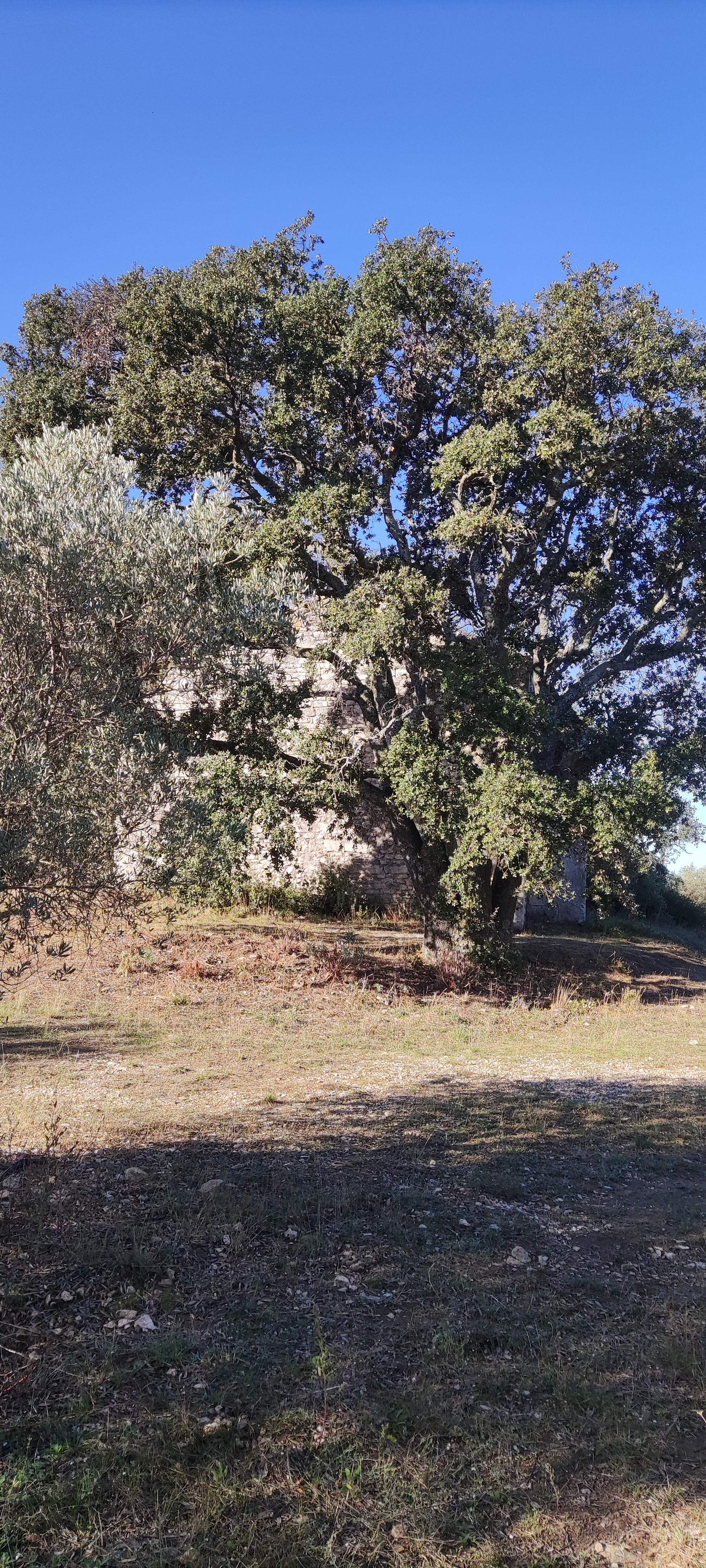
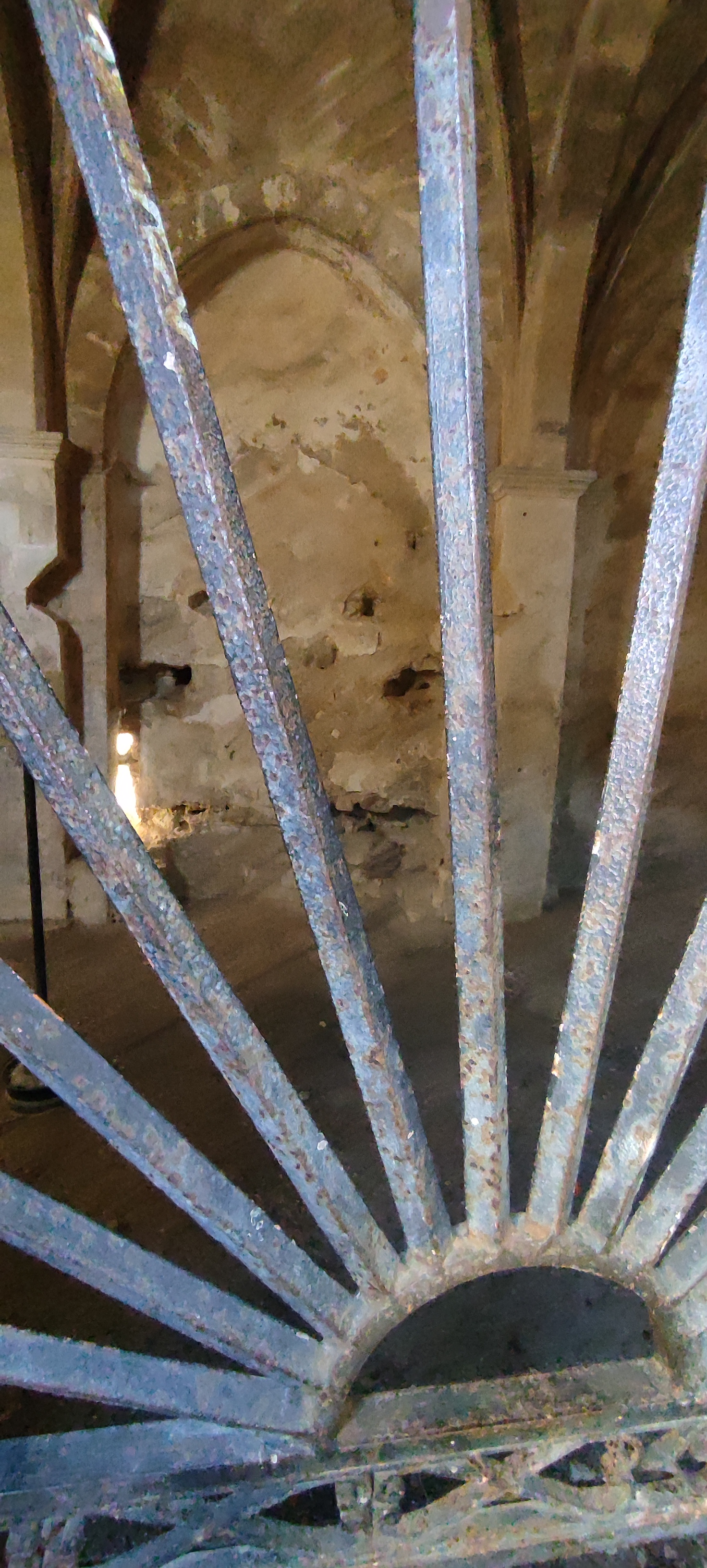
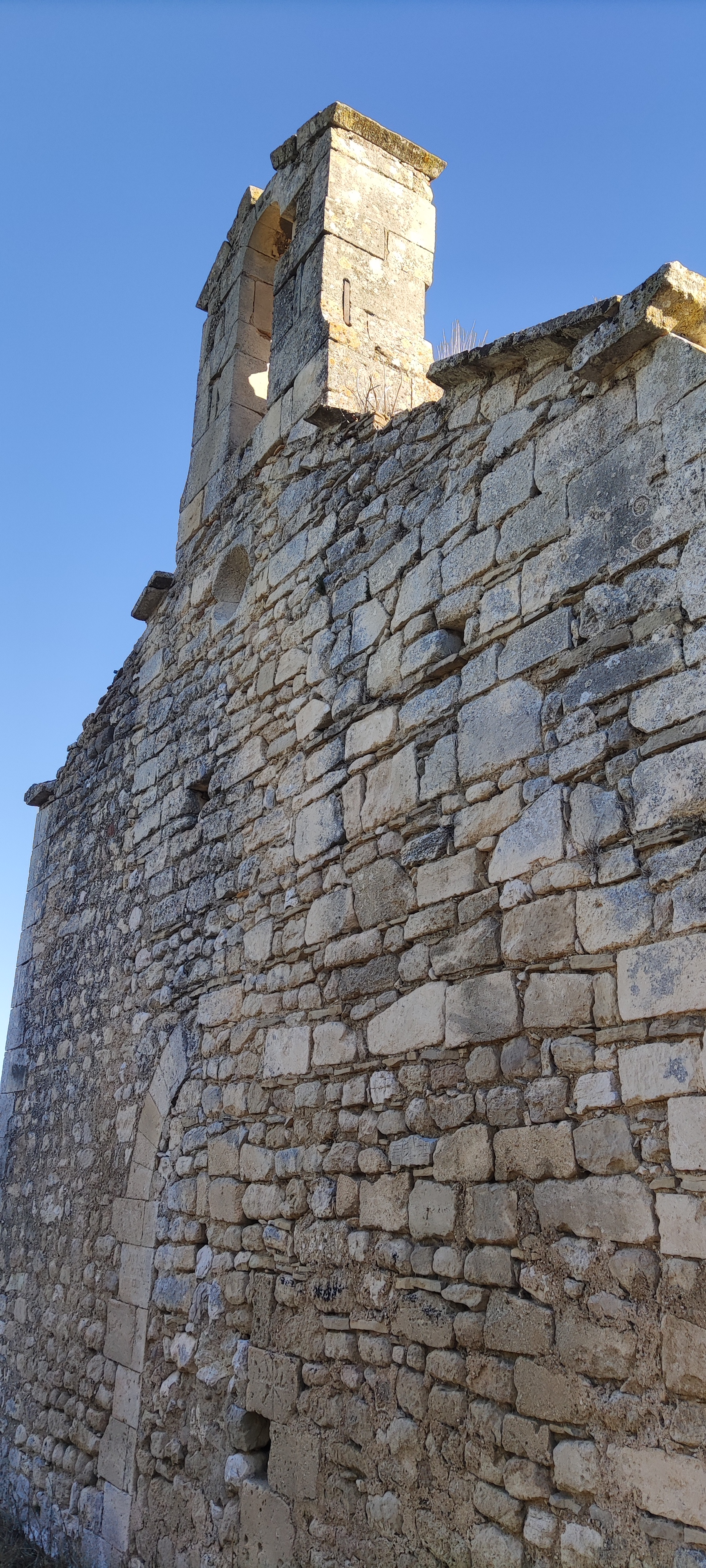
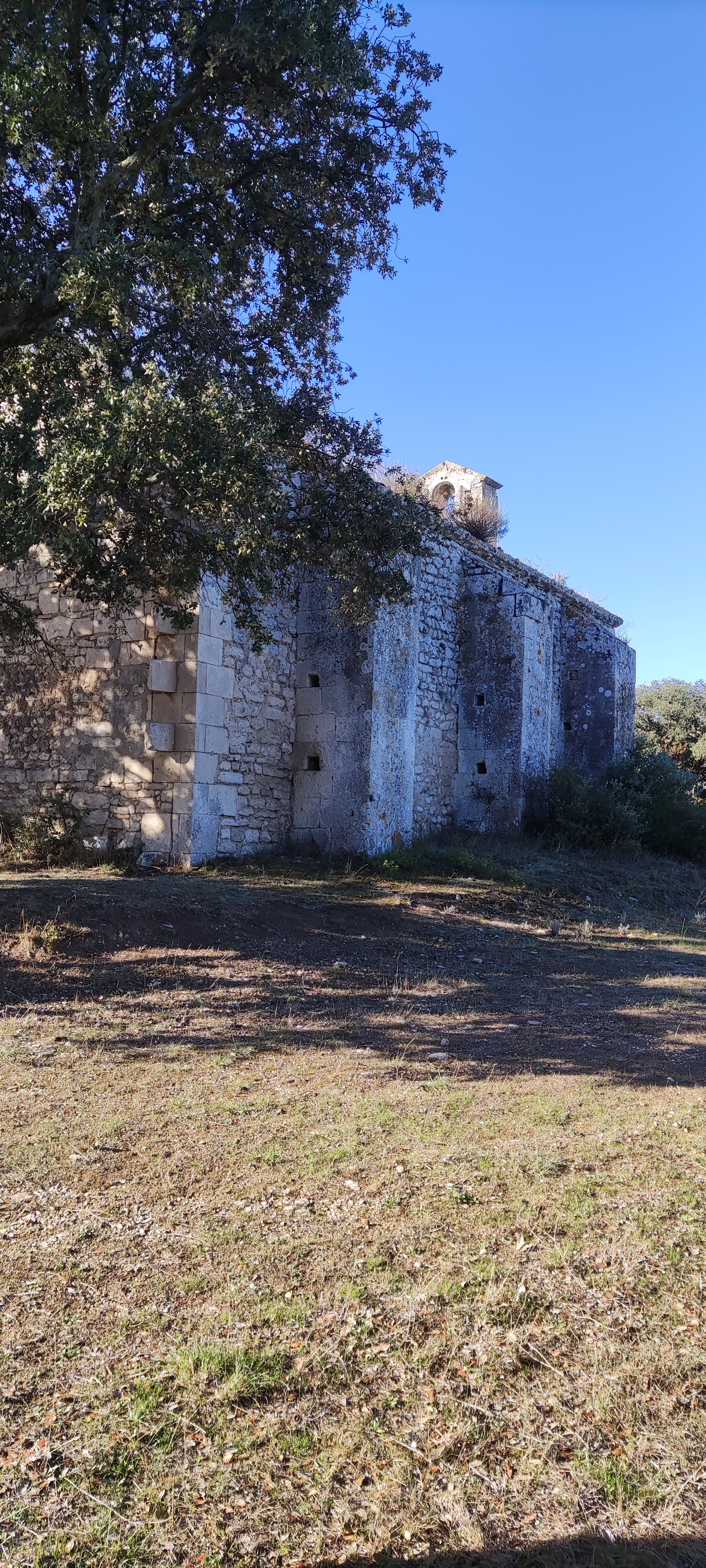
Eventually, we arrive at the Chapel of Romanin which, despite being rather large, is completely hidden from roads, tracks and paths; we’ve had to take an unmarked path across the olive groves to reach our destination. The base was built in the twelfth century and the rest of it has been added to and dismantled over the years. We can’t gain entry but, brushing the foliage aside, it’s possible to see the interior which, in the French tradition, is covered in graffiti. Why do they always do that I ask? Anais has no answer but explains that this is why all the beautiful chapels are rarely open to the public. It makes me sad.
But llittle else about this walk has disheartened me. It’s the end of October and way back we discarded our coats in the warmth of the sunshine. Yet again, my French has improved, almost by chance, and I consider myself so lucky to have a friend who gives everything for the enjoyment of others.
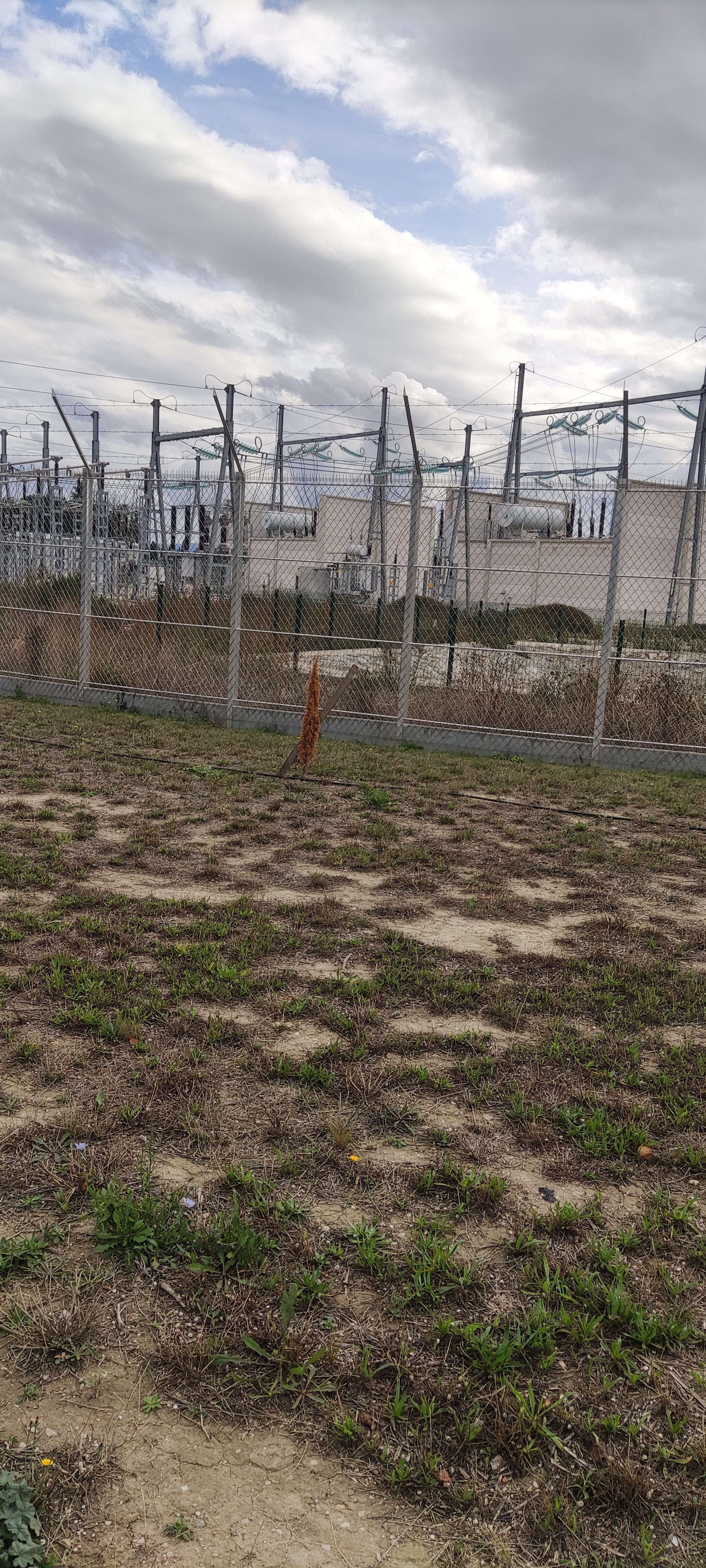
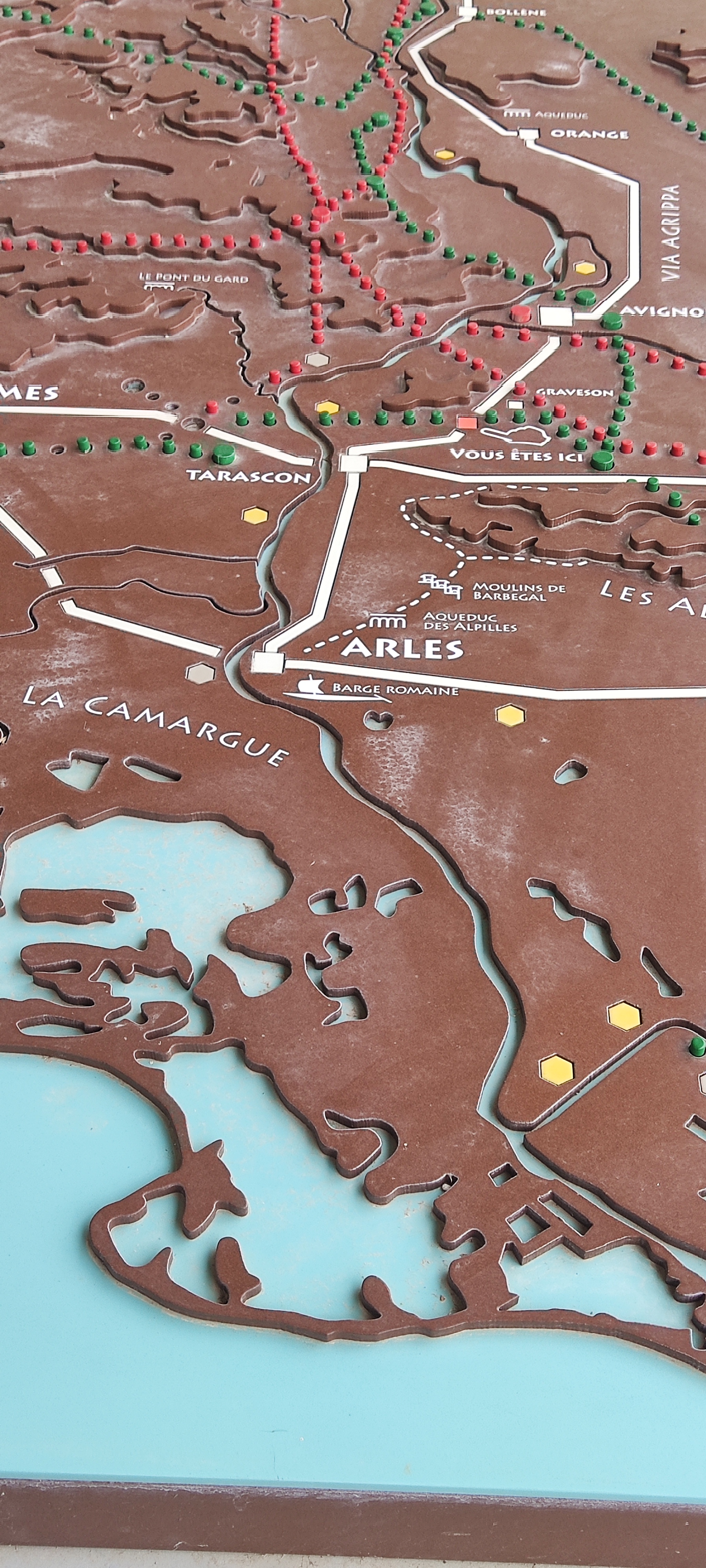
I’m almost at the end of another fabulous stay in Provence so, on this, my penultimate full day, I decided to finally visit a place which I’ve been driving past for the last five weeks, but had never yet seen. It’s an electricity sub-station. Looks nice doesn’t it? When on the road to Arles, on passing this place which is just outside the village of Graveson, you can see one of those small brown signs which denote a place of interest, usually historic. The one I’m thinking of says ‘archaeological site’, though obviously in French: ‘site archeologique’ – so not too tricky.
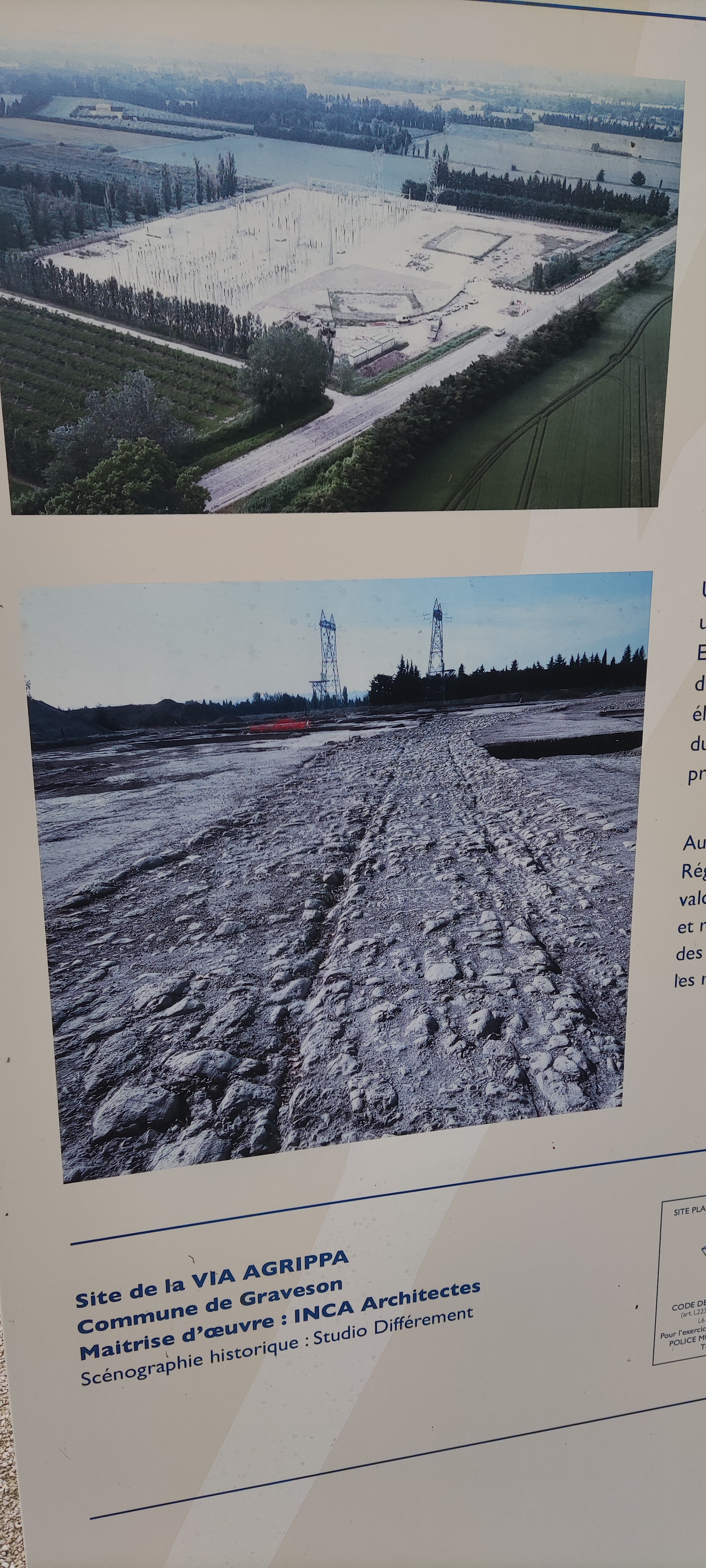
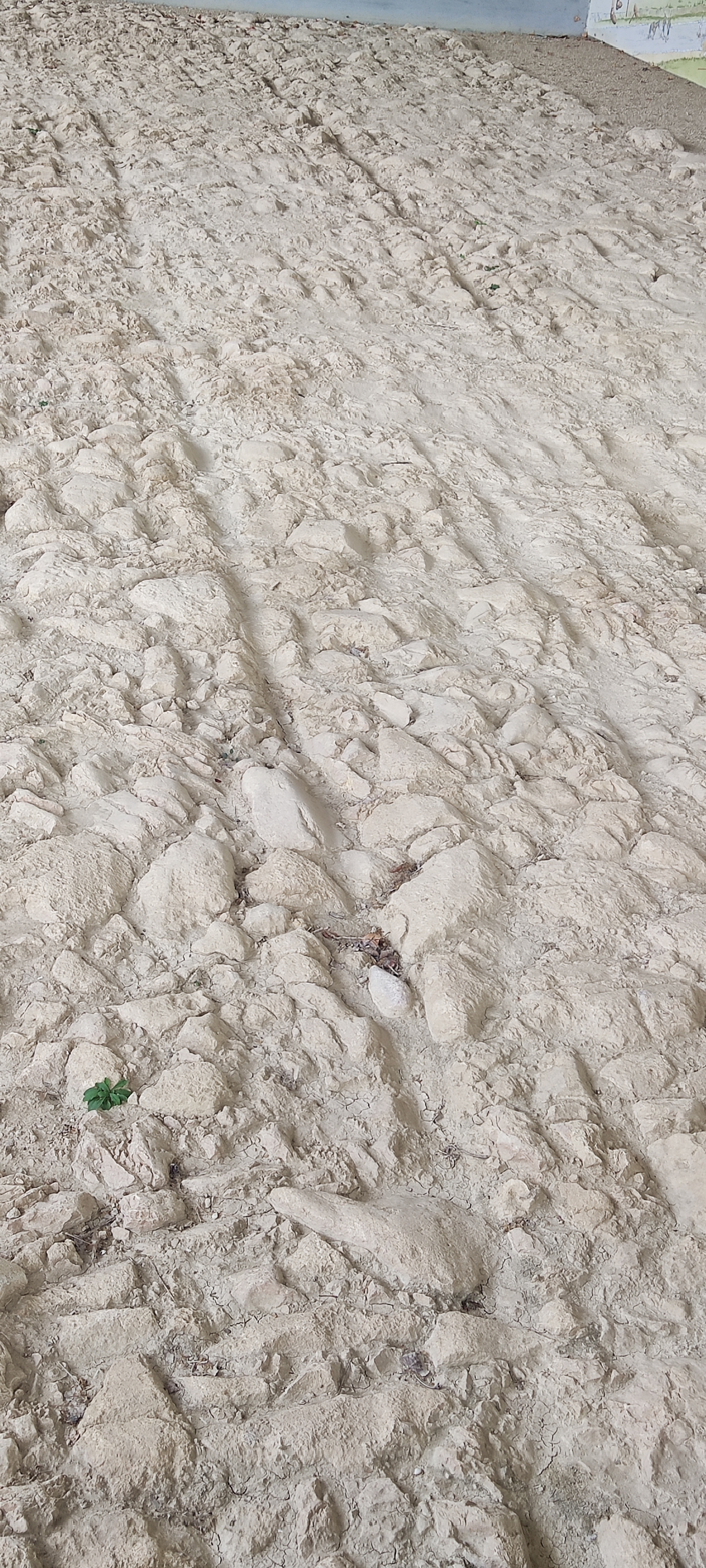
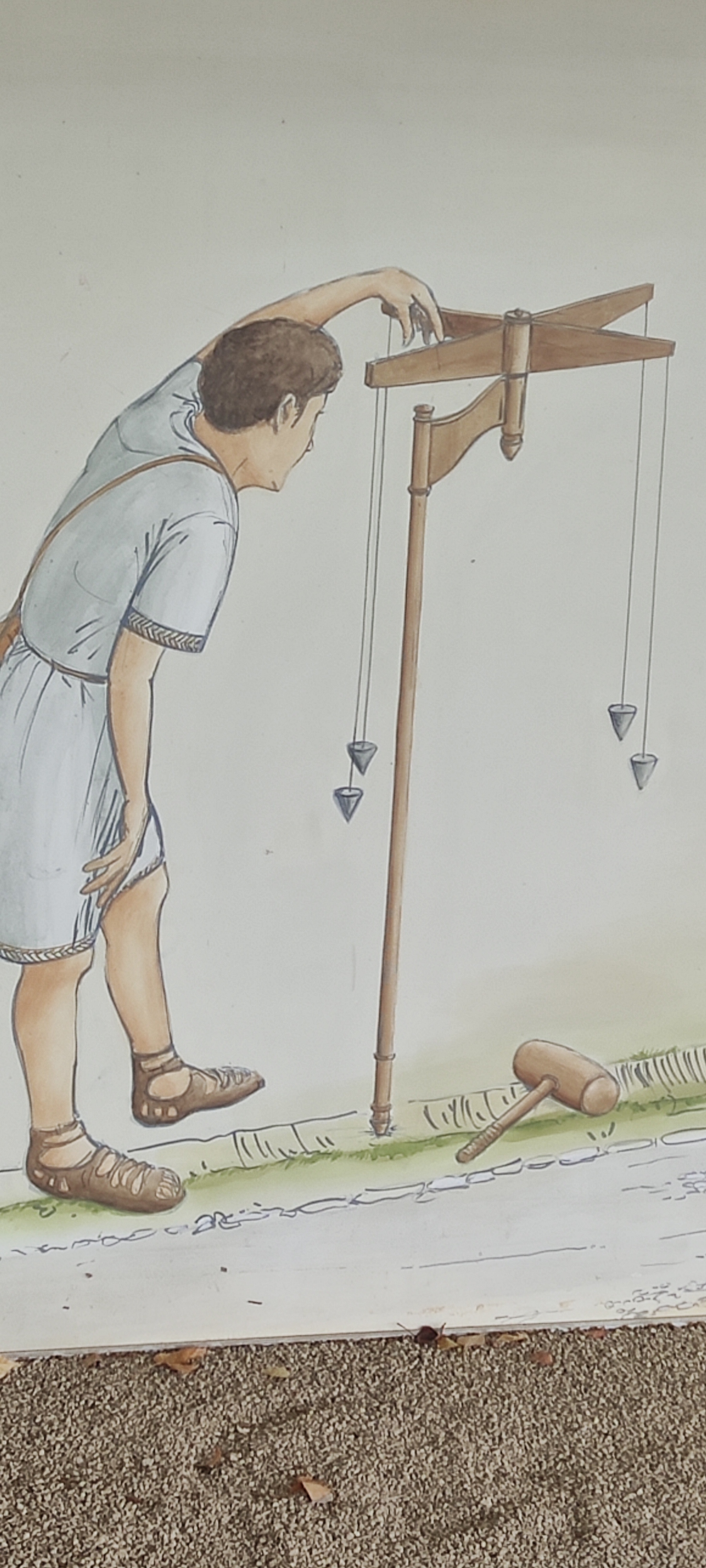
The top picture denotes the construction in 2015 BCE (Before Covid Era), and the bottom shows a road, the commencement of which was believed to have been in 16 BCE (Before Common Era); ‘common’ having replaced ‘Christian’ when political correctness was invented in the DOAE (Don’t Offend Anybody Era). Whatever, I just love the juxtaposition of the two. And here’s the story:
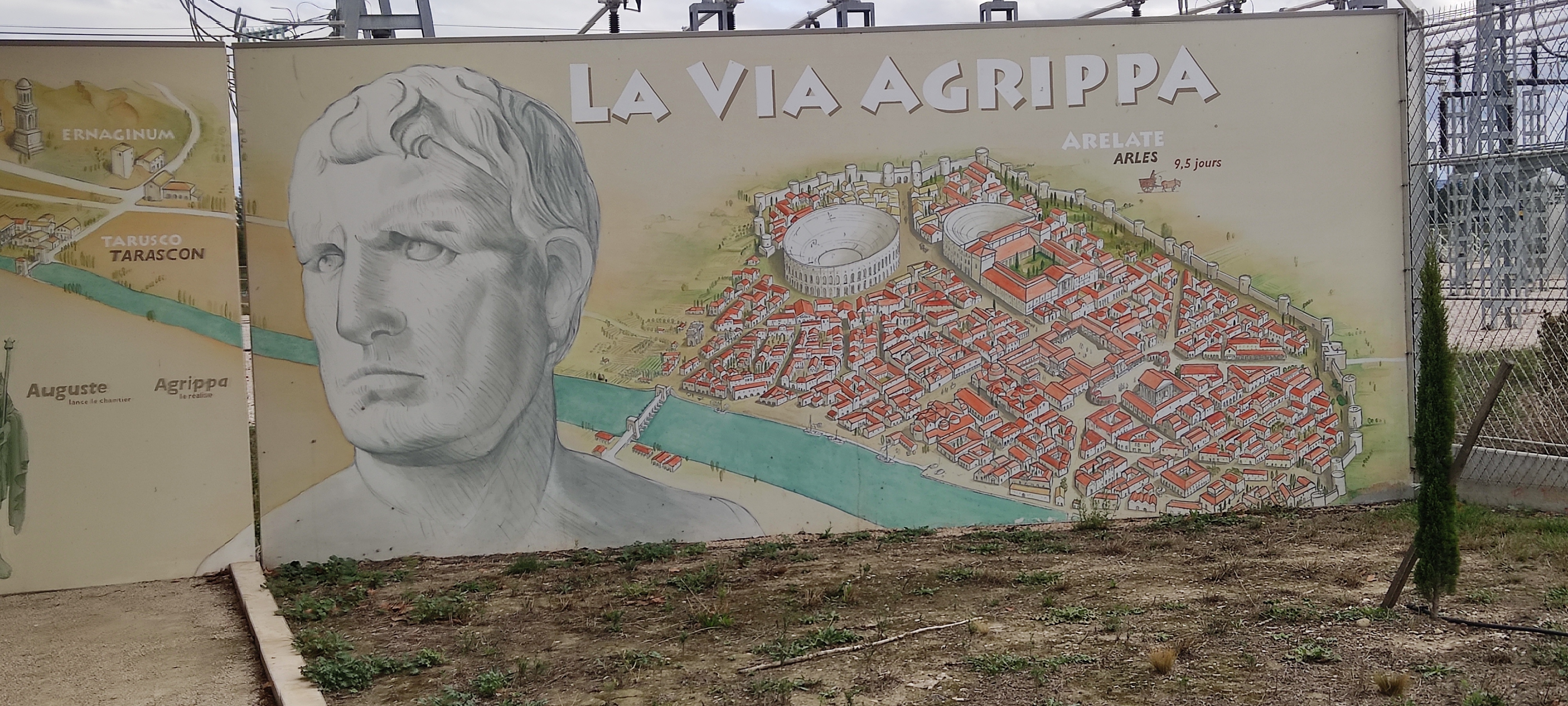
Back in the day, RTE (Network of Transport and Electricity) decided to build two new underground electricity lines but, at some point, they discovered that their chosen venue sat on a stretch of a rather ancient looking road. A team of twenty archaeologists was called in and they determined that this was an unknown part of La Via Agrippa – do you really need the translation?
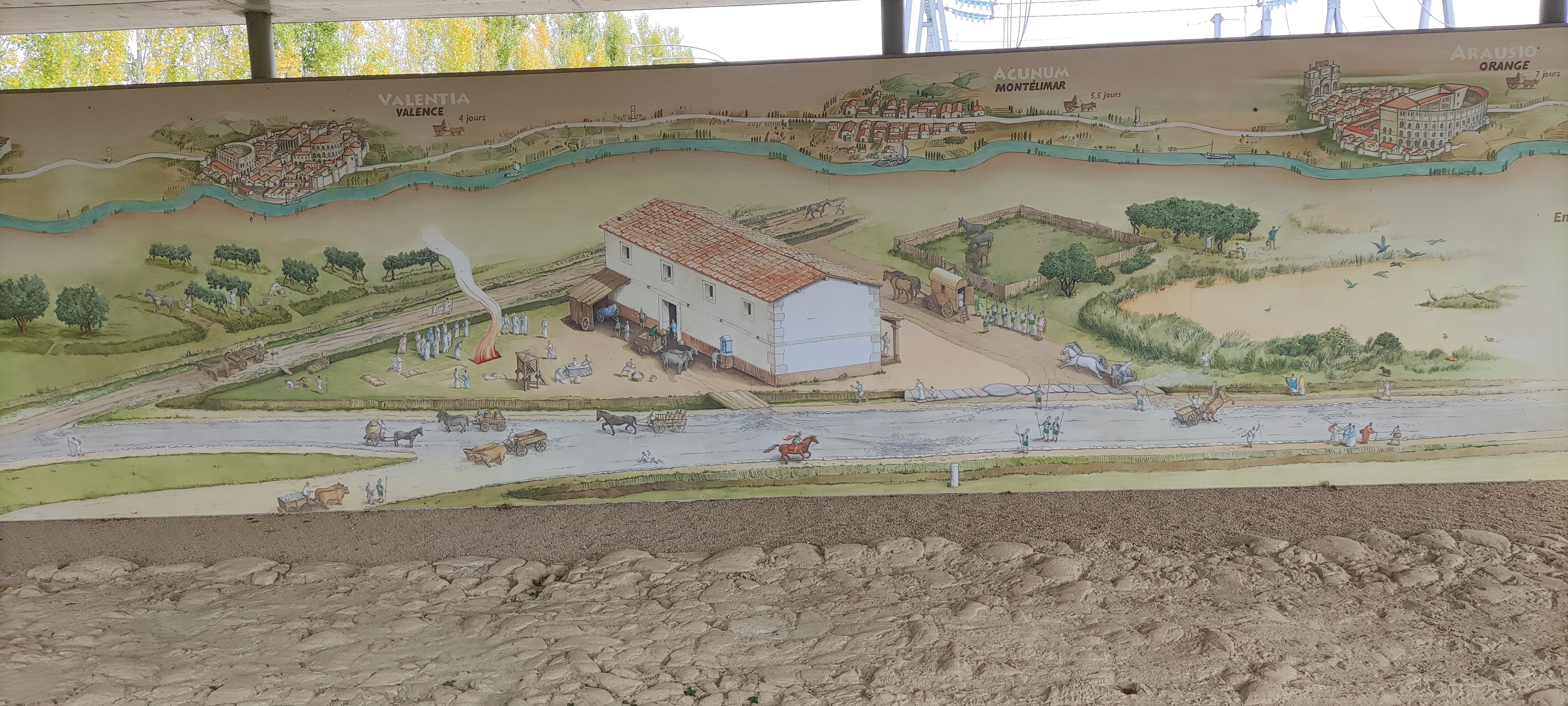
La Via Agrippa comprised around 13,000 miles of roads built by Marcus Vipsavius Agrippa, throughout what we call France today, to help subjugate those tricky Gauls. The strategic hub was Lugdunum (Lyons) from whence the routes emanated in four directions. Our particular road was the one which took the Romans down to Arles where they could take their boats from the mouth of the River Rhone into the wide open sea. Graveson would have been a relay station where horses could be exchanged and people could refresh themselves.
Sometimes, the French do history well; other times not so. I once stayed with a family whose next door neighbours were putting in a swimming pool. On discovering their garden was covering a Roman site, they instructed the builders to destroy all those old stones and crack on. How we laughed when they recounted the story under the shade of an old fig tree. Another time, I heard of a fellow over near Les Baux whose soon-to-be landscaped garden unearthed some large stones which, to the workers, were an irritation. Shall we continue, they asked? The owner decided to call in a specialist whence the stones were determined to be the missing part of a Roman aqueduct for which folk had been searching for years.
Not so RTE. They halted construction, then modified their plans by moving the sub-station along a bit in order that the small part of La Via Agrippa which had been uncovered could be preserved and made accessible to the public. And it is only a small portion but RTE have made a really interesting and child friendly ‘event’ from this. At the end of the day, you could say that it’s just a placard, but it’s been done very well and I learned a lot. Berets off to those guys.
I might’ve previously inferred a preoccupation with my feet. Just days before I arrived in France, the lovely Helen painted my toes a delightful shade of cornflower blue, albeit faded cornflowers, but I loved it. It was my first experience of shellac. You’ll never have anything else now, she said. They won’t chip. Too true: ever tried removing the stuff? I don’t know whether it’s something to do with the sun, but out here there’s no stopping nail growth. Before long, they were like two-tone talons: not a good look.
In our village, out the back of the little clothes shop, I discovered a beauty salon. Can you do something with my toes I asked? It’s shellac and I don’t like it. Shellac, said Madame, it’s semi-permanent, she continued screwing up her nose in distaste. Can you replace it with something less hardy, I enquired? You want a pedicure classique. It wasn’t a question, more of an order really. Camille, called Madame, the Englishwoman needs a pedicure classique. Camille inspected my toes: meh bah, says Camille also with the nose business, c’est semi-permanent! She needs a pedicure classique. I got the distinct impression that, politically, I’d made a bit of a feet faux pas; one that said a lot about the English – neither one thing or another, just a pathetic compromise. Bit like Brexit.
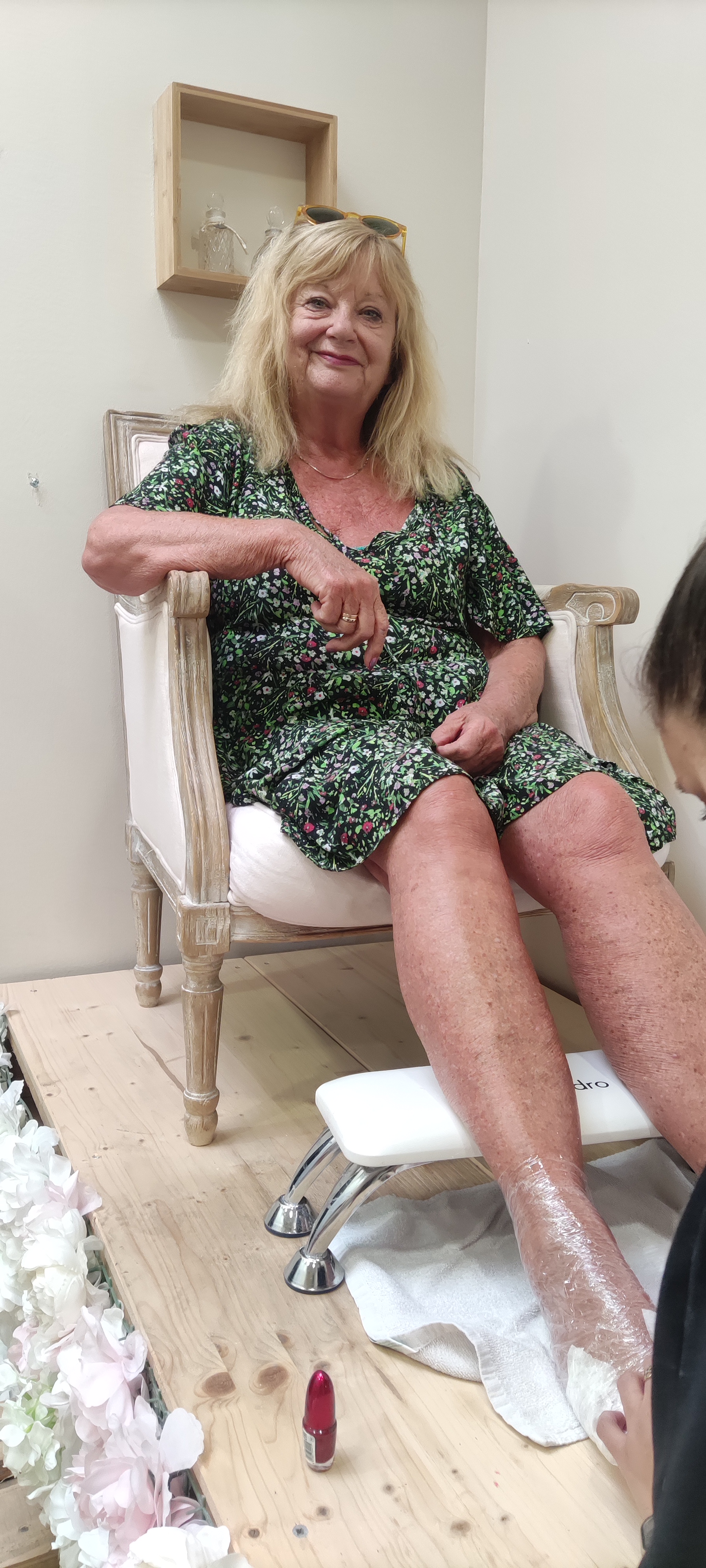
Yesterday, I returned equipped with a new vocabulary and was invited into a small back room to sit on a throne comprised of a number of wooden crates. Up there, I asked with some incredulity? Mais oui, they said hoisting me upwards.
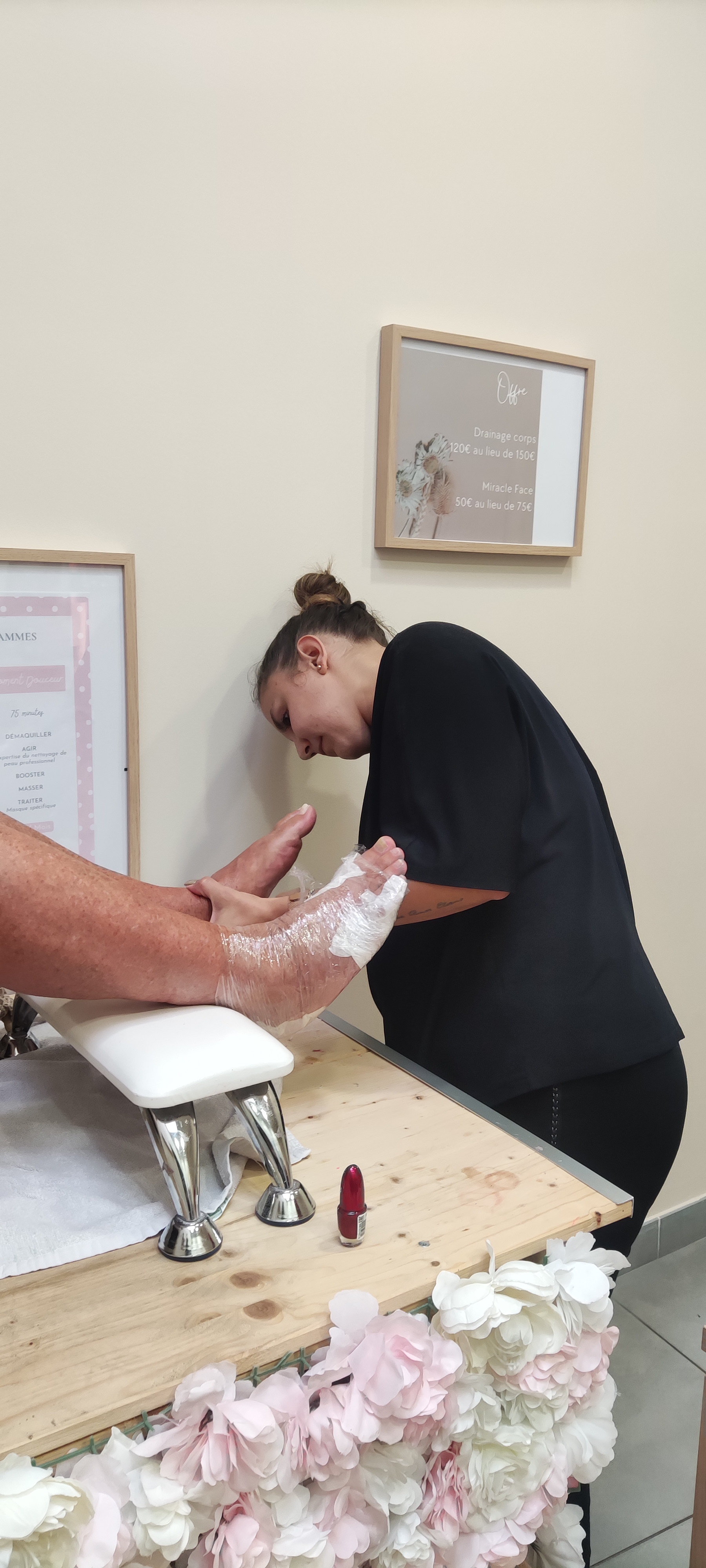
Camille was down below, ready to rock. Are you going to be comfortable, I asked with concern, although, in truth, I felt this was something they should be asking me. What about your back, I continued? She looked at me as though I’d just come down in the last shower before pulling on some black latex gloves and choosing a suspicious looking electrical implement from her selection of tools previously owned by the Marquis de Sade and probably purchased the week before from a local boot sale. Camille proceeded to drill the cornflower blue from my toes prior to giving my feet the once over with a stiff brush. I must confess, it wasn’t unpleasant.
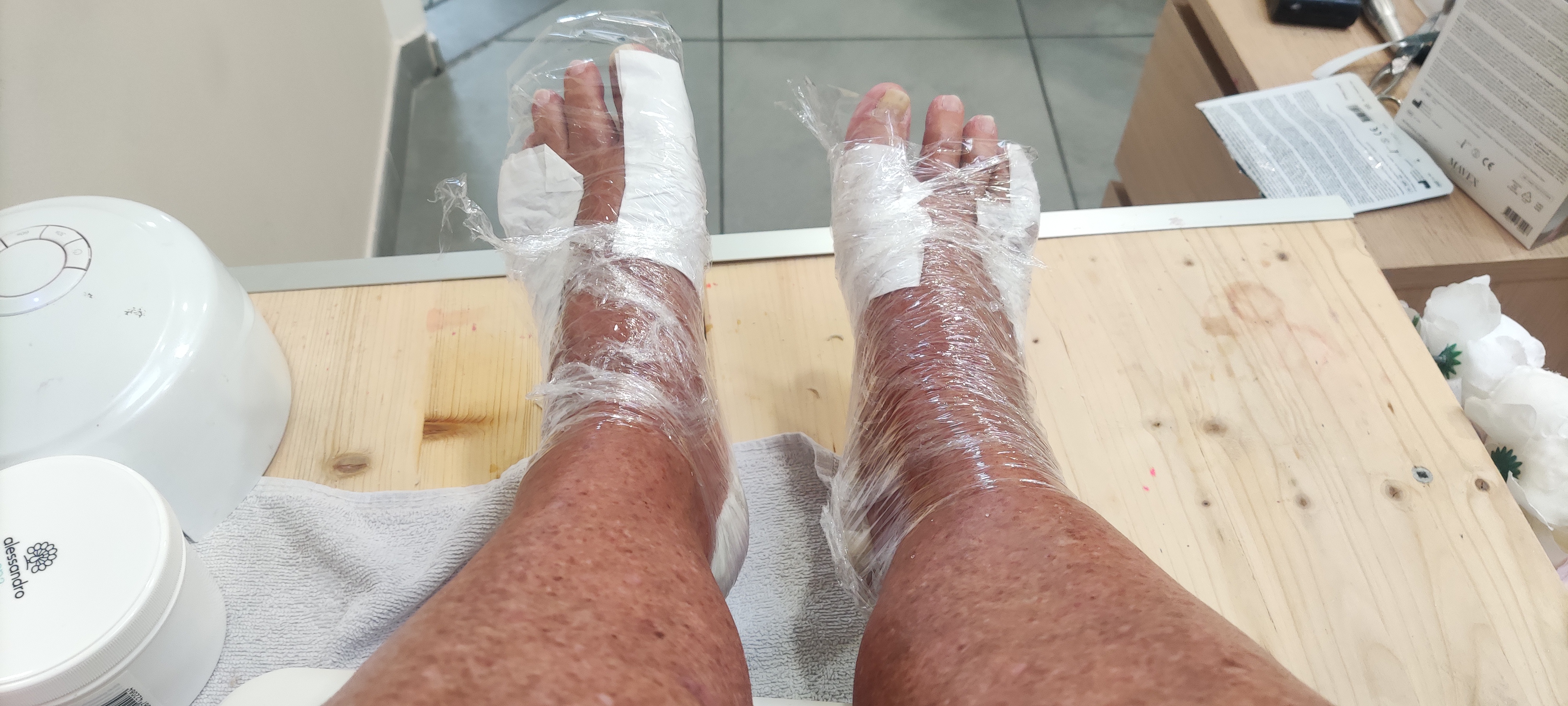
There followed an exfoliation which was pretty effective – feet felt like those of a new-born. But, I thought, pretty damn speedy. Helen would be massaging my legs by now. But, Helen wouldn’t then have produced a roll of cling film. Camille unwrapped some of those hydrating sheets, normally worn on the face, and wrapped them around my soles and toes before encasing my feet in the cling film. And before disappearing. I sat alone on my throne wondering what was happening.
Looked at my phone for a bit. Madame passed by. Excusez moi, I asked. Any idea what’s occurring here? We are preparing you for the rapee, she replied. Well, when considering cheese, rapee means grated so I knew what was coming. Helen, if I ever see you again, I’ll explain what happened next.
Eventually, Camille returned, possibly from a rendezvous with her boyfriend. Washed and creamed my feet and applied the chosen colour.
Et voila, she exclaimed. And I have to say, after yet another foray into the French unknown, feet felt and looked entirely acceptable
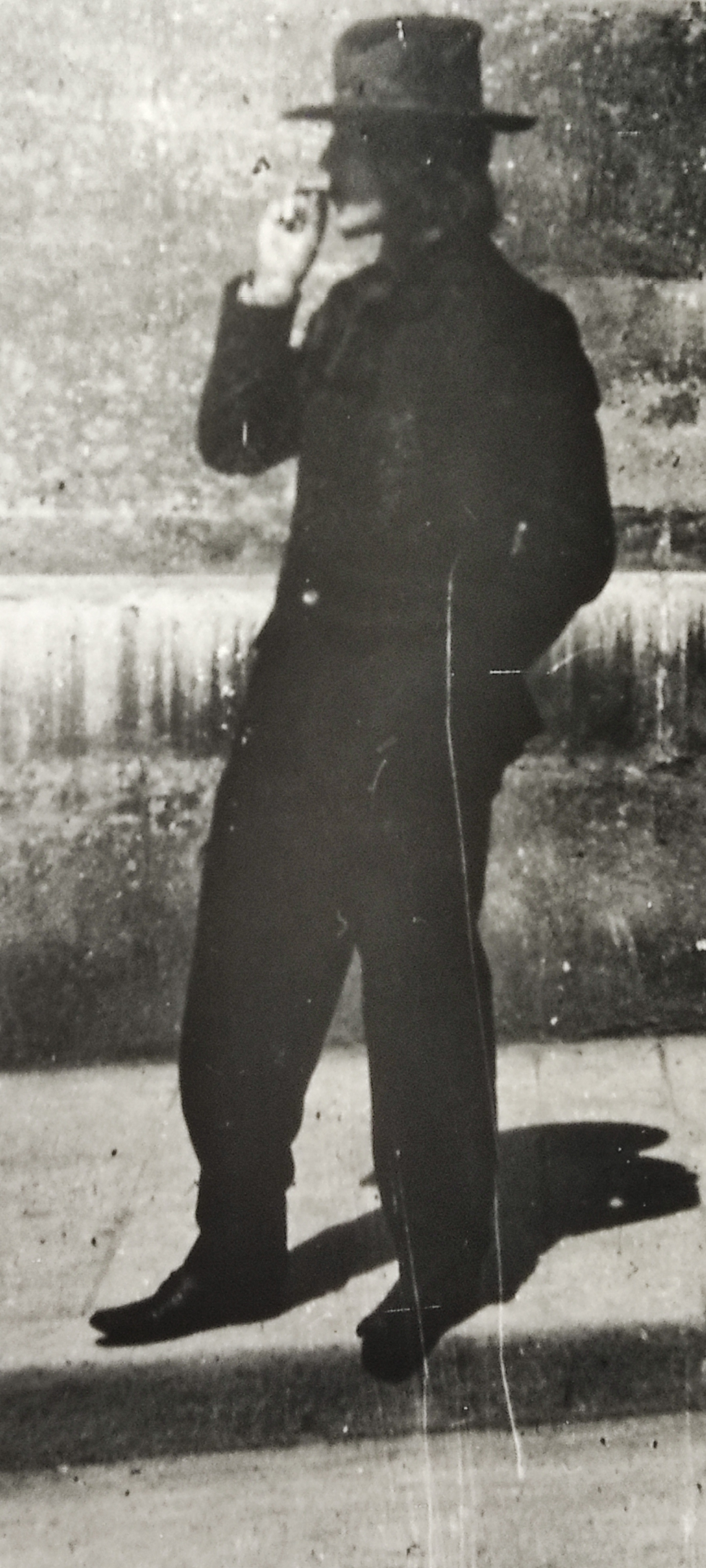
A bit of culture for weasel readers tonight. And even though this rare photo is grainy, you can see our man looks pretty cool.
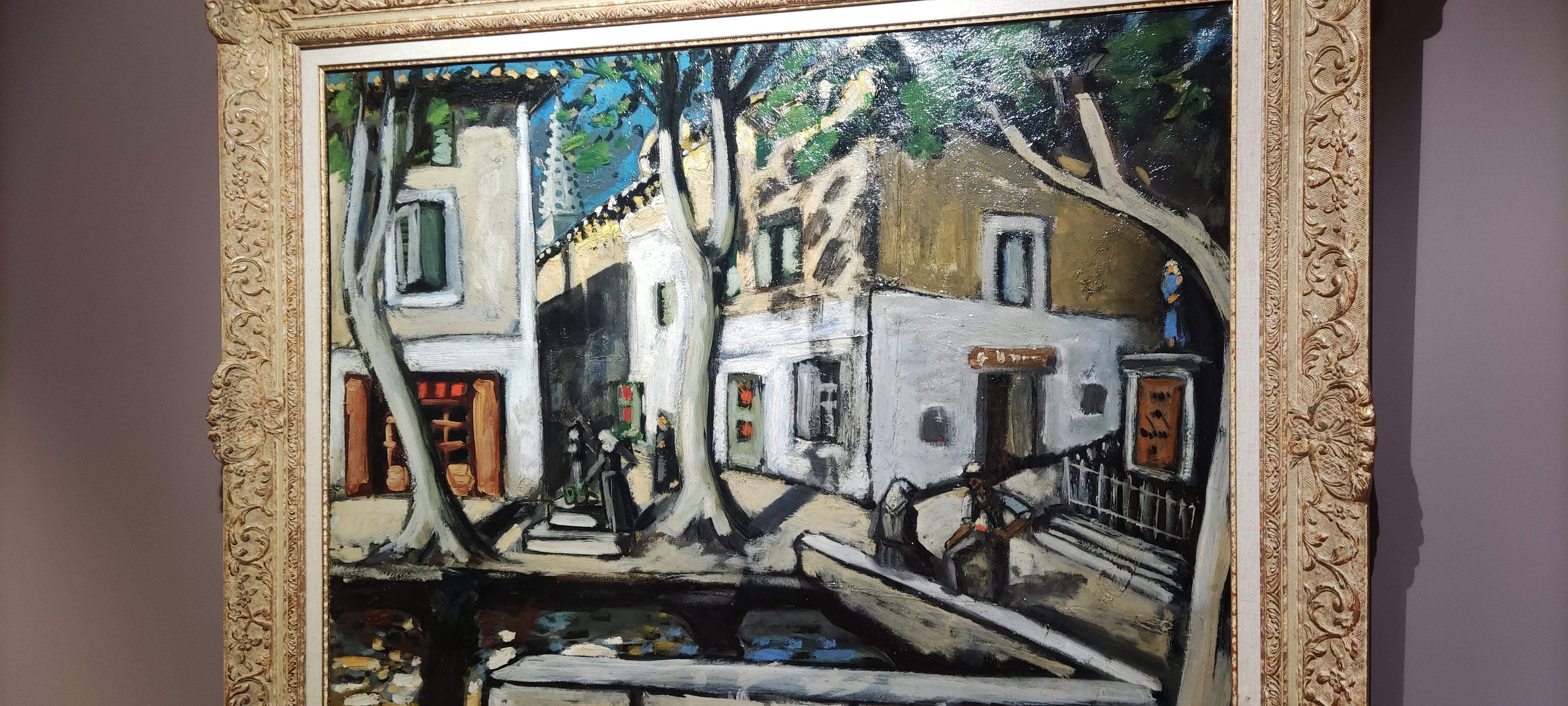
This is the village of Graveson…just down the road from where I’m staying, so I’ve visited many times before, but never to the Chabaud Museum. Who knows why? Maybe it was closed; perhaps I was waylaid in one of the many bars? Maybe I couldn’t be bothered, knowing little about this artist. I had the pool almost to myself this afternoon, only the cleaning robot was also present. I hate that thing. It’s chasing me, I tell my hosts which they find hilarious. But, let me tell you, one minute it’s lurking at the side then, as soon as I make a splash, it’s off after me. So, I gave up, thinking I’d have a quick look at the museum. A quick look? It’s now one of my favourite places in the area. Possibly in the world.
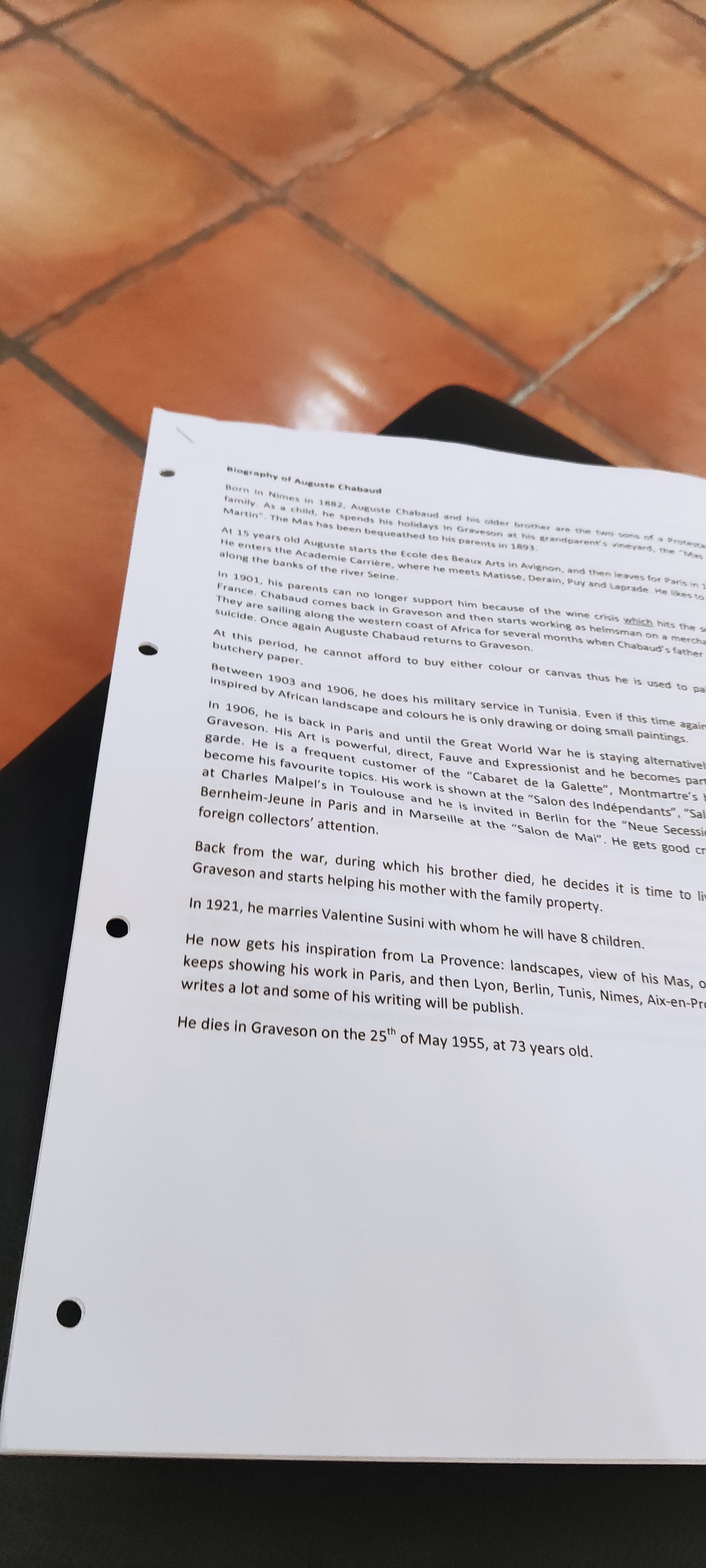
You might’ve noticed that the cropping function is still not functioning so all the photos are ginormous. Sorry… bear with. Anyway, about five minutes into my tour of the museum, I decided that I could do with a translation so returned to the reception. Have you got a guide in English, I asked optimistically? Madame gave me a look, arose from her desk, went to an ancient filing cabinet, found a mouldy file and withdrew the only paper ever written in English in Graveson. Voila! It comprised two pieces of stapled paper and as there were no photocopying facilities, I had to handle it with care before returning. It was next to useless, but, hey, brownie points for entente cordiale.
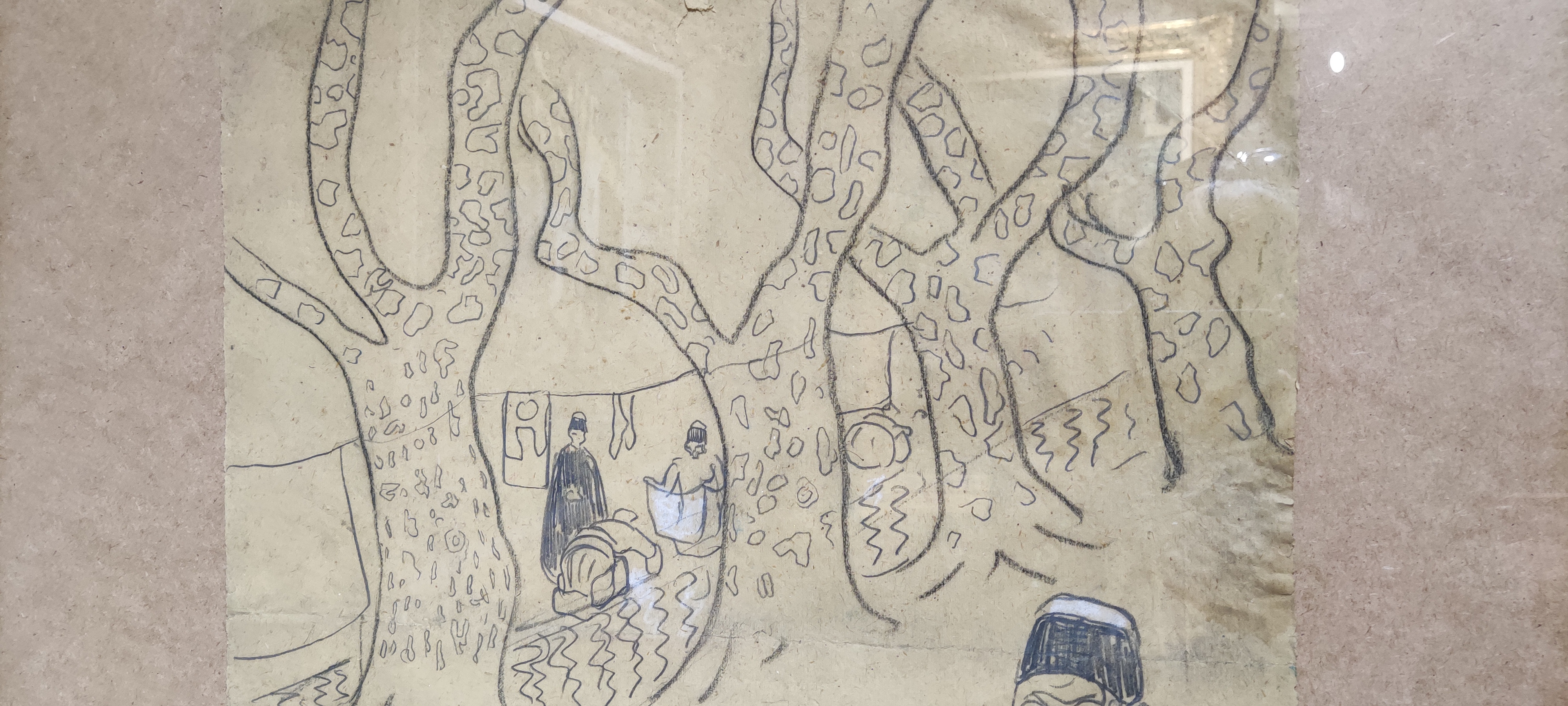
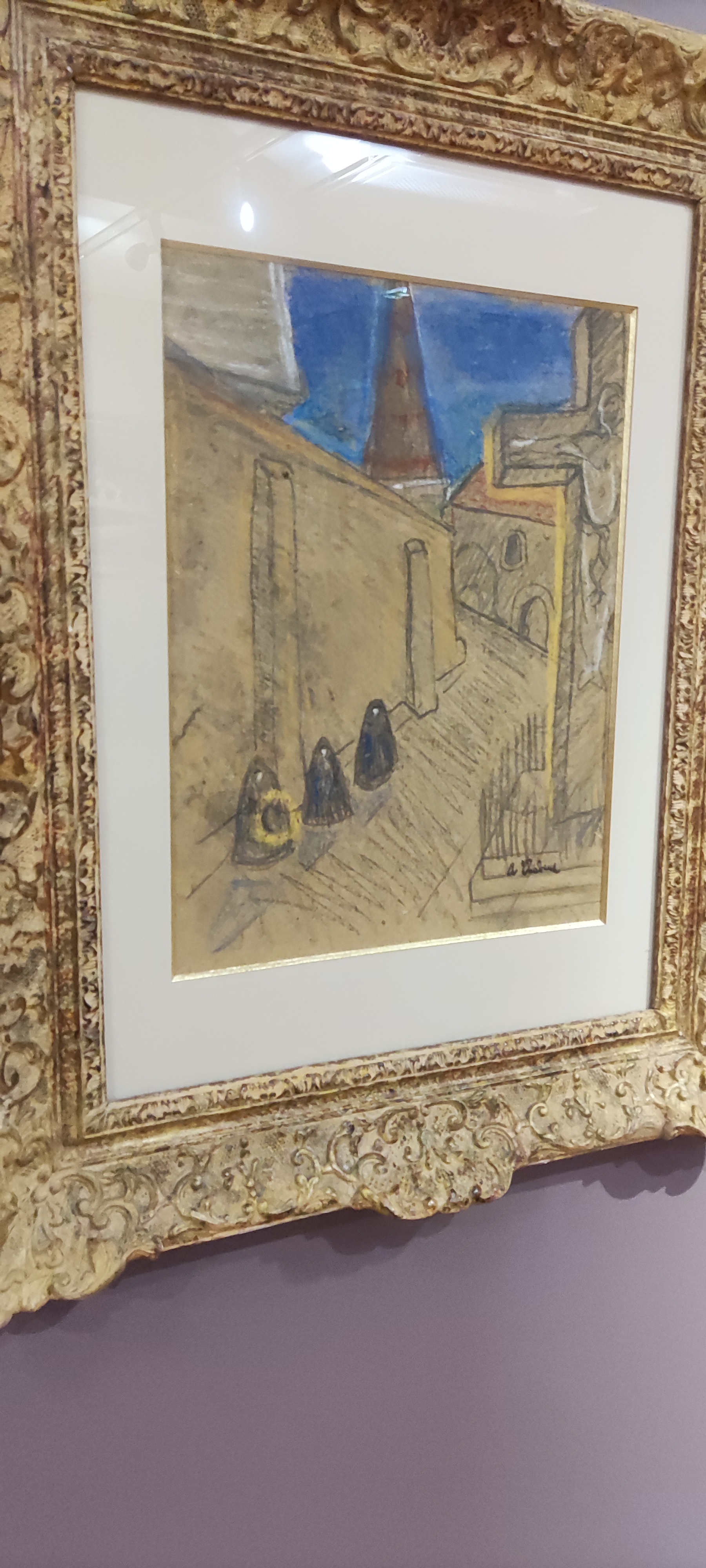
So, Chabaud sloped off to Paris, as all artists must, but returned to the family vineyard to help his parents whose business was suffering from the phylloxia crisis that was sweeping France and decimating grapes. Then, a few years of coming and going were followed by his permanent return in 1919 after WW1. The pictures above depict his early work when he was drawing on butchers’ paper. I’m not an art critic, but even I can see how clearly he captures scenes from a provencal village. And once he was back, he never stopped painting the South, especially immortalising La Montagnette and Les Alpilles.
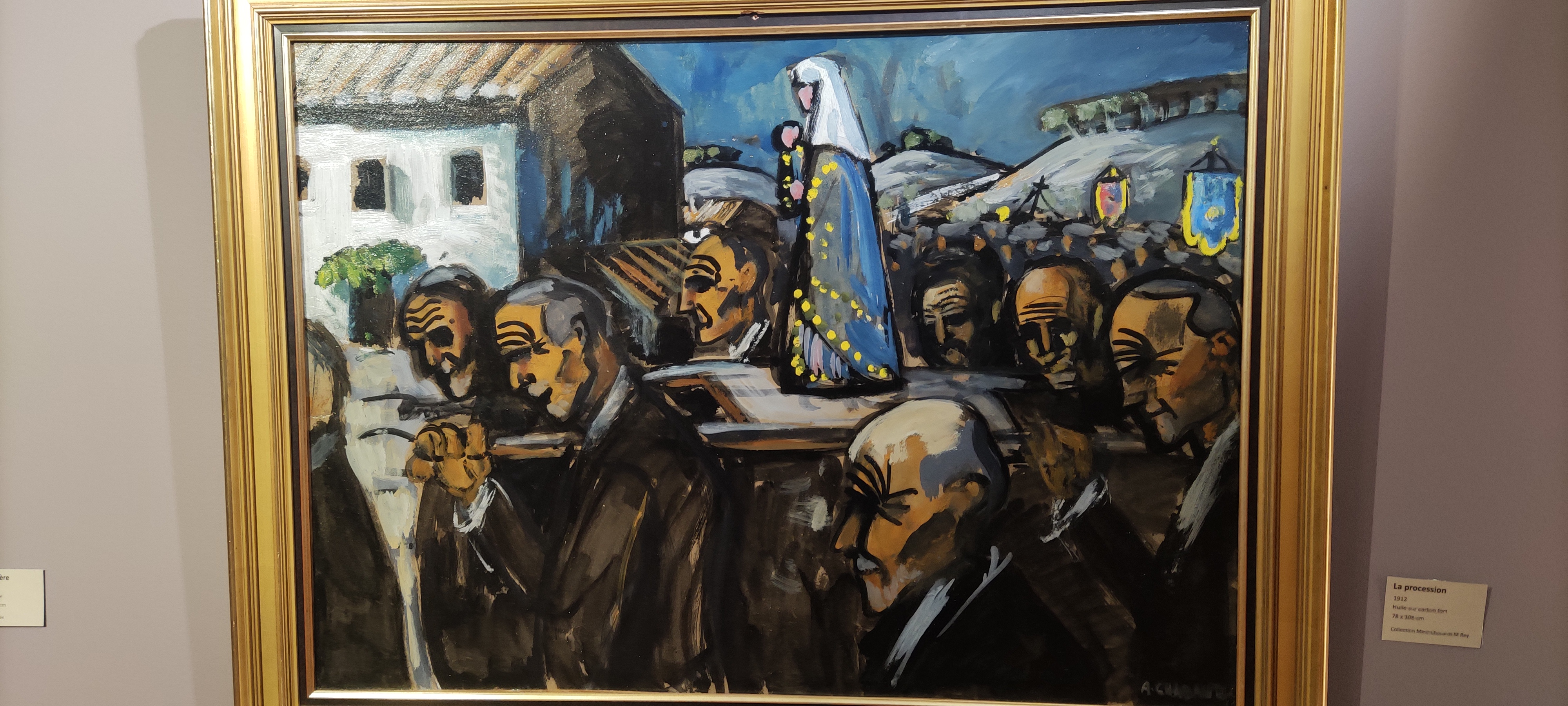
Here’s a painting of Graveson which, apart from parked cars, looks pretty much the same today. The other depicts a group of village elders carrying the local relic, yet another version of the Magdalene, from the church to some other sacred place…these events are still carried out throughout Provence: different men, same procedure.
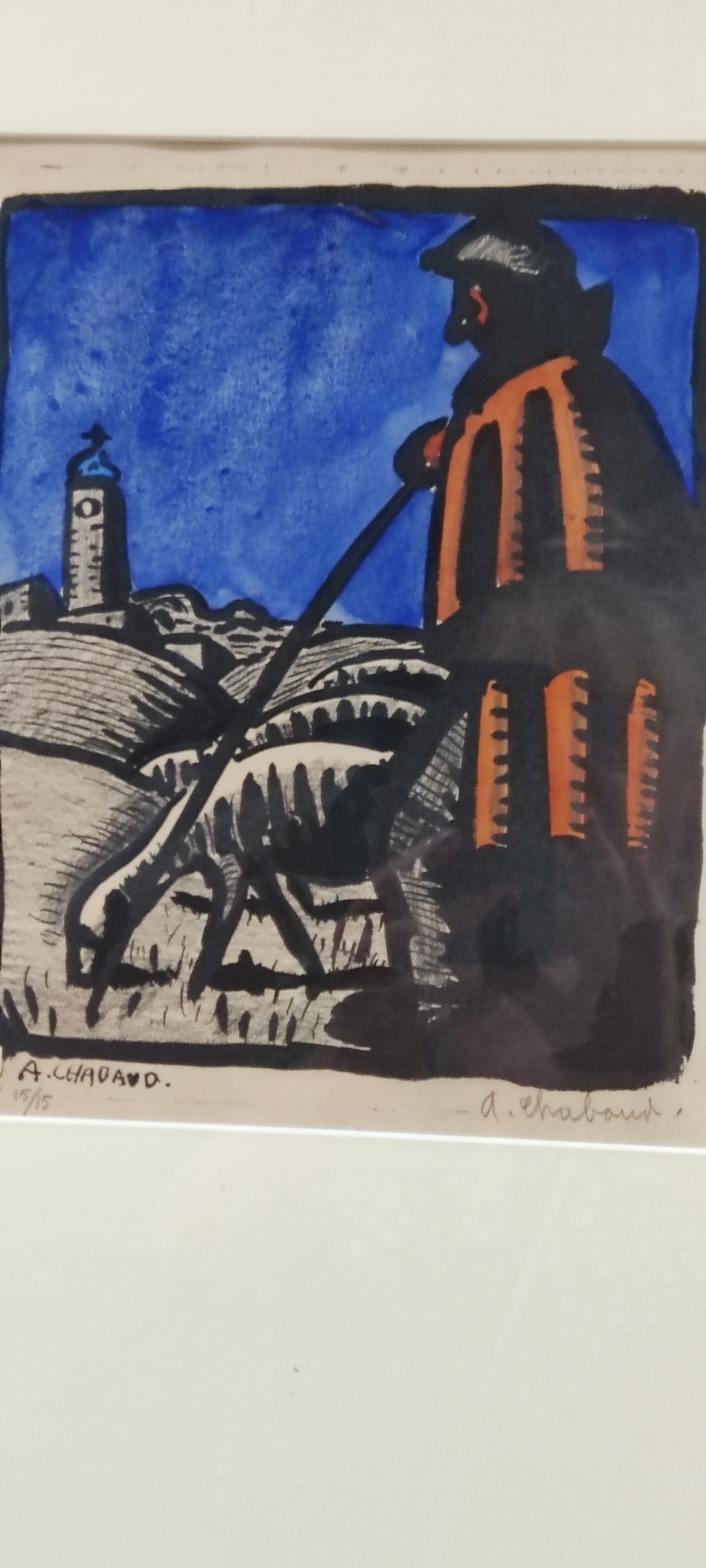
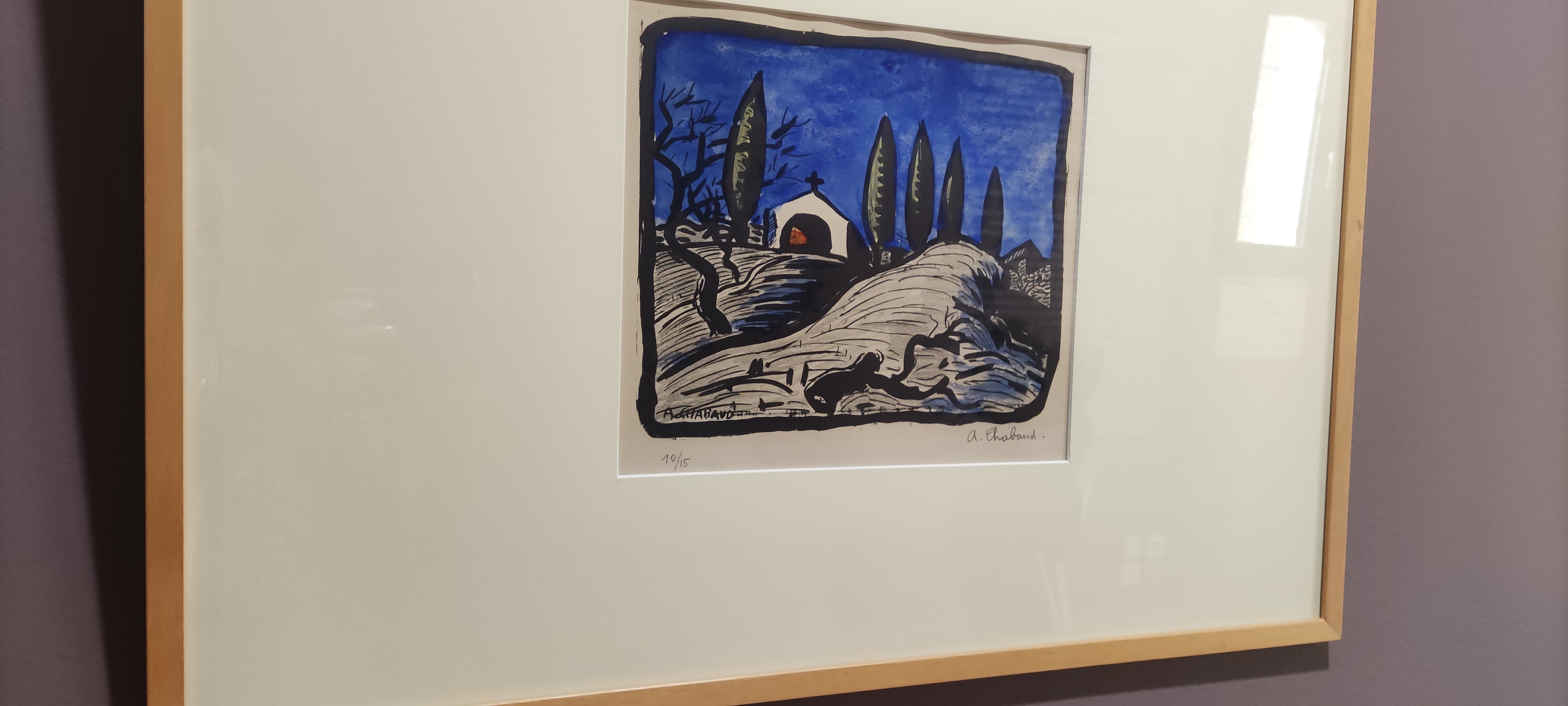
And this is Chaubaud’s blue period. Do I sound as though I know what I’m talking about? It means that he used pure Prussian Blue to highlight the local people and their traditions. They’re beautiful: there’s the shepherd on the hill looking over the village; and something that looks like Chapelle Sainte Sixte – I have a painting of that back in Dorset.
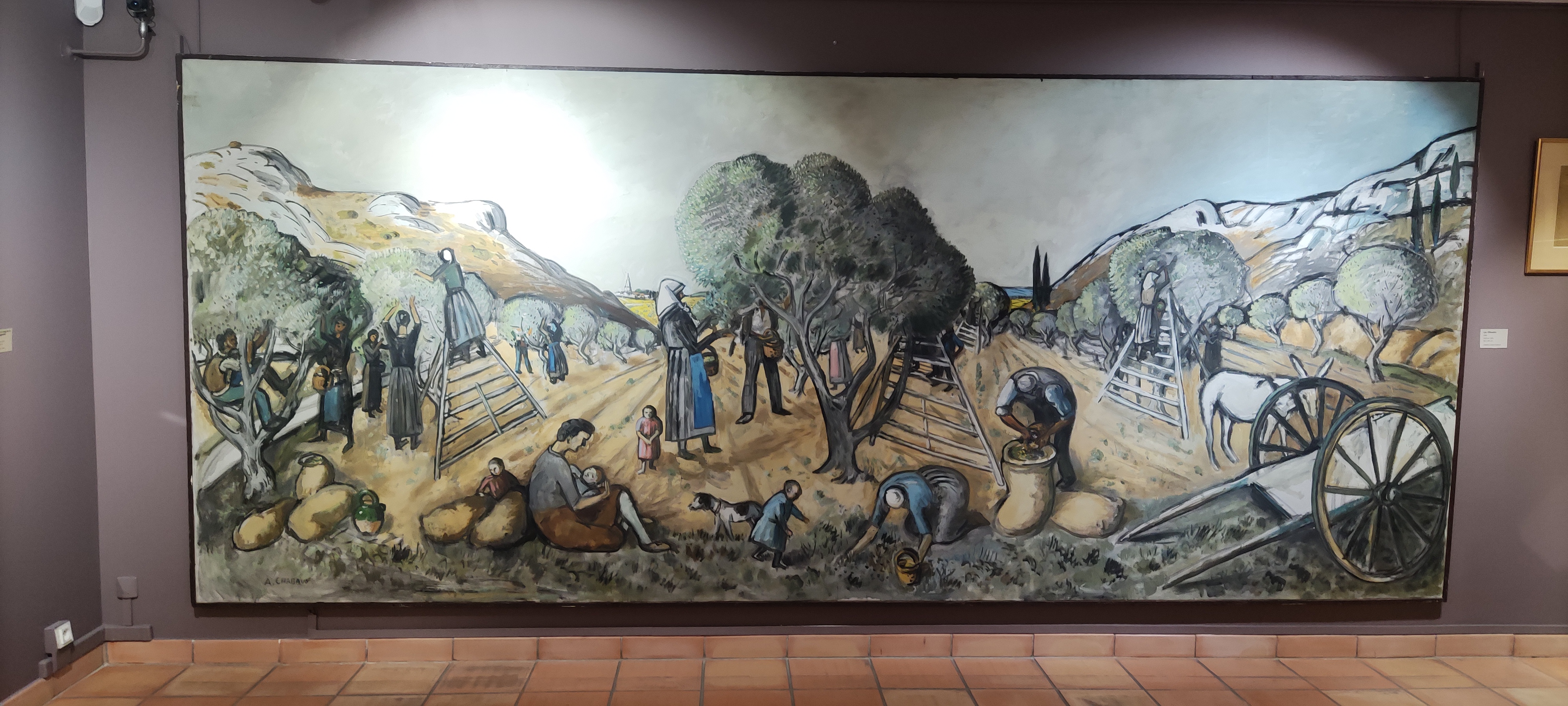
And here’s my favourite painting in the whole exhibition. It’s the locals collecting the olives. Try clicking on it to get a feel for the place. I love it and passed a lot of happy time sitting on the bench that someone had carefully placed in front of it. In fact, I spent a lot of time in this fantastic gallery, purchased a bunch of stuff in the gift shop and I’ll be going back because, in the heat of an afternoon, this is the most fantastic place to immerse oneself in a Provence of not that long ago
Eleanor and the dogs took me to Montfrin today – a first for me and what a charming village it is, situated in the Gard between Nimes and Avignon (although you’d never know those two ancient cities were so close to hand). The name comes from the Latin, Mons Fremens which means the mountain of fearsome beasts. Rumour, myth, what you will has it that wild animals sought refuge here after fleeing from the flooding of the Rhone and the Gardon. It’s believable because if you look at recent statistics, one can see these rivers, plus other local irrigating waterways, flood for a hobby.
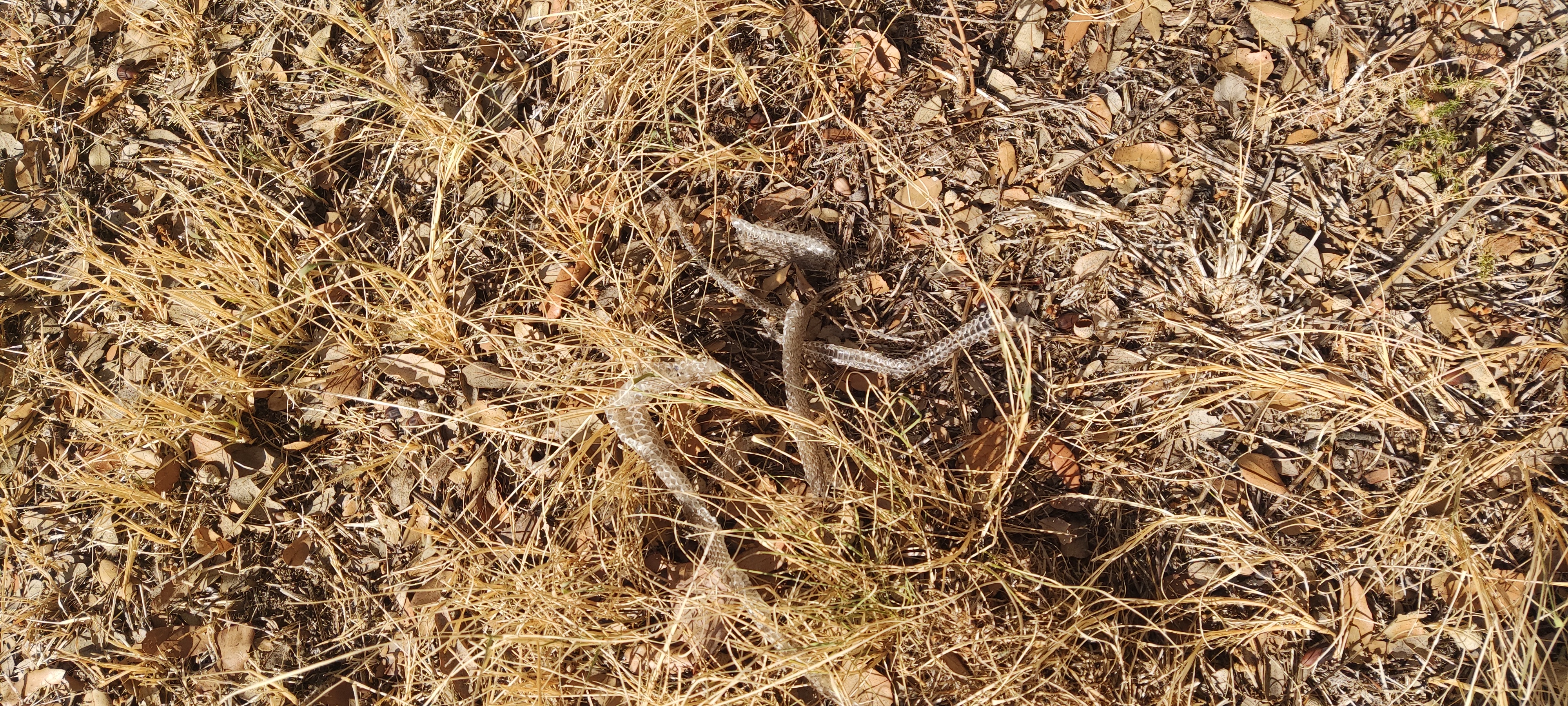
Fortunately, we didn’t see any wild creatures today, but we did spot this discarded snakeskin which meant I spent too much time looking downwards in case its owner, or any of its friends, might be lurking around. More of the walk in a minute…quickly back to the village though. A brief interrogation of its heritage will inform you that two or three ancients used to hang around here back in the day. For me, however, the most interesting of the village alumni is the TV chef, Keith Floyd who lived here for a while. Poor old Keith, an erstwhile favourite of the British viewing public, spent a lot of time in the South, trying and failing to establish various restaurants. He was a genial type but useless in the business world. When researching Montfrin for this post, I discovered so many wonderful obituaries for him: it seems that no-one had a bad word to say about the man.
Anyway, the walk beckoned. There goes Eleanor, striding ahead with Tapas and Jazzy. Are there hills involved, I’d asked nervously beforehand? No, she brushed away my enquiry. Well, I think you can see she’s already on an incline.
We walked up to the chateau which was built around a Roman tower and a Templar keep. First occupied in 1304, it was constantly rebuilt until 1791 and is now a domaine producing local wine. I think weasel readers with a minimum of topographical awareness can see I’m standing on a hill to attain these views.
That would be a scrubby hill; the type of place in which Hissing Sid might be hiding.
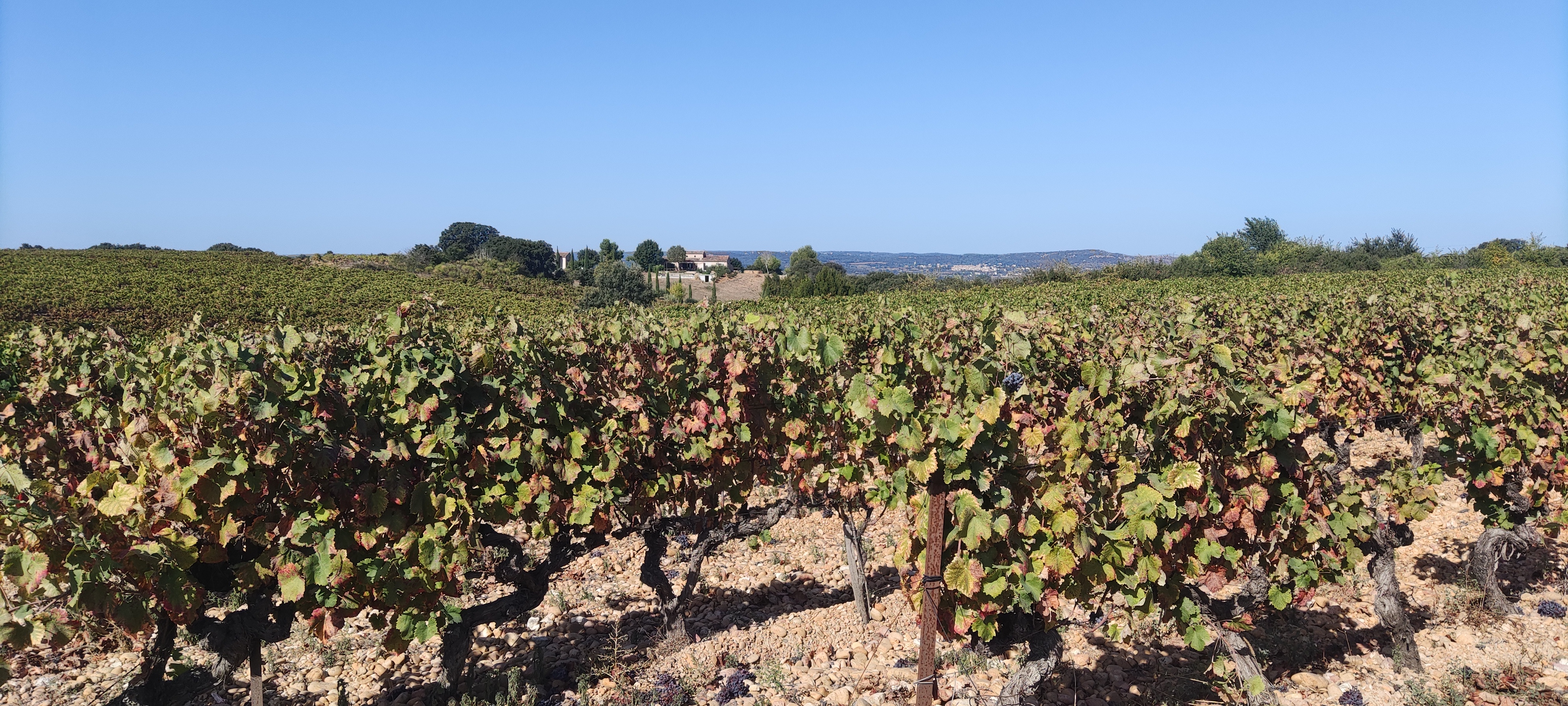
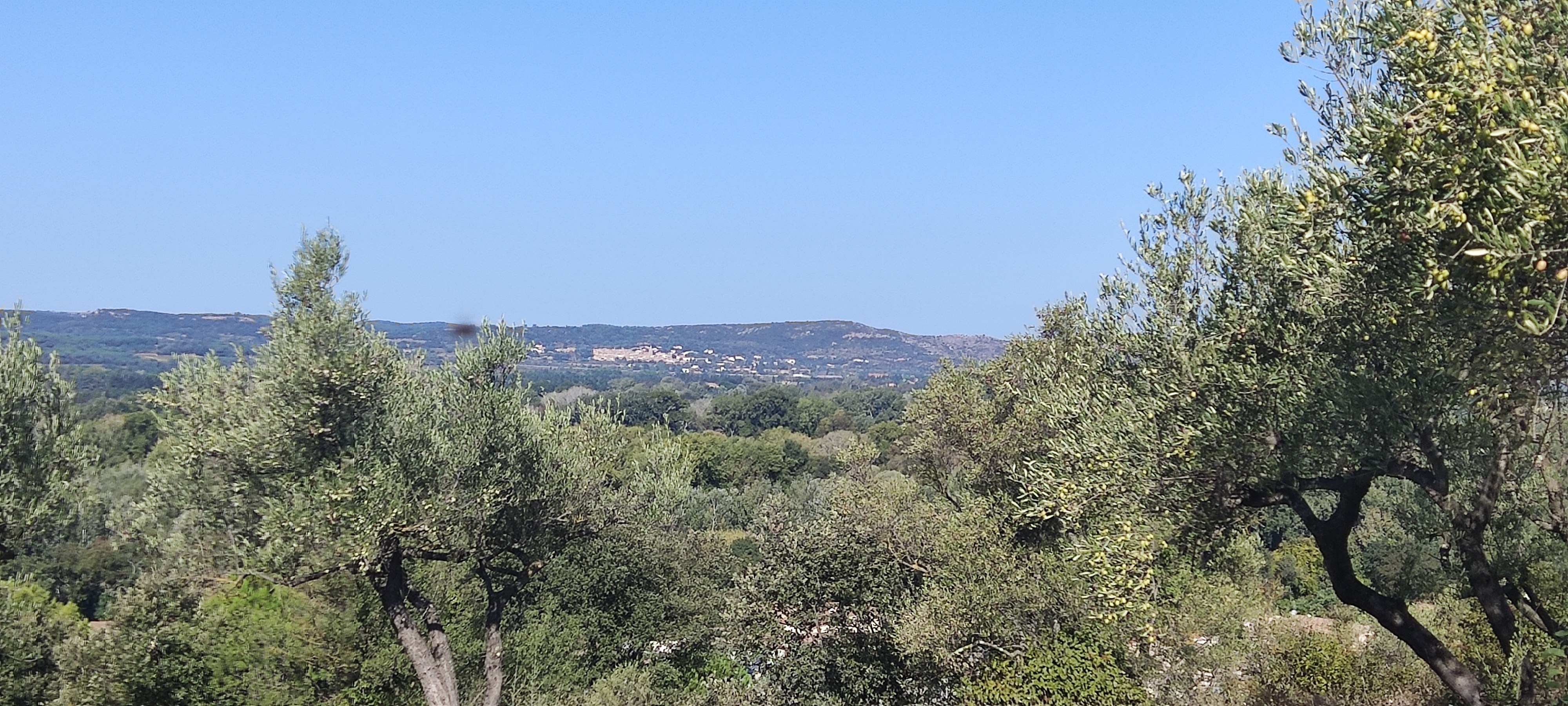
In rising temperatures, we walked through endless vineyards with stunning views in all directions. Although you can’t see it, in the distance, is Pont du Gard. Today, it’s a World Heritage Site, drawing travellers from around the globe. However, just the other day, my friend Anais told me that when she was a child, you could visit at no cost: people knew there was something of interest and beauty over the other side of the Rhone, and families would visit to swim in the Gard and have a holiday picnic under the oldest known Roman aqueduct in the world. They found it by word of mouth. Amazing really but, I suspect, like Stonehenge used to be.
We spent a bit of time trying to work out what this sign on an old disused building might depict. I had a flash of inspiration: maybe it’s where you park when you want to shoot pheasants.
More beautiful scenery in which we spotted an enormous bird floating on the thermals. I was too entranced to think about a photo, but both of us concluded it was an eagle. If only…you’ll have to take my word for it. The other day, I was excited to see an unusual bird outside my gite which I later discovered was an Eurasian Blackcap. Seems a bit pathetic to even mention it after this. I think Eleanor might have liked to walk further, but Tapas, Jazzy and I were ready for a drink.
Over at the weasel emporium, I’ve been having a bit of a sulk. Barely anyone has commented on or even ‘liked’ recent posts and, let’s face it, I need my life validated. I’ve started writing a new novel and thought I’d give up on the other stuff: Donald and I were finished. End of. No-one cares. Farewell and so long. Write the book. But, suddenly today, by other means of communication, folk have started telling Donald and I that they’re enjoying the blog. Perhaps a reconcilliation is in order?
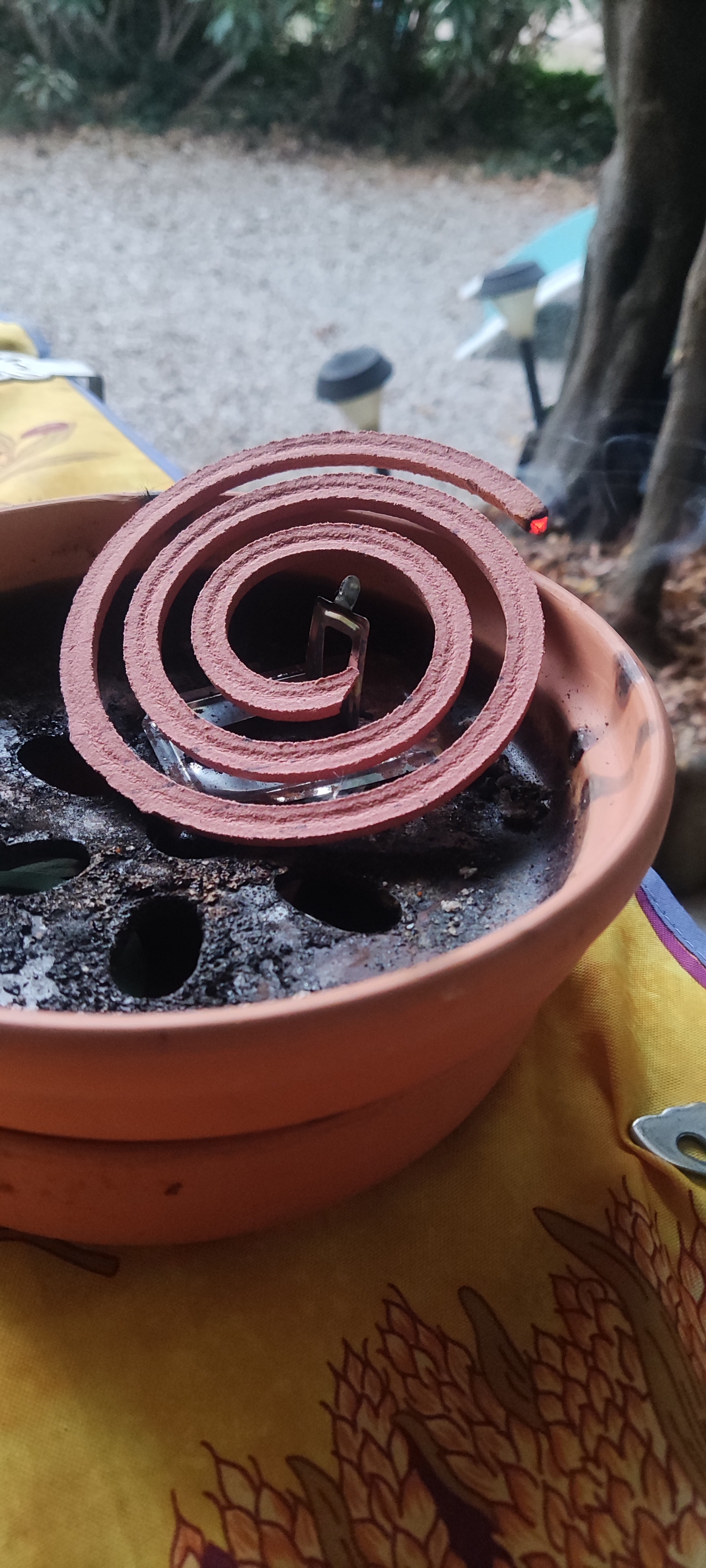
Some folk write from a lonely garret or a cottage in remote countryside. Me, I send my missives from a provencal table, accompanied by a spiral shaped mosquito repellent. It’s functional rather than romantic, although doesn’t completely thwart the incessant ankle scratching. And speaking of lower body parts, this morning I walked into the village to try to arrange a pedicure. I would’ve posted a photo of my feet, the toes I was so proud of a couple of weeks ago. Now, sadly, they look like a prop from Hammer Horror Films. I can’t bear to share them. I’d done a bit of research beforehand to get the vocabulary right: shellac = gomme laque; remove = retirer. I don’t want it any more and so on. I knew Madame would be stuffy – oh, semi-permanent she cried with a distinct sneer, calling a compatriot to view the English disaster.
Pas encore, I suggested. I don’t blame you, she didn’t say, but I could read that bubble coming out of her magnificently coiffeured head. Madame needs a pedicure classique she advised her partner. Next Friday at 4pm she announced. Our village has a population of 4000, most of whom are old men. Are they all having their nails done? Telephone number, Madame demanded. I gave her the number. It’s too long she and the partner agreed. I wrote the number down fearing I’d made a mistake. Non, too long. Is it an English number the partner enquired? Well, of course it is, I didn’t say. That explains it, they said. Next Friday. Trying to make myself invisible, I sidled out. Next contender, said Madame.
In other news, Eleanor and I are still sitting by the pool, drinking late afternoon wine with our new friend, Jessica. The water is much cooler now, and the dips less frequent. We stay as long as we can but the early evenings are chilly. The laughs are long though between the three of us. Glorious days in which nothing much, but almost everything passes.
Here in Provence, the days are getting shorter and cooler. Even though I can sit outside after 7.30 in the evening to write a short post, I’m wearing a jacket. With a hood. Not that long ago, folk would still have been poolside; but time rushes on, and older age advances hourly without a care in the world. Good grief, that was a bit morbid thinks Donald, taking another hearty swig of the red stuff. The owl-filled nights move quickly from hot and sweaty (turn on the air con), to slightly worse than chilly (turn it off and reach for the velour dressing gown). In my curtained boudoir, it’s no longer possible to tell whether morning has arrived and I’ve successfully seen off another night. The room is dim – my favourite shade which I feel suits me best. Even the bathroom’s not too bright so, as I rebuild my face, it’s impossible to tell whether I emerge as Coco the Clown as, vampire-like, there’s no looking in a mirror in daylight for yours truly.
Wednesday, and the market at St Remy calls. No point in leaving too early as it’s October so the car park won’t be packed. I arrive around 10. The car park is packed. I attempt parking in a side street but Madame, walking a small rat on a lead, takes great pleasure in shouting obscenities at me. Merci beaucoup, I respond and drive further up to a point where I can’t be seen. Coffee and book a table for lunch. Then return to ask whether my reserved table will be on the terrace. You didn’t say you wanted to be outside says the patron’s wife. You didn’t ask, I don’t say.
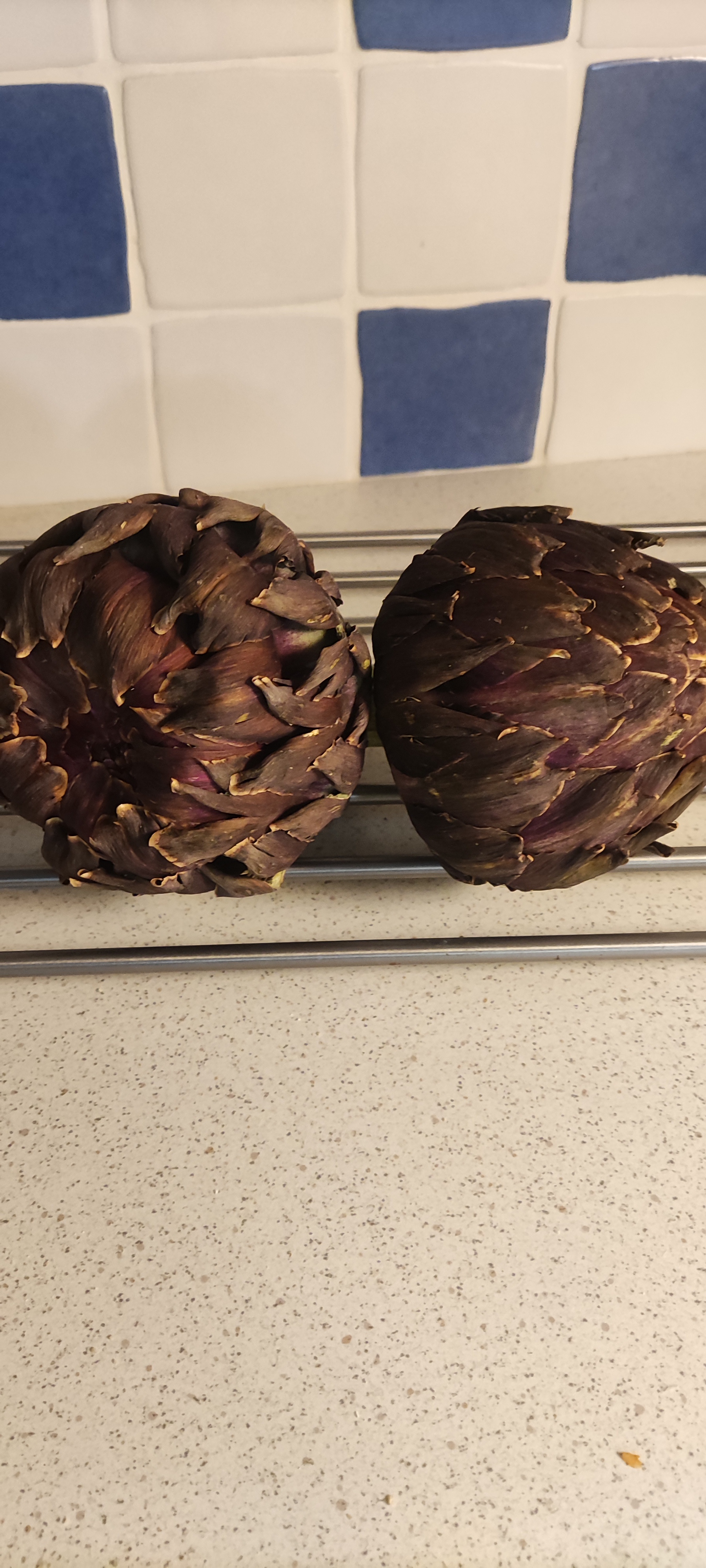
I have a plan and head for the square where the clothes are. On the way, I pass a greengrocer’s stall and notice they have a few large artichokes winking at me. It’s a dilemma: do I buy them now and lug the the things around the clothing department, or do I risk leaving them behind in the hope that they’ll still be there when I return. Tricky, but I opt for the latter. I’m headed for a particular stall which I’ve only ever seen in this town and frankly, who wants to be encumbered by a bag of cultivated thistles when perusing lovely dresses?
My favoured stall is called Rhum and Raisin. It’s a designer brand from Aix-en-Provence and is super expensive. But, at this market, they have an outlet stall where one can purchase some real bargains. When I first found them, it was cash only, but they’ve upped their game and now have a card machine. It’s always packed and today, as usual, there were American ladies aplenty purchasing goods by the armful. You can’t even try the stuff on and the options for those of us who aren’t stick insects are limited. Nonetheless, I found a beautiful princess skirt reduced from 150 euro to 30. (Only one of my readers will appreciate this description).
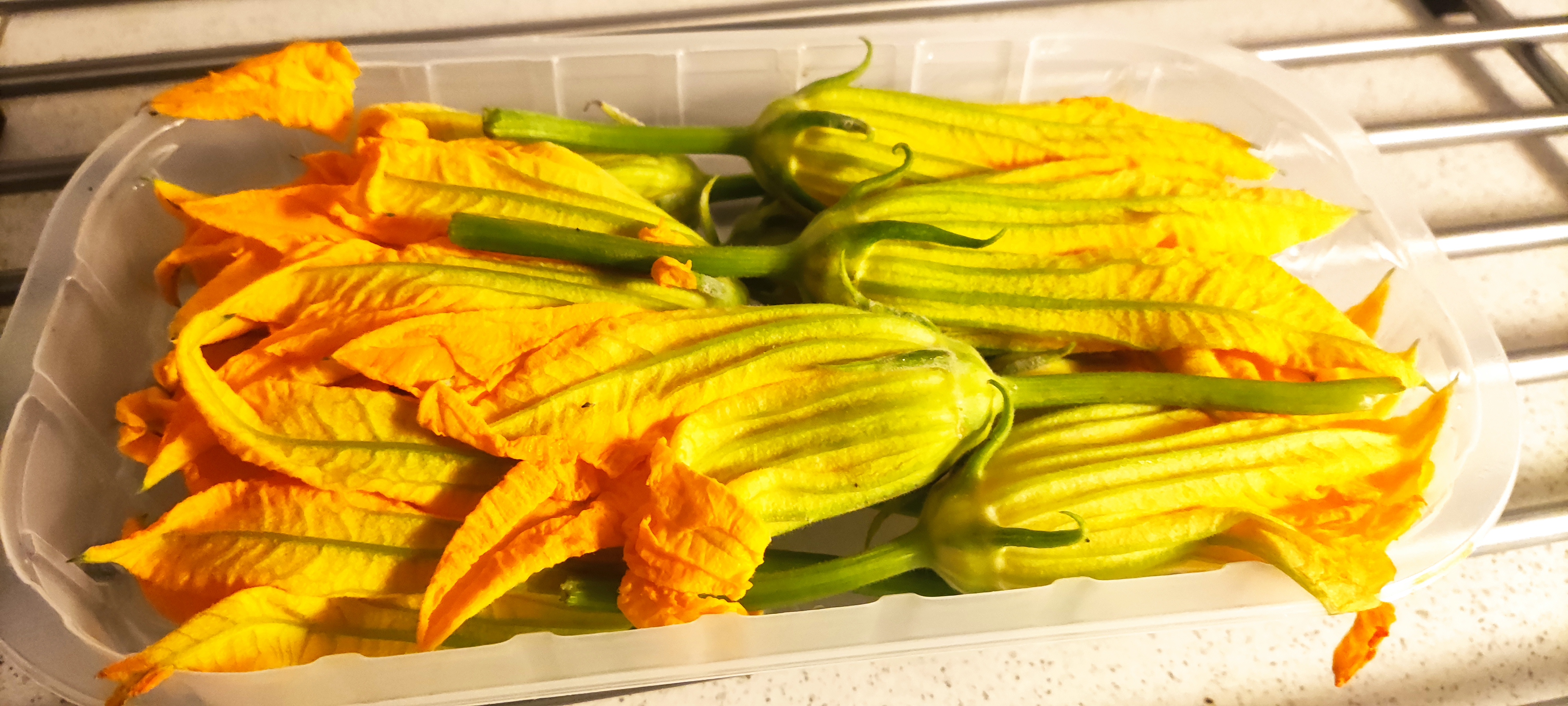
Back to the greengrocer and guess what? Three artichokes left so I took two. But what is this? Courgette flowers? I had these once before in Italy with lobster but I’ve never cooked them – not the sort of thing one finds in Tesco. There follows a long complicated conversation between myself, the stall-holder, the phone, and anyone else that’s passing by, on how I might deal with these treausres. At one point, Madame shows me that Google might be involved – BREADCRUMBS she shouts, as if this is the meaning of life. An American lady intervenes. Do you speak English, she asks? Mais oui, I respond stupidly. They’re very expensive she warns me. Not if you’ve just saved 120 euro on the clothes stall and are unlikely to ever see these flowers in England, I don’t say.
Armed with purchases, I move back to my reserved table which now comprises three place settings plus a high chair. Did you change your mind, I ask? You’re outside now on that little table in the corner he responds. I had the lamb which was the reason I chose this place. Here’s your lamb Madame Green they said. It’s the best lamb in the world and the house rose couldn’t be bettered. Sometimes, people you’d like to be present are missing, but I was happy.







 Donald and the Weasels