
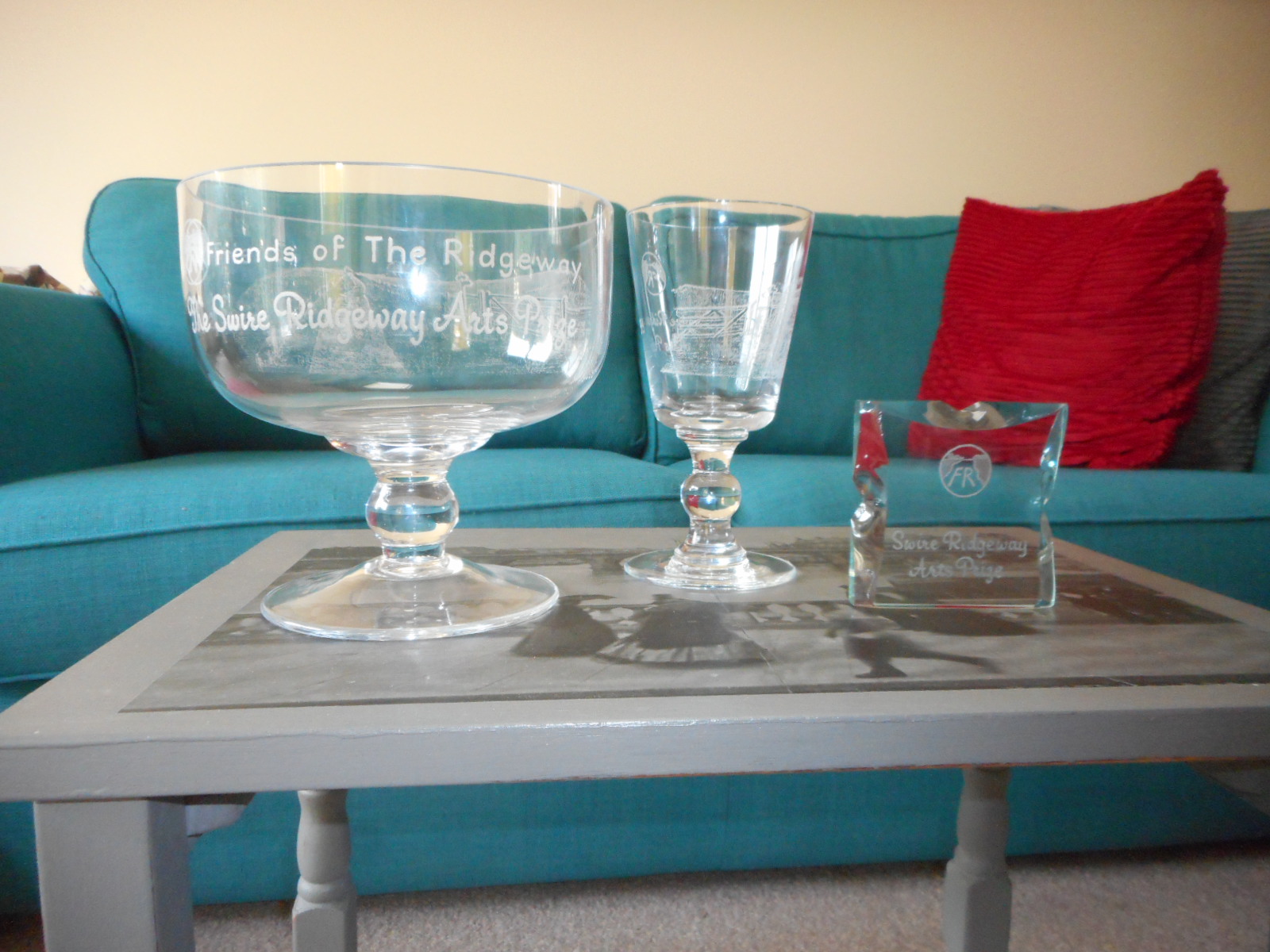
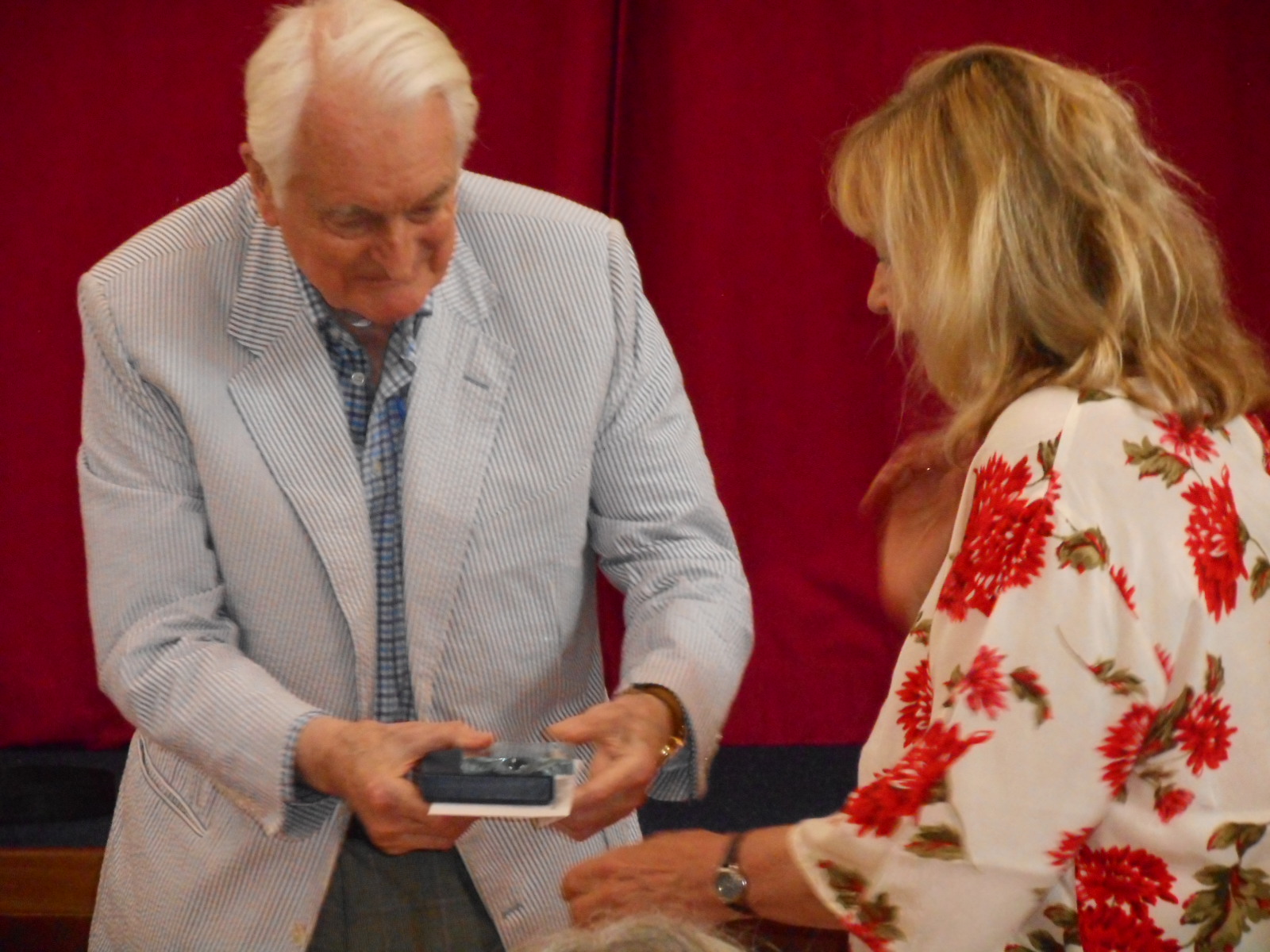
Just back from a fabulous weekend in deepest Oxfordshire where I was the proud recipient of Writers’ Prize and Overall Winner in the Swire Ridgeway Arts Competition. Here’s my winning entry:
Time Travelling
At breakfast this morning, a small porcelain dish of words has been carefully secreted amongst the home-made honey and preserves. The intention is to pick a literary portent, without looking first, and live the day accordingly.
Preamble, forerunner, what you will, assumed original meaningfulness on arrival yesterday. I walked nine or ten miles past white horses of both the living and chalky types just to be where the Ridgeway begins, but it may as well have been journey’s end in this world. With unexpected serendipity, my hostess takes me to close-at-hand woodland where the source of sacred water has been uncovered. Into this, I’m encouraged to dip my weary feet. Later, we visit an enormous yew tree whose trunk has divided in two, leaving a space to hide within the bark. It all seems perfectly natural which, of course, it is. Thus, the dish of words comes as no surprise and my compliance even less so.
My word is ‘surrender’. I don’t understand what it means.
…………………………………
With Milk Hill to the rear, I commence my ascent of the Ridgeway on what will become the hottest day for many years in England’s living memory. But I am beginning my trek to somewhere away from living memory, into a surprisingly remote landscape that even the lowland, thyme-flavoured, time-forgotten sheep have forsaken. For them, the herb infused chalky grasslands are preferable. You know where you are with a piece of pasture; in every sense. The incline is almost unnoticeable, unless you happen to be walking up towards the first and most important of Albion’s astutely named highways. There are a few sporadic clumps of trees and bushes ahead but the horizon beyond is a clear straight line bisecting what lies below and above. Even so, the huge sky remains an integral part of the all-enveloping landscape.
It occurs to me that, already, I am no longer an intruder and I momentarily rest on the ground at the point where the Ridgeway crosses the Wansdyke Path. Just another old girl alongside those two ancients. I feel about a million miles away from this morning’s honey and preserves; from my home and from anyone I ever consciously knew in what I thought was my time. Here, a moment becomes an interminable measure of nothingness and the opportunity to stay awhile evolves into philosophical reverie: can people who have been wrapped in the pattern of a landscape hold it, unknowingly, in perpetuity for their subsequent incarnations? Do folk who choose to walk into the unknown unconsciously guard something more than a passed-down memory or even an instinct of the Otherworld? My Ridgeway is a paradoxical highway: both unimaginable but simultaneously obvious as it stretches across the topography of middle earth offering a tempting confusion of numerous tentacles and trackways leading to other ridges and routes.
Nonetheless, on entering the beech and conifer woods, I become distracted and confused. The veteran trees, baring their ancient scars from a lifetime of battle, sport intricate bark patterns providing a place called home for fungi and insects and small mammals; inexplicably, they make me anxious. On my map, I mark the place where, earlier, I sat and rested: Red Shore. But what to make of the unexpected darkness of the ancient trees wherein I feel just the tiniest bit alone? This is Britain’s oldest road and the noises emanating from within the overhanging branches sound as if they might belong to something that’s been here since long before the way was first forged.
Just as I’m reflecting on the sense, or otherwise, of my lone journey, I’m suddenly able to mark the next place of importance on my map: the place where the lucky feather lays waiting. For looking down, I find a beautiful unseen hawk has left me a kindly remnant of his passing. I thread it into my hat and almost immediately the feather weaves its miraculous spell: the woods close over behind me and I emerge into a vast and untroubled open landscape. I have stepped through a portal into the sun-soaked hidden past and I wonder whether my gasp has been noted by the spirits that roam hereabouts.
Walking along Cow Down, it’s difficult to digest what this Otherworld offers. The land is strewn with long barrows and tumuli. Sarsen stones decorate the furzy fields and tiny pathways wind up and down and round and about like intricate embroidery. Borders are embellished with old plants: cow parsley, amaranth, brown and green grasses, ragwort and a sprinkling of coralroot. And in the distance, like the proverbial jewel in this precious crown of innumerable spoils, rises the majesty of Silbury Hill. Finally, I understand the meaning of that scrap of paper in the porcelain bowl for there is nothing to be done except surrender to the magnificence of it all. Later, I discover that a recent theory suggests the process of construction of Silbury Hill was probably more important than the end result; which seems rather like my walk along the Ridgeway.
It seems apposite to end my journal recording here, somewhere in nowhere. But, I deviate and tag along behind countless other travellers who, walking for eons through this countryside, have temporarily left the Ridgeway to journey towards Avebury. For the Ridgeway, like our short and indeterminate lives, is not a straight and orderly line: it’s a track with important diversions. I cross the road from Londinium to Aquae Sullis and cut through a gap in the hedge that the Romans missed. Did those not-so-ancient intruders forge a path, as quickly as they could, away from the all-powerful signs of the past? I skirt around the perimeter of golden barley to find myself walking bravely alone down the Avenue. There are no visible souls here: just five thousand year old ravens perched, like sentinels, on the stones of the past. It’s like Silbury, it’s like the Ridgeway: it’s the procession which holds the meaning.
…………………………………
Further down the track
‘…there was a main sight of strange old things up there on the hill, besides the White Horse; and though he didn’t know much about how they got there, he was sort of proud of them, and was glad to pay his pound or two…to keep them as they should be’. (Hughes, The Scouring of the White Horse, 1859)
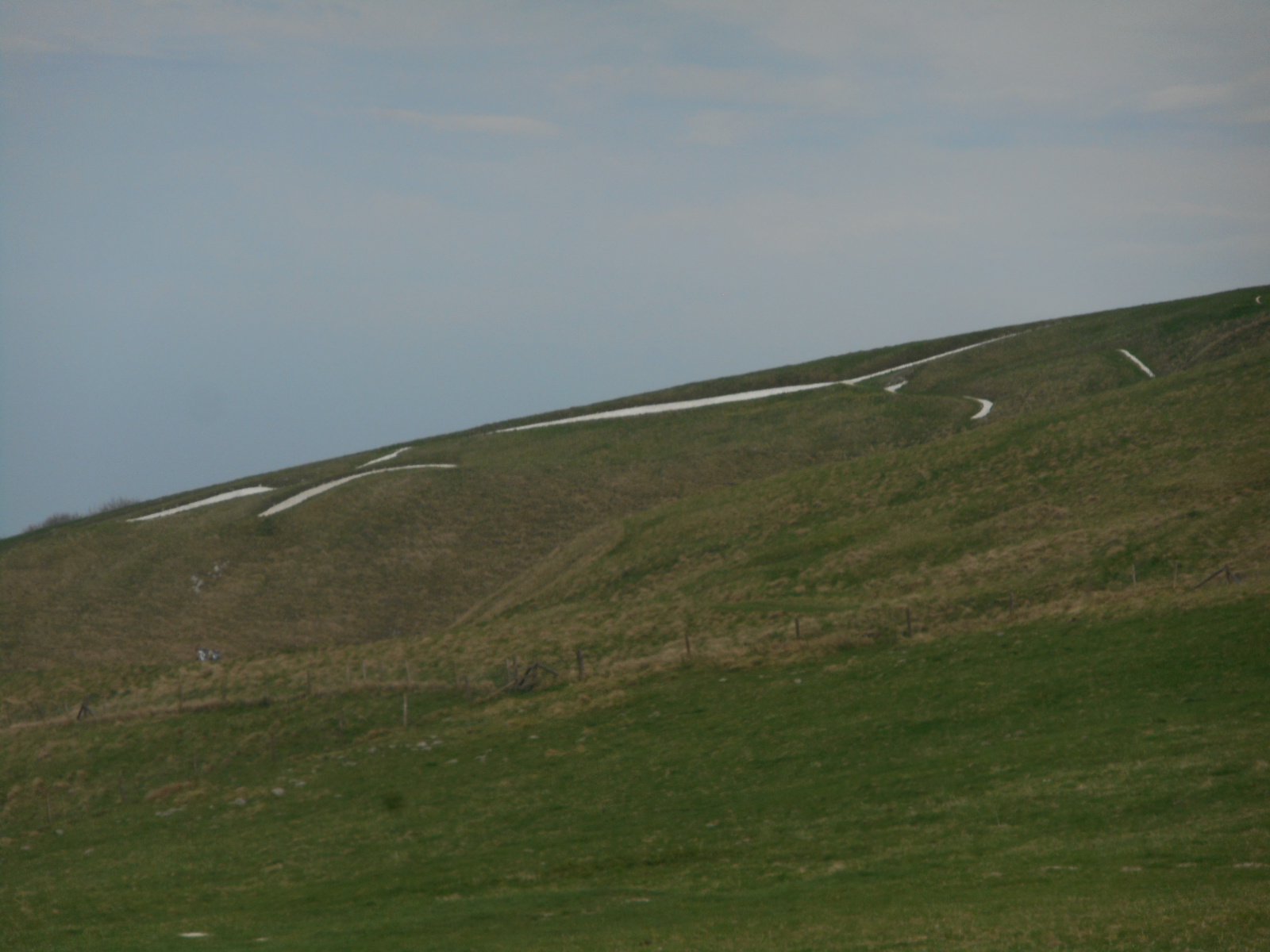
I’m on the Ridgeway once more. What is reputedly the oldest road in the country has become an enticing, demanding magnet that I am unable and unwilling to dislodge. I travel many miles by car just for the joy of standing on the old country. I am as an exile returned: one of a nameless diaspora dreaming of a not-quite-forgotten home. But, even in the now-time, in this incarnation, I am not completely new to these parts: something has lodged itself immovably within the memory that has been generally interfered with over a lifetime. When I was a very small child, nearly sixty years ago, I was taken from my primary school to see the White Horse at Uffington. Despite the annual outing being an intensely anticipated event, I have no recall of places we visited in other years. In truth, I only really remember two things about the trip to what was probably never referred to as the Ridgeway. The first was the profusion of wild flowers, especially the shy cerulean harebells startled by the intensity of their neighbours, the sapphire cornflowers. The second was the horse itself which, in those infantile days, never looked like a horse in my small eyes but, more romantically, as an elongated dragon stretching its fiery way across the hill.
 Today, as I walk towards Wayland’s Smithy, I am once more embraced by timelessness. It seems like a cliché but why seek another word or expression when this is the power of the Ridgeway? For a long while, I am all alone in the morning sunshine, just another solitary traveller on a route well-trodden. I am happy to be alone. I feel privileged to have this all to myself, especially as the Ridgeway seems permanently overseen by the sun on my travels. Somewhere down in the valley are the unseen dreaming spires of Oxford: a city ancient and enduring in itself but somehow new when compared with the agelessness of the track I tread. Unexpectedly, a man runs out of the past accompanied by a dirty Neolithic dog. ‘Good morning’, I greet him happily but the exhausted man has run through so many years he can only lift a vaguely acknowledging hand as he passes by.
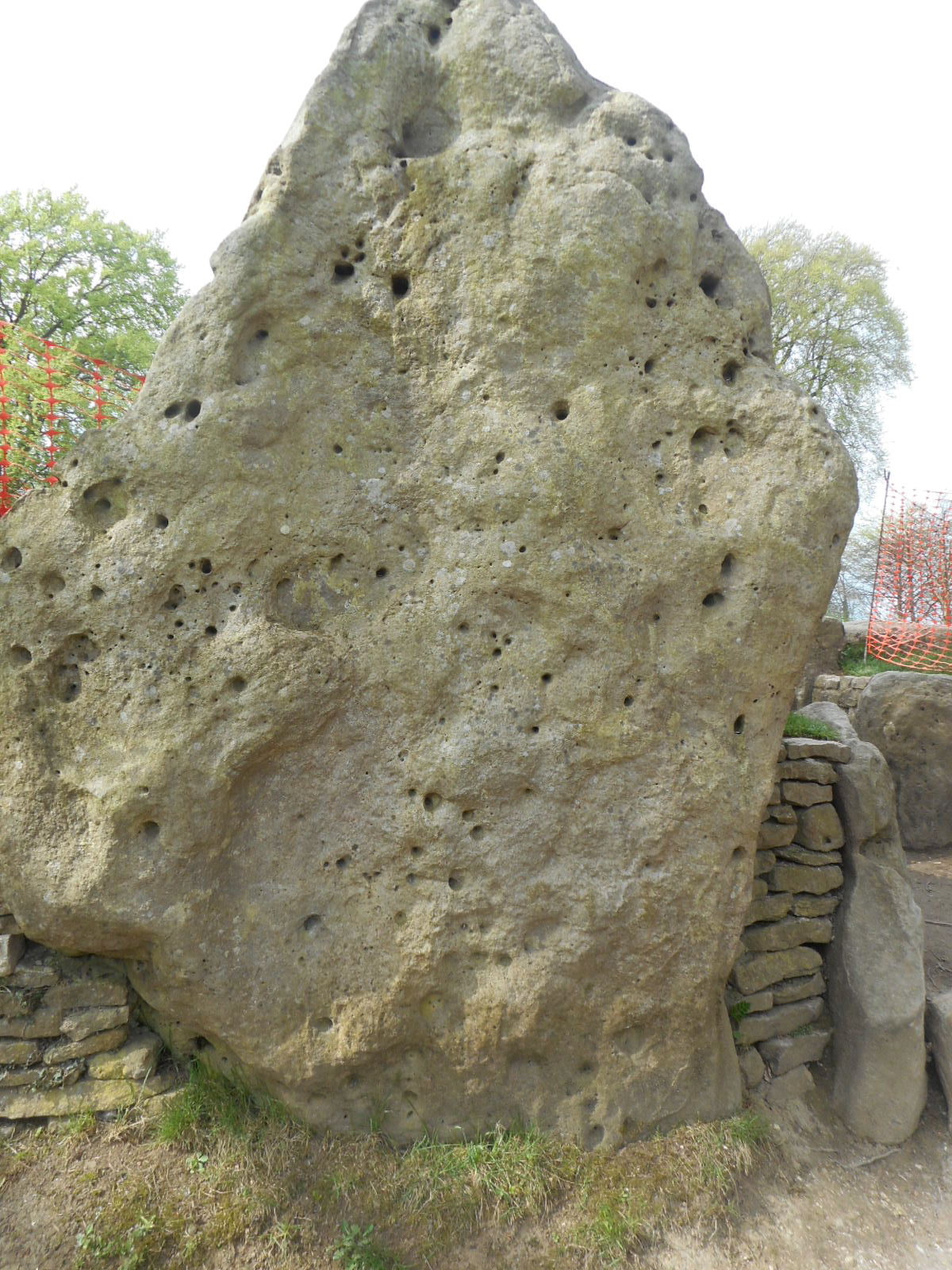
Wayland was initially apprenticed to the trolls who, as everyone knows, were masters of metal craft. Wayland was a quick learner and soon outshone his bosses by becoming the best smith in the western world. Legend has him living in caves and burial mounds all over Europe, secretly repairing metal objects for gods and kings. Clearly, this is nonsense because when you see his Oxfordshire smithy, which comprises a chambered long barrow constructed 5000 years ago, you just know this is THE place. Perhaps it was more obviously accessible in the past to those who trod the route in the company of animals needing repair courtesy of the master. Today, the smithy is hidden within a verdant copse some little way from the Ridgeway. In fact, the few modern visitors tramping the route this morning seem to be ignoring the signpost. These loud Sunday folk are spaniel-ridden and drowned in Barbour as they trudge a path that, to them, apparently avoids a church or any sense of spirituality.
Well, white horses for courses and all that stuff, and the way is free to all denominations, and those of none. Discrimination is an unknown quantity up here. Me, I’ve come to see the past and Wayland’s Smithy epitomises everything the Ridgeway chooses to offer in the way of atmospheric sideshows. Mind you, today’s peaceful environment belies a far more violent age. The latest research on bone dating here has overturned previous theories surrounding Neolithic life which, it transpires, was short, sharp and horribly brutal. More recently, a tradition of depositing coins in the cracks between the stones was all the rage – a sort of ‘ritualistic narrative’ as one folklorist claimed. I think it sounds a rather nice thing to do but the practice has been latterly discouraged to save the unseen wardens the job of coin removal. I feel there’s something missing from this story. Possibly a sufficient number of wardens.
I turn tail and walk up and along the Ridgeway towards the White Horse. Saving the best for last, I’m appalled to find a change in the weather. I don’t know why – after all, this is England and from nowhere come black clouds full of rain. Finding a still dry stump, I take shelter under a hawthorn and retrieve my notebook. It’s another delight of the Ridgeway that one can simply sit in the rain recording one’s journey without hindrance or judgement. ‘Writing your memoirs’ a passing stranger asks? Well, as a matter of fact, yes, I don’t say. I just smile benignly. No matter: the shower passes and the sky is big enough to hold the promise of imminent sunshine as I continue on my way.
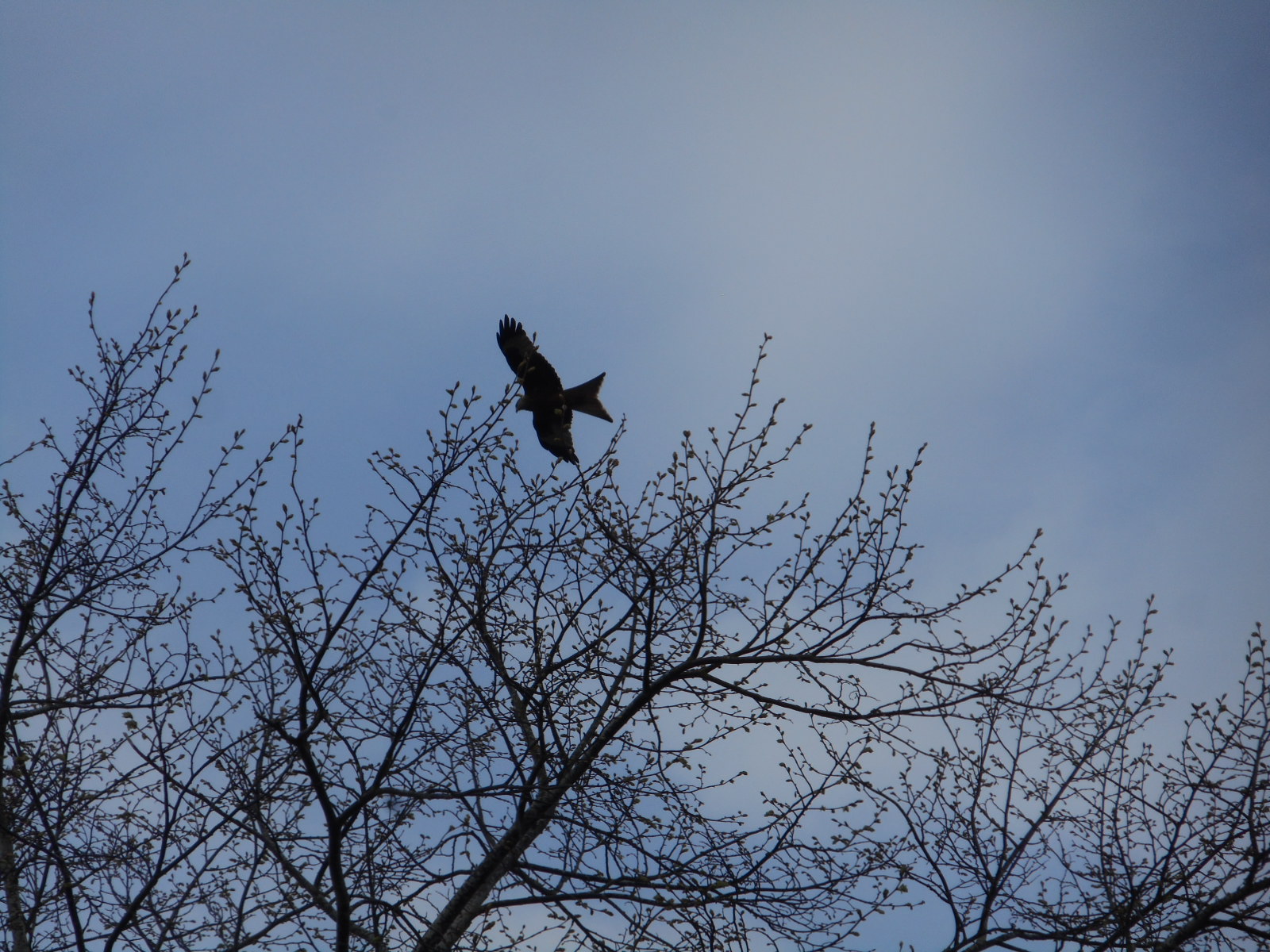
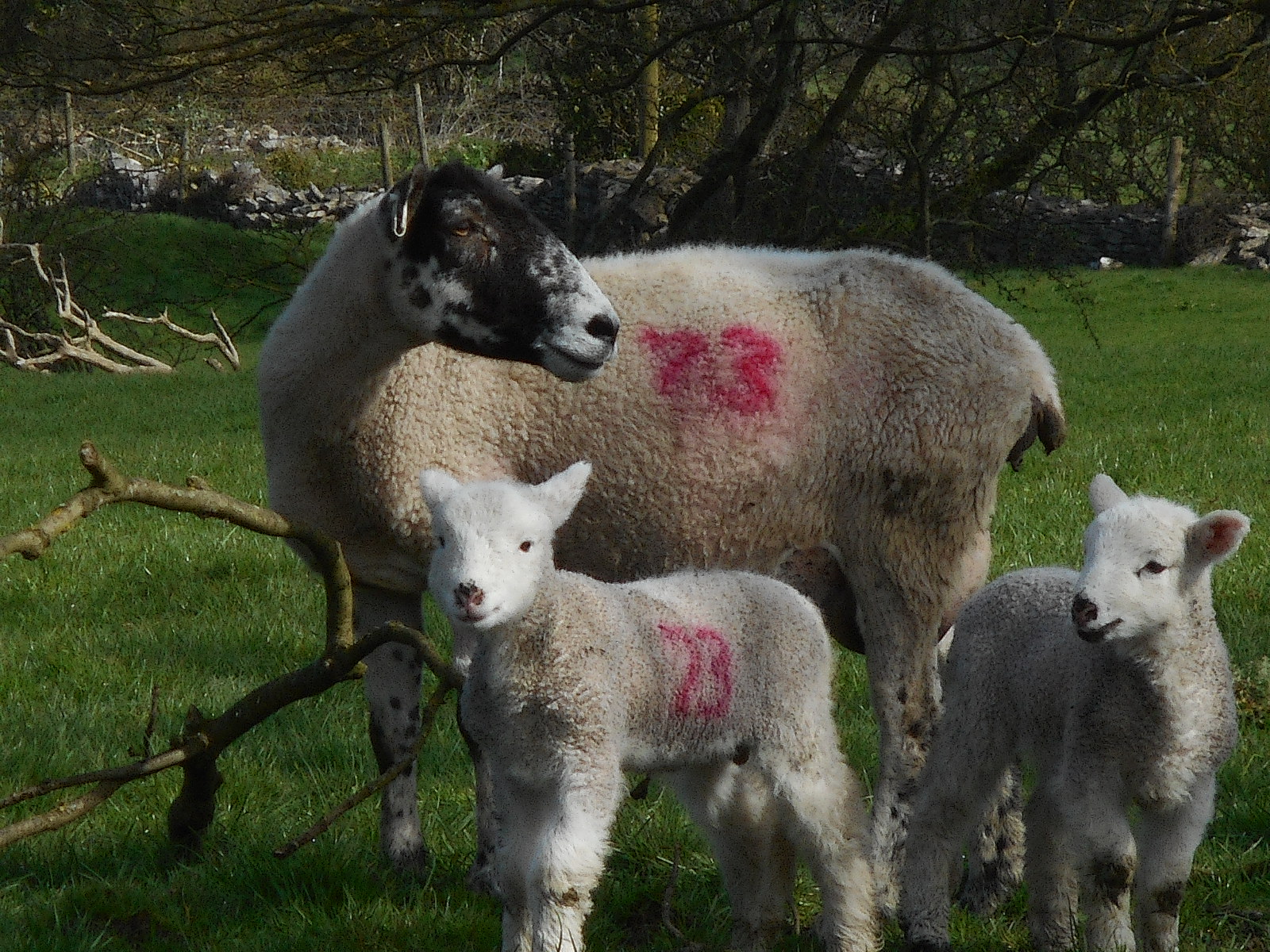
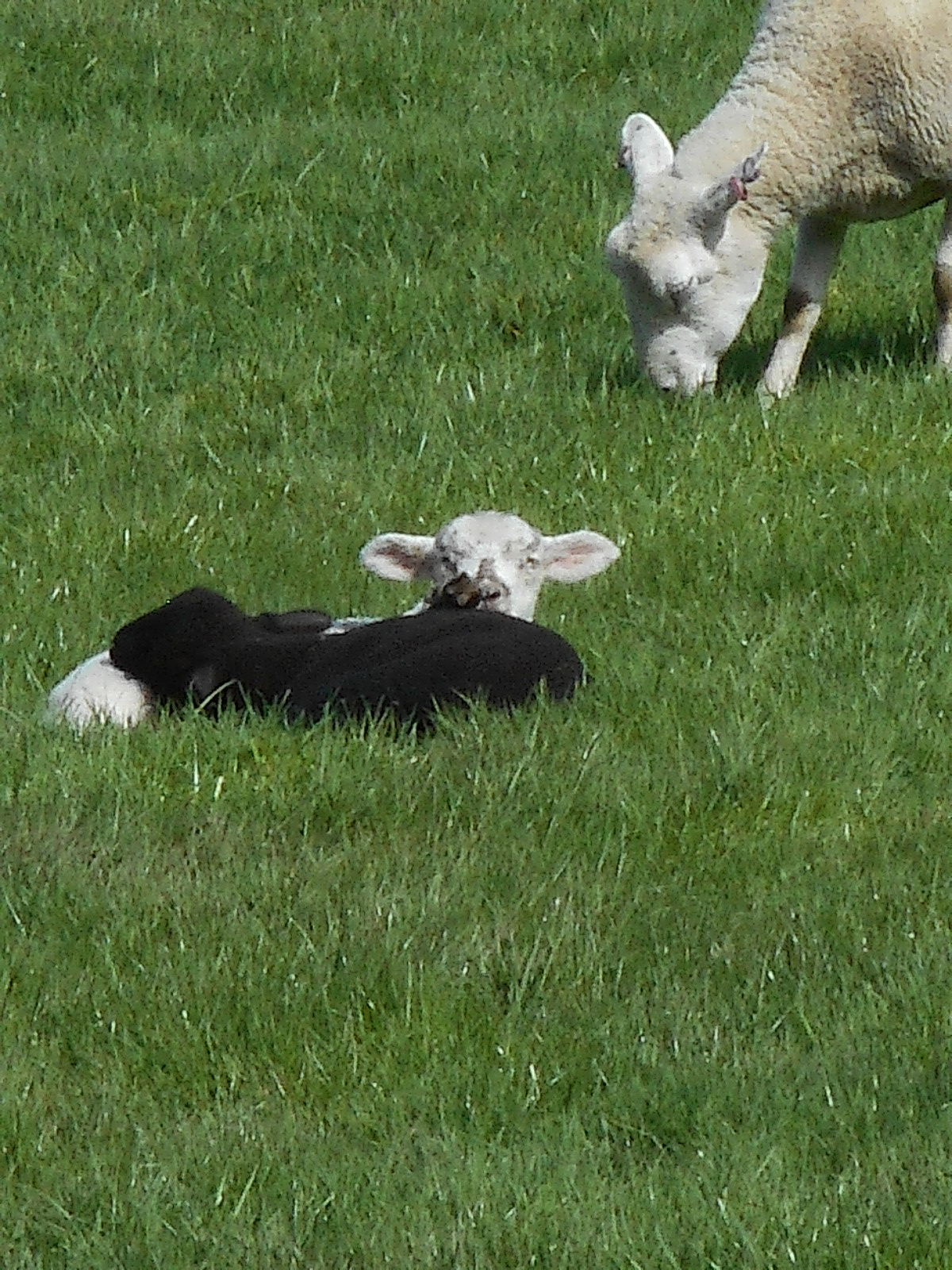
A flock of pretty sheep have pushed themselves against the fence. Shorn to the extreme, they are seeking shelter from the wind. I stop to speak to them when, to my left, I see the red kite sweeping and soaring. It’s such a joyous moment. I’ve seen buzzards and the small birds that took rest amongst the hawthorn but, concentrating on prehistory, I’ve forgotten to look for today’s nature. Now, away from the hedge-lined track, in the vast openness of the White Horse Hill and Uffington Castle, nature and history merge into nothing less than what we might call the spirit of the Ridgeway.
In the village where I’m staying, and where the horse is continuously celebrated, I discovered Thomas Hughes’ informative little tract so I know all about the sideshows of the sometimes long-ago, sometimes recent, nineteenth century that took place on Uffington Castle. Villagers and travellers and gypsies, alongside the squire, would sport their feasting, games and general reverie after a collective cleaning of the horse. Today, it’s a windy hillfort keeping its secrets and the lives it has witnessed safe as it rests quietly. People may place whatever meanings and interpretations they want on the Uffington White Horse but still they flock here in the hundreds and thousands. Tribes and governments have come and gone; beliefs and values have disappeared, yet still the horse remains, surveying the landscape over which it reigns supreme.
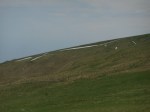 On the way down, I see the red kite again in the distance and stand for some time in contemplation hoping it will come close, but it’s busy over Wayland’s Smithy. Finally, I sit on a bench near the car park looking back at the horse and watching more visitors trudge up the hill towards it. Except that no-one is really trudging. Two grandparents come through the gate with a small child aged about three years old. ‘Can you see the horse’ asks Grandpa? The small person looks around, anxious to please but clearly looking for a live animal. ‘Over there, on the hill’, says Grandpa. The boy sees it and all the emotions in his little world pass across his face in a millisecond: ‘It’s there, it’s there’, he cries pointing excitedly. And just at that moment, when all of us have been busy looking elsewhere, the red kite soars from the grass where it has hidden less than twenty feet in front of me. And all the emotions in my small world fly over my head and it makes me cry.


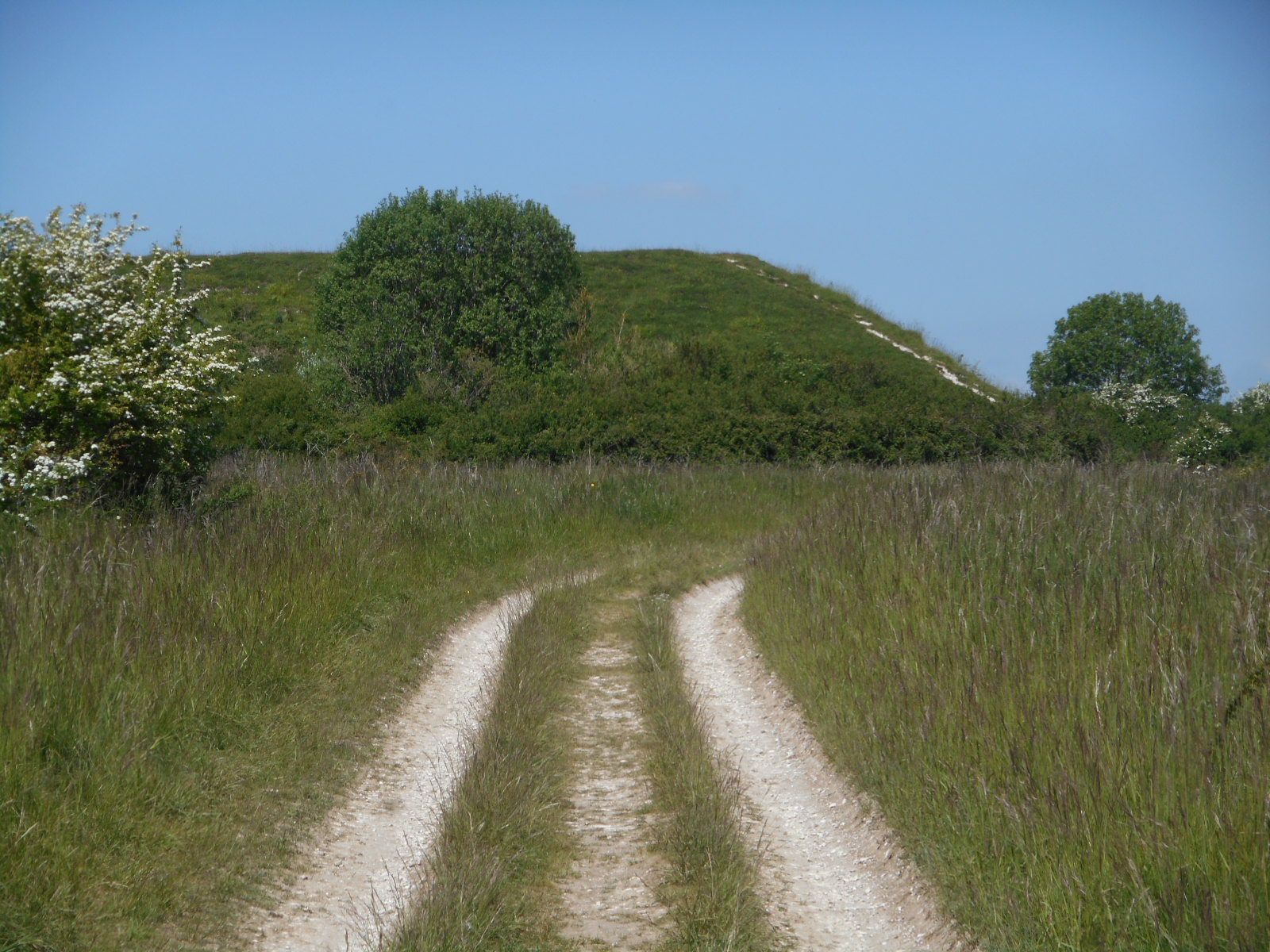 On a gloriously sunny morning, when vast swathes of humanity are indoors watching an event on TV, I head north to the old Neolithic chalk grasslands of Martin Down. Actually, these earthworks aren’t so old: they’re the remnants of a WW2 firing range.
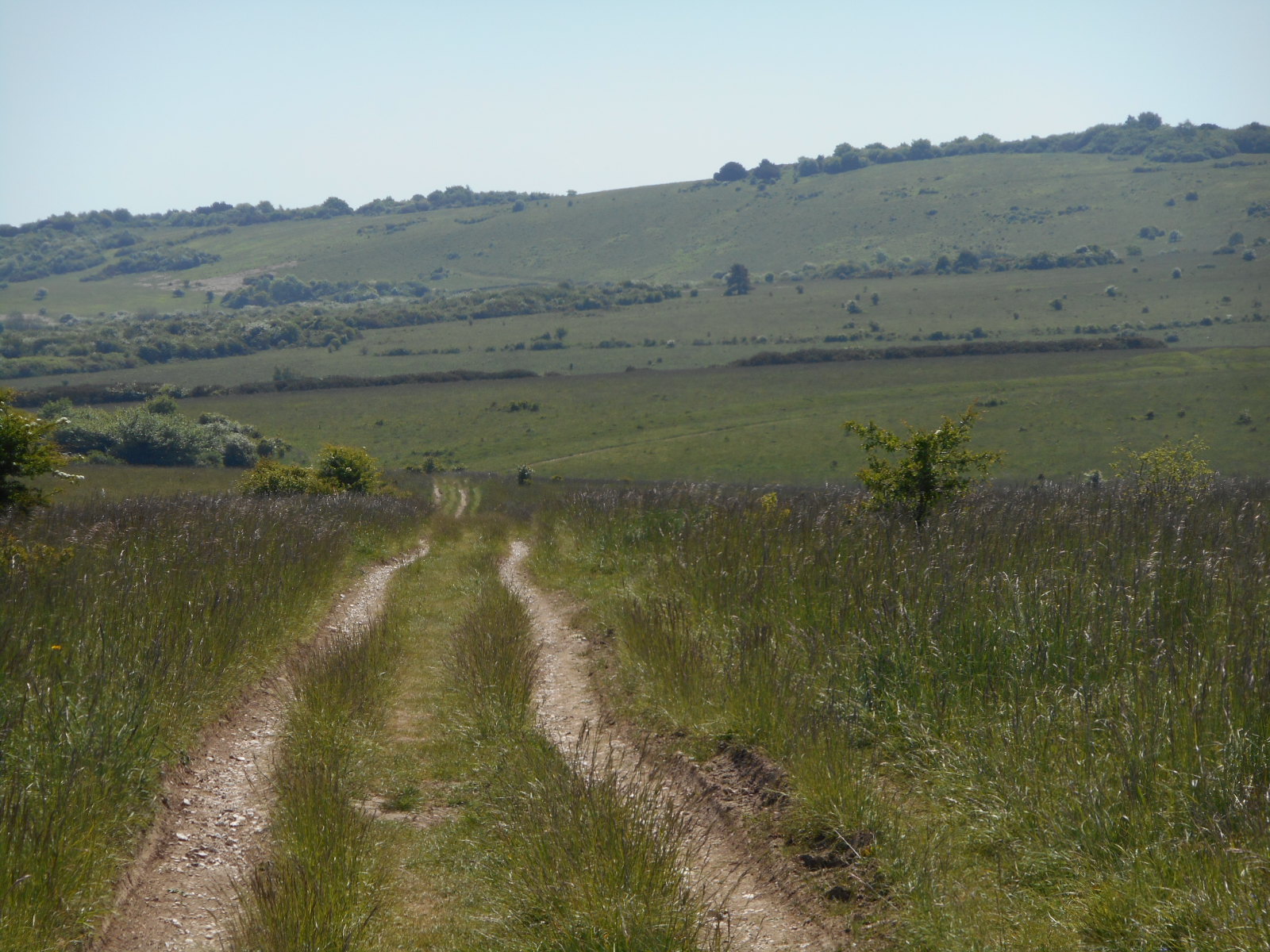 The ancient downland, which has been unploughed for centuries, is important for ground-nesting birds. (Have you noticed how this blog is evolving into a birding site?) This morning, the grassland is full of sound: some insects, but mostly skylarks which, every now and again, ascend, soaring into the sky. I doubt those latter-day riflemen disturbed them: I recently read Lewis-Stempel’s moving account of nature at the front in WW1 wherein, despite continuous shelling doing its very best to destroy the habitat of the once beautiful Somme, the larks continued to soar; much to the delight of the battle weary country type Tommies.
 Naturally, I have instructions to follow for this walk and, as ever, I lose my way. This overgrown hollow is full of butterflies and moths, none of which stay long enough in any one spot for my photographic skills to capture. In this very sheltered place, the sun is fairly beating down and the temperature is akin to the hothouses at Kew. Alas, and not according to the plan, I end up back on the track I’d previously followed.
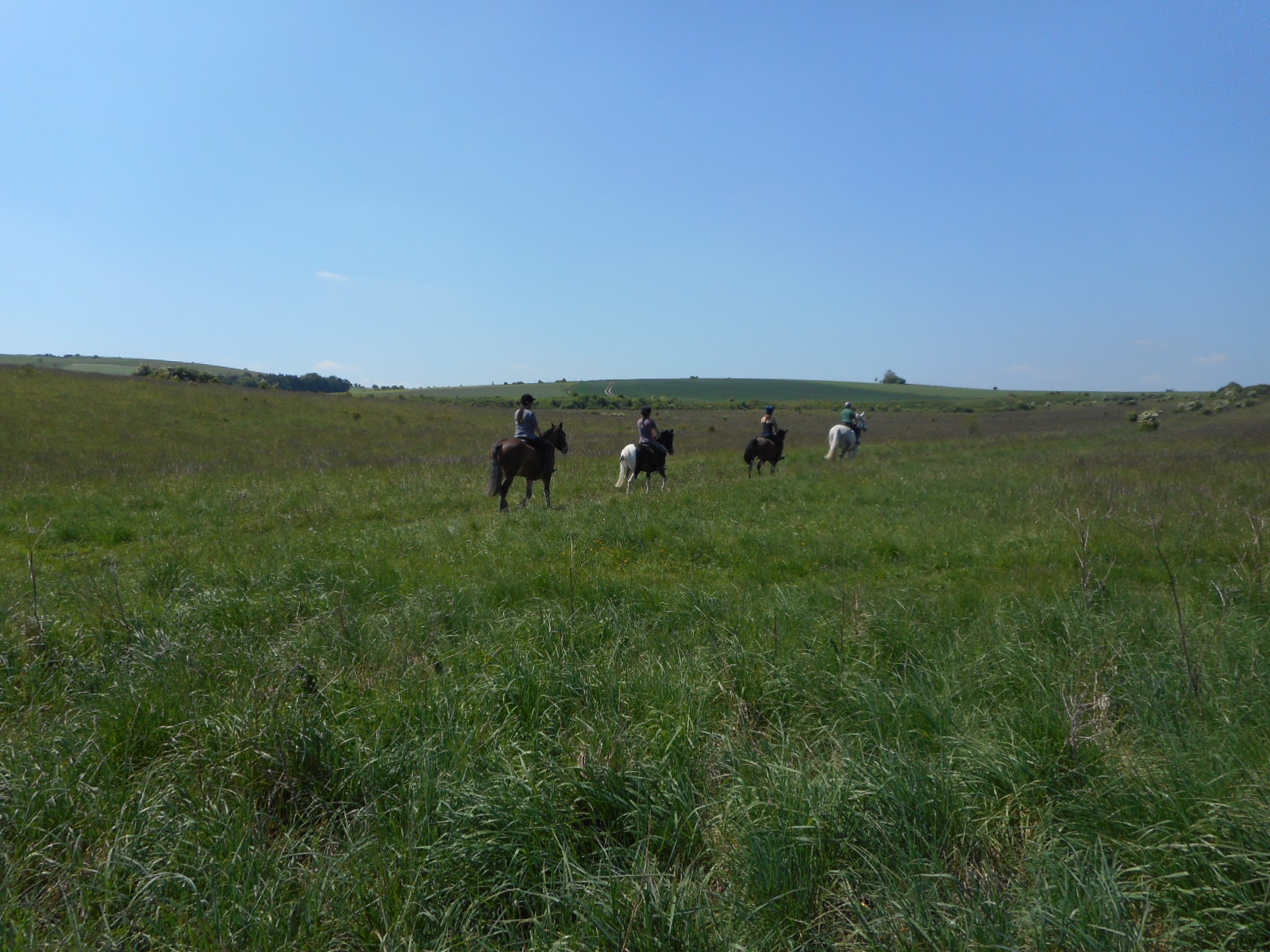 I’m supposed to be walking diagonally across a field and past a barn. No sign of either. No sign of anything, in fact until four horses and their riders cross in the distance. ‘Fancy a canter’, shouts the one in front? ‘Definitely’, says the one at the rear in an uncertain voice.
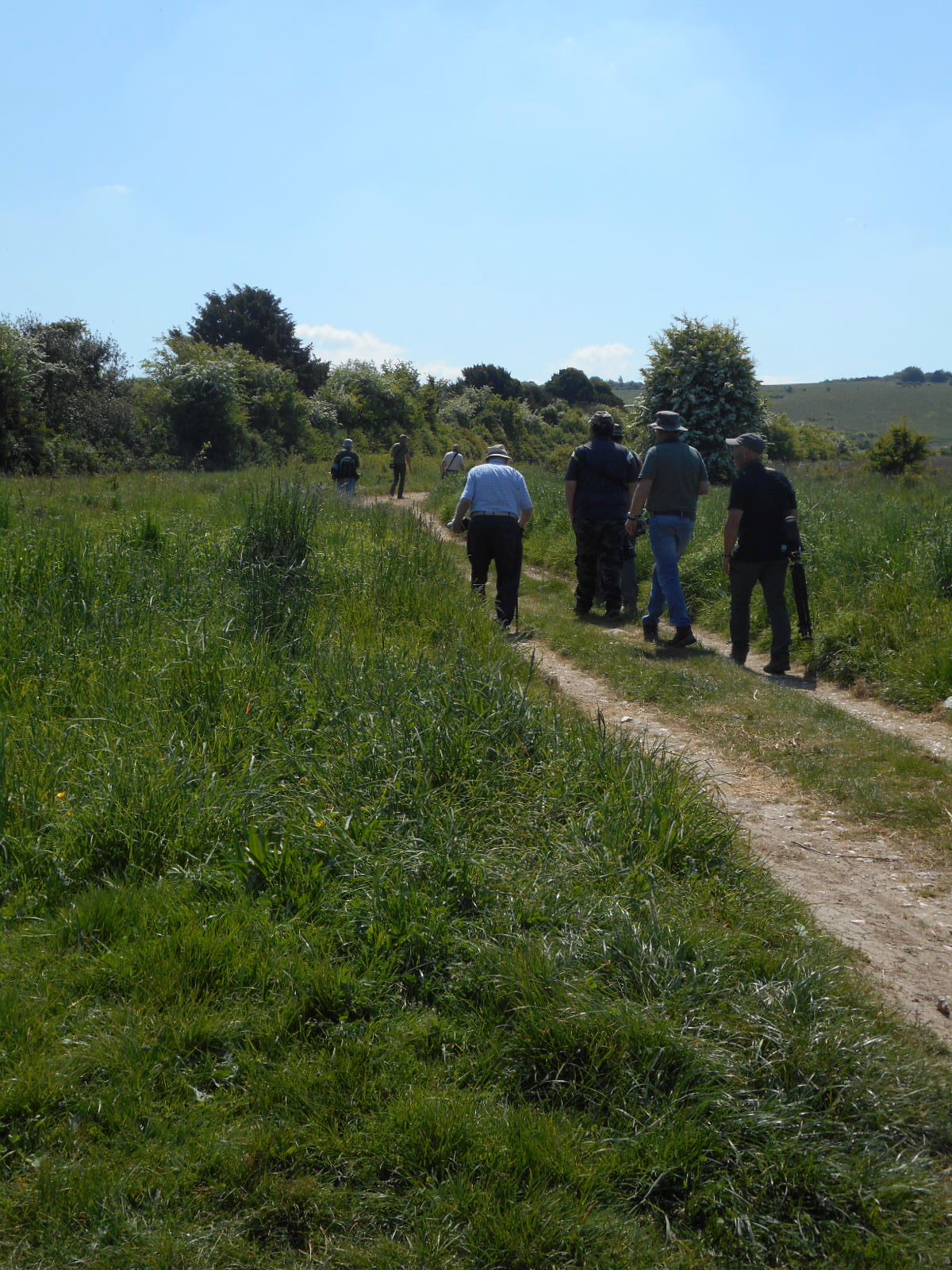 I walk for some miles with the downland to myself until, suddenly, the place is teeming with birders. Clearly, I’ve hit an ornithological hotspot. ‘Seen any turtles’, one group asks of another? ‘Loads, comes the reply. Not a drop of water in sight but even I know they’re talking about turtle doves. I wish my friend Sally was here: she has a deep-seated desire to see a turtle dove.
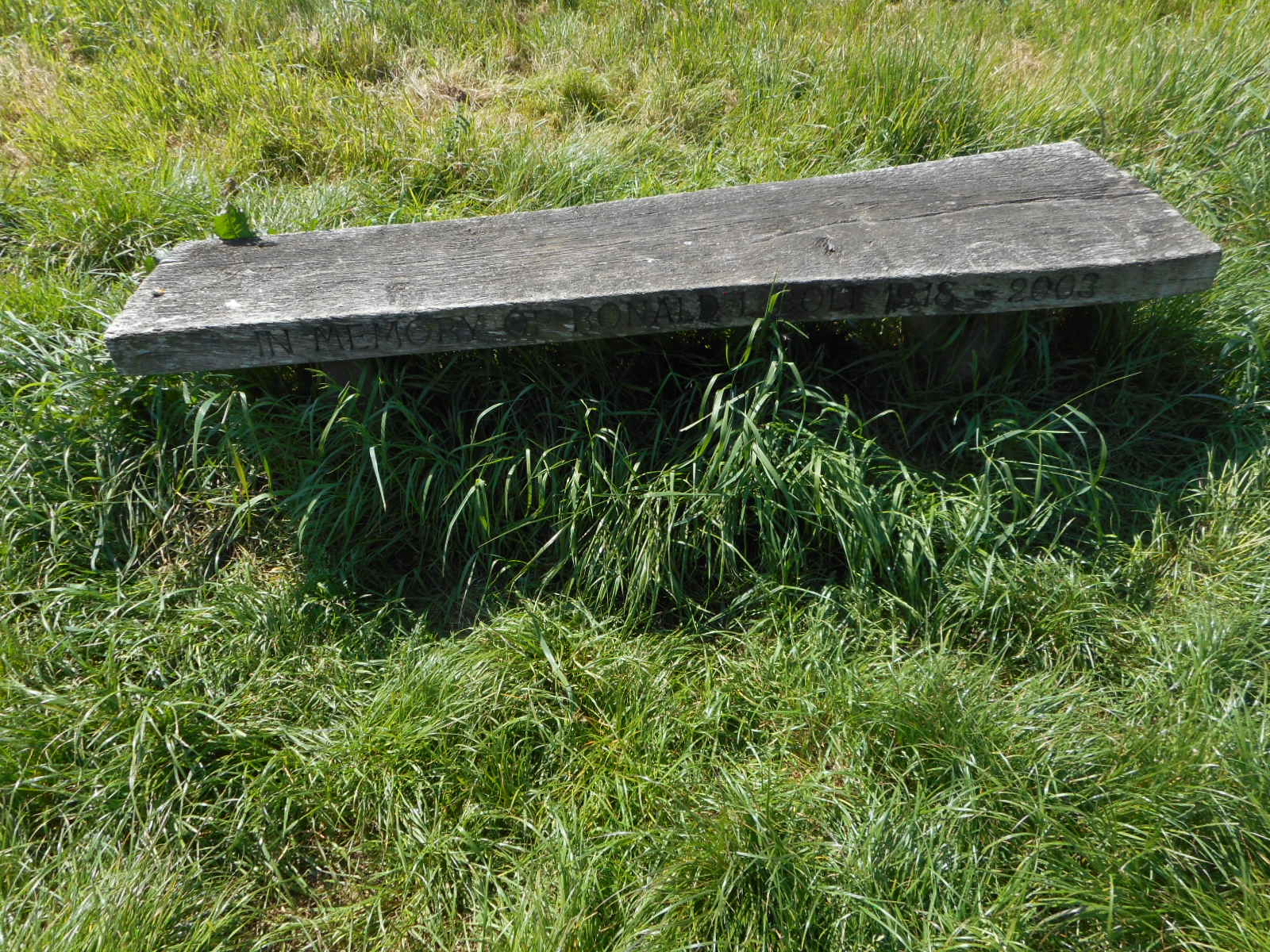 It’s so hot, and I’ve walked so far already, that I decide to take a rest on Ronald’s bench. Poor Ron – he didn’t last long did he? Anyway, I’m surrounded by birding types. I’ve noticed that they fall into a typology of two: those (always men) who hang around in flocks and are dismissive of people whom they deem to know nothing; and those nice ones who are embracing and keen to make helpful conversation. Luckily for me Sean, who asks if he can share the bench to eat his lunch, is of the latter variety.
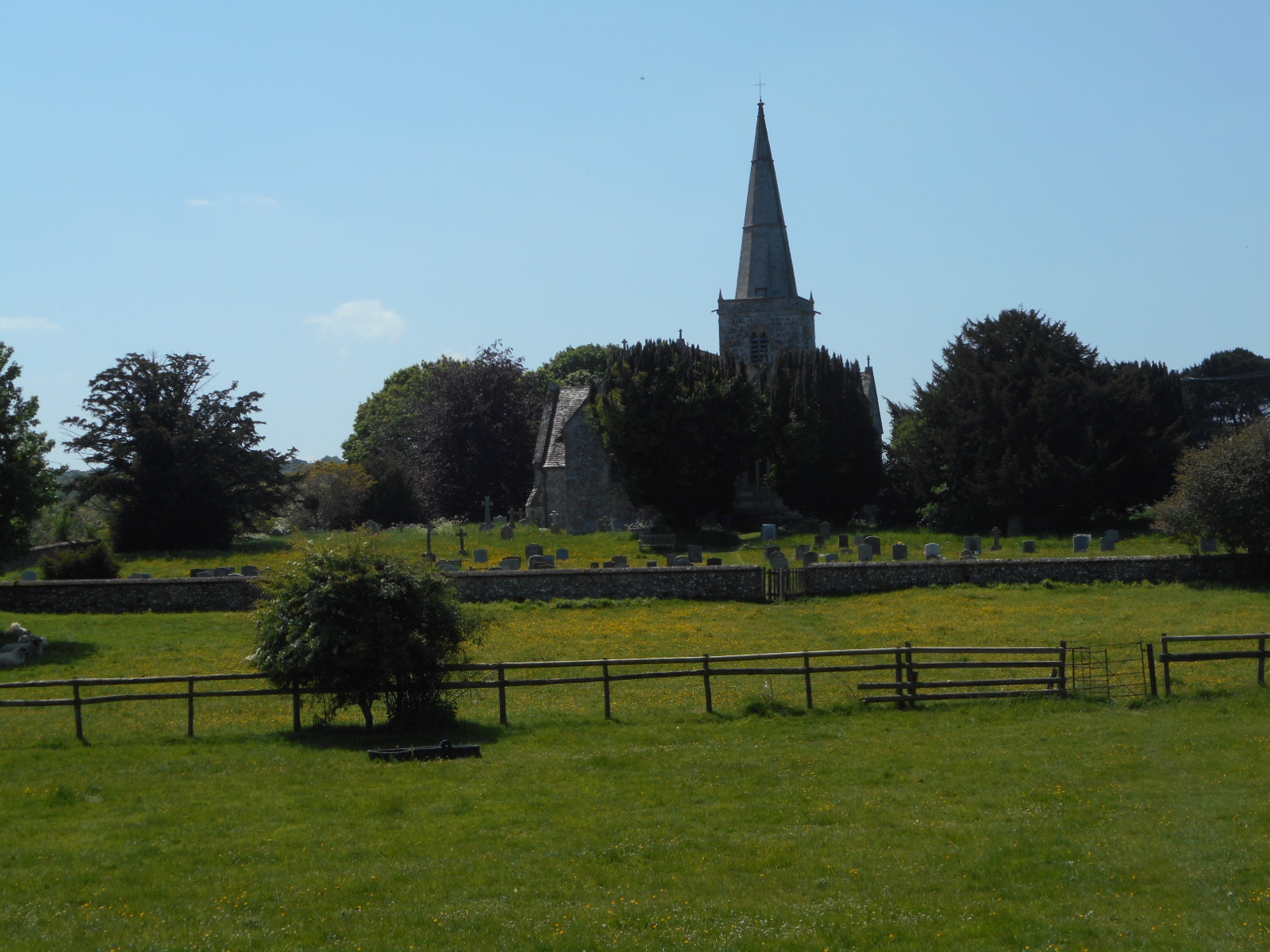
 My redundant instructions mention a church so I head off down a handy lane for about two miles until I begin to see roofs and suchlike. Must be near civilisation.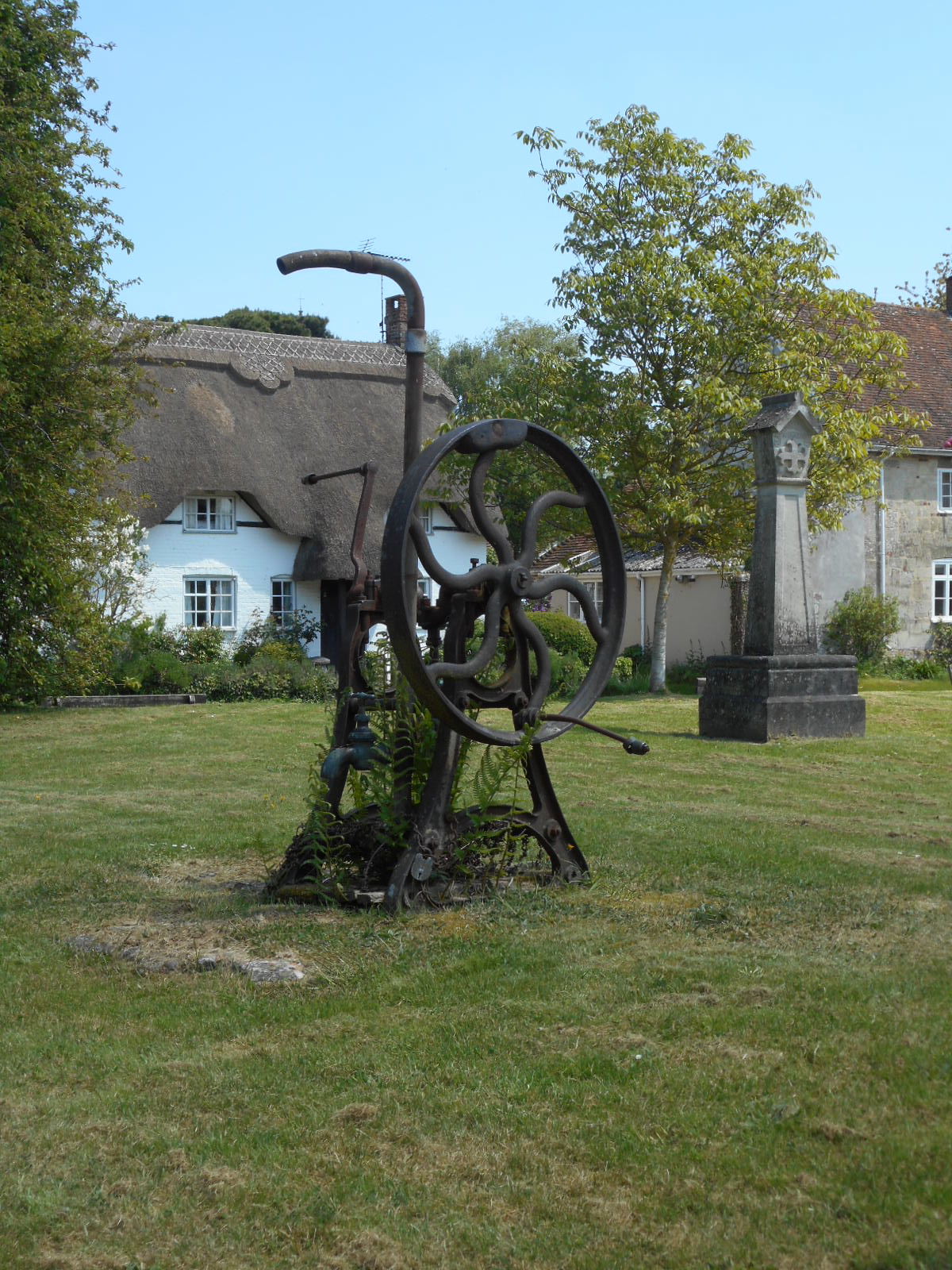
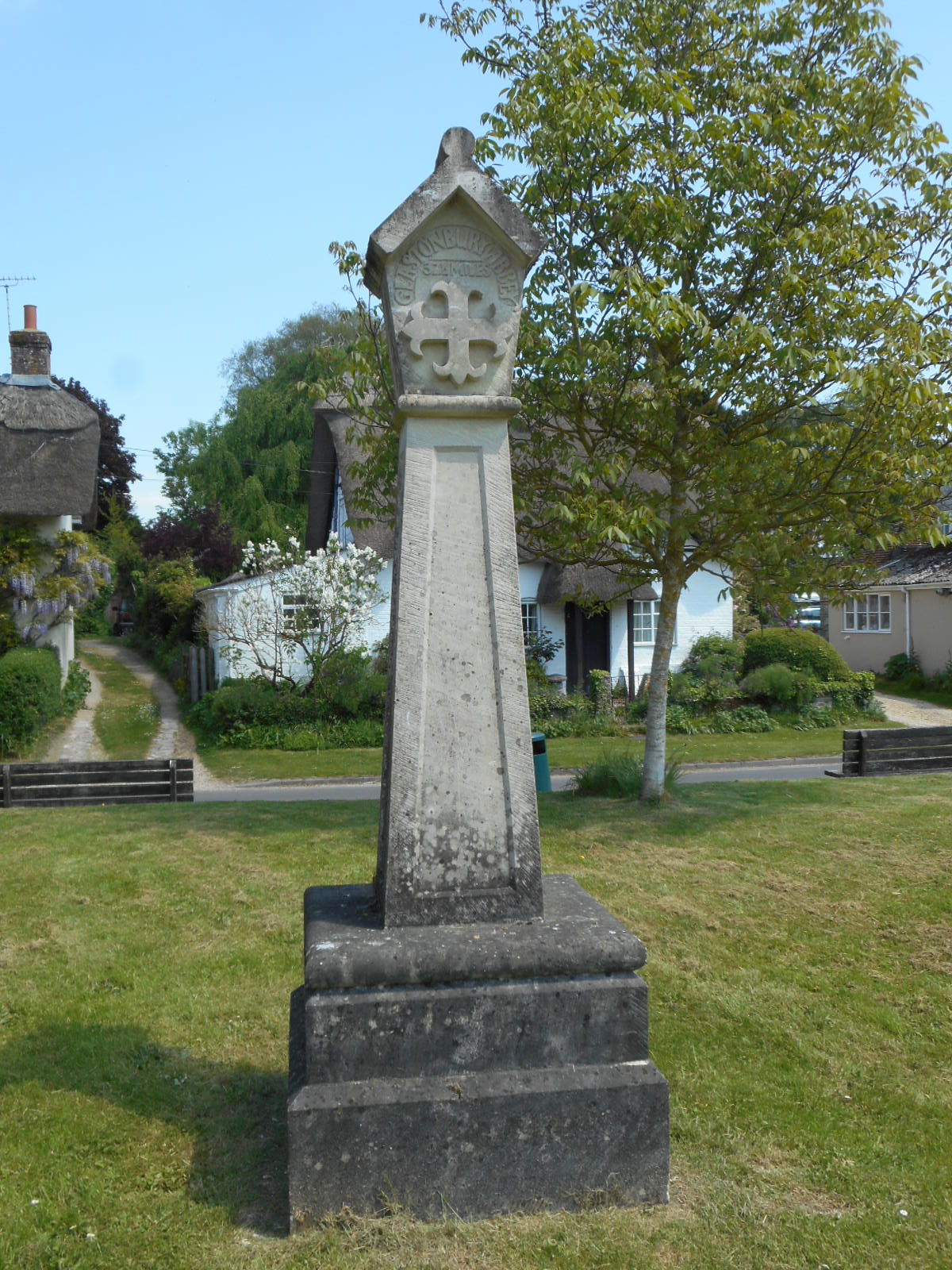
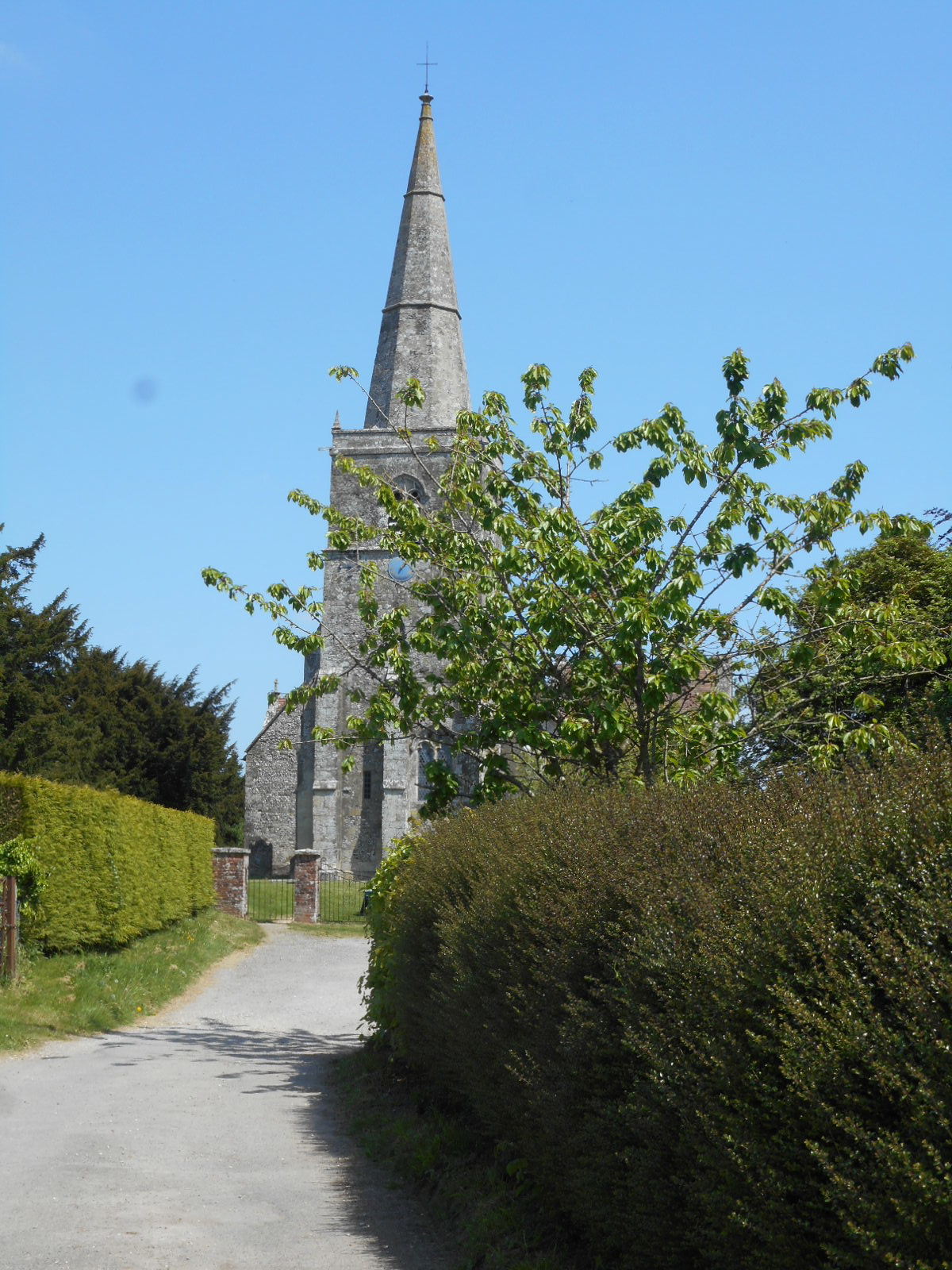

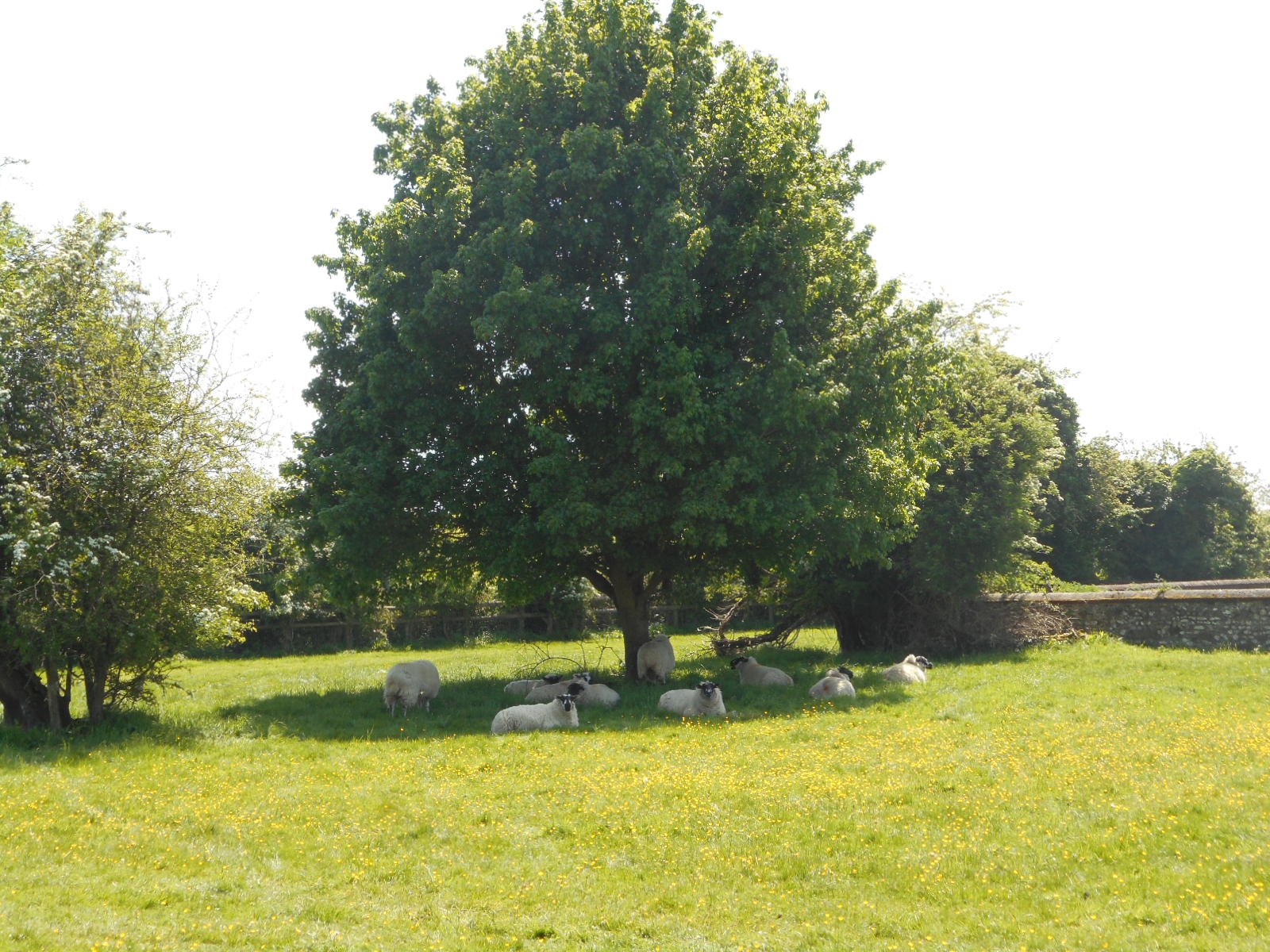
 And I wander across sheep-ridden pasture trying to find my way out. Who wrote these instructions?
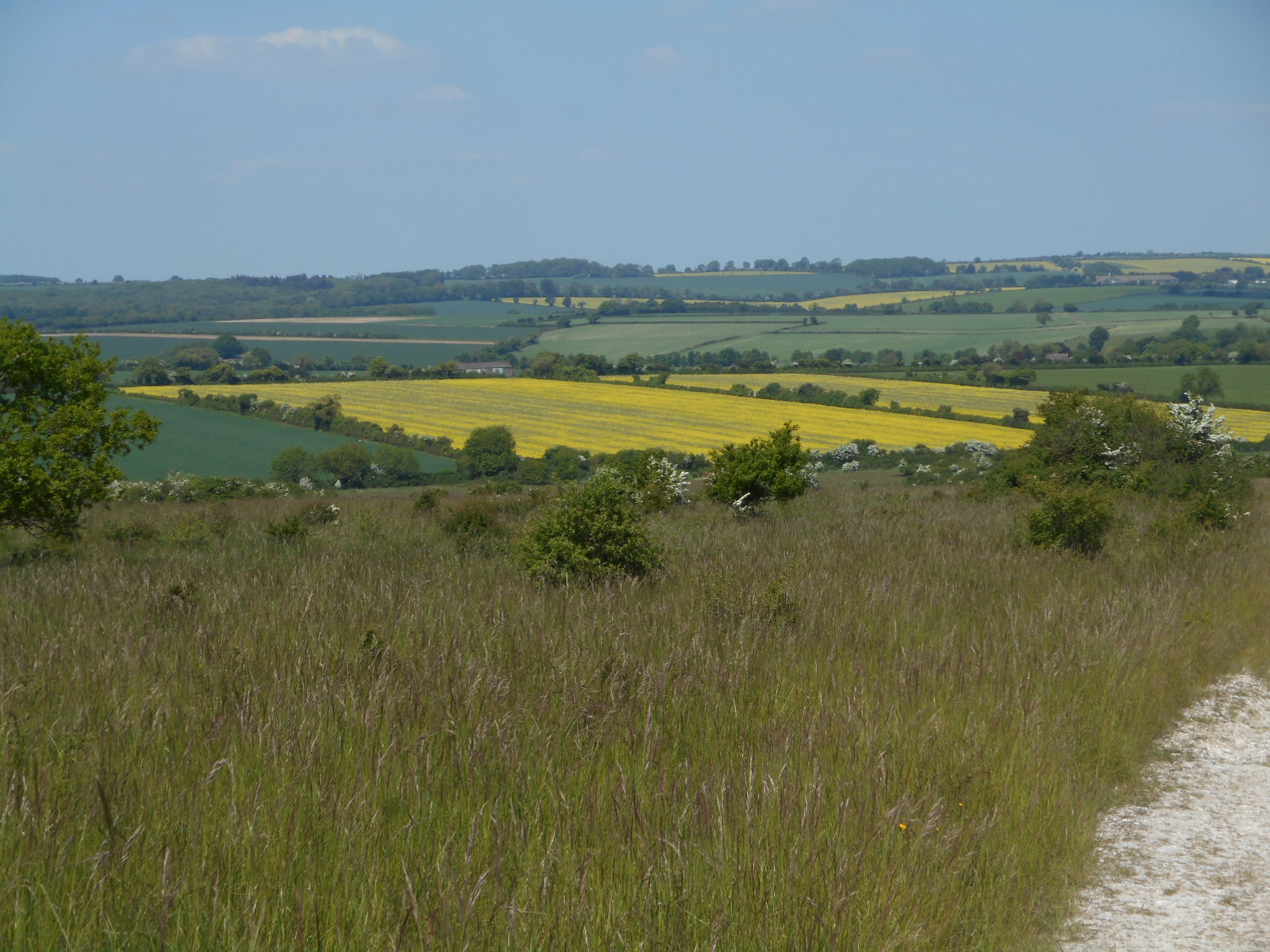 Eventually, I end up back on the reserve but not before I’ve been accosted by a woman who asks me if I’m looking for anything interesting. I can’t be bothered to fill her in so she starts telling me that turtle doves are just sitting around the place. Really? However, she does tell me how to hear one and this is very useful because, as I’m running away from her, up Pentridge Hill, I hear one purring in a hedge.
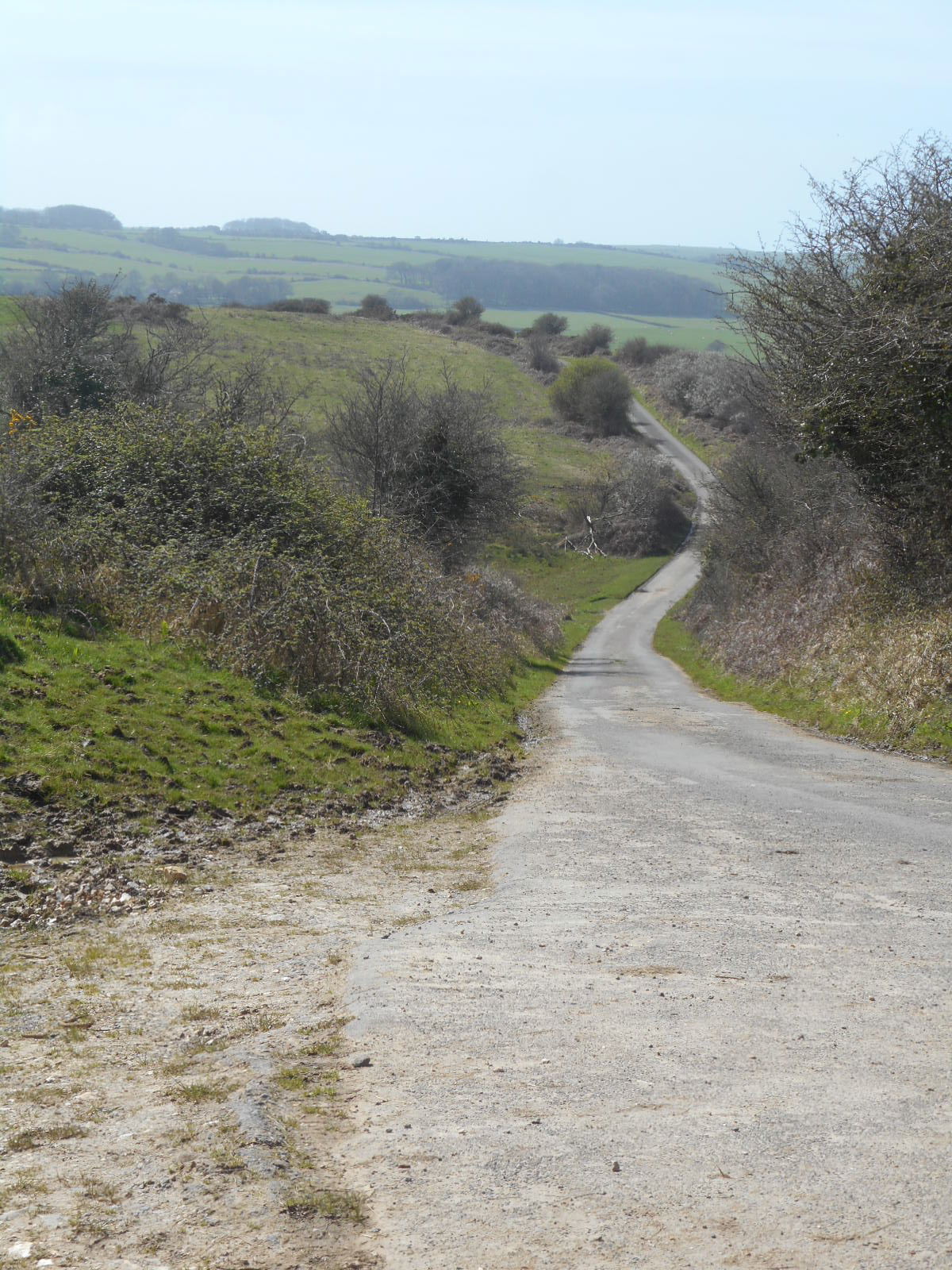
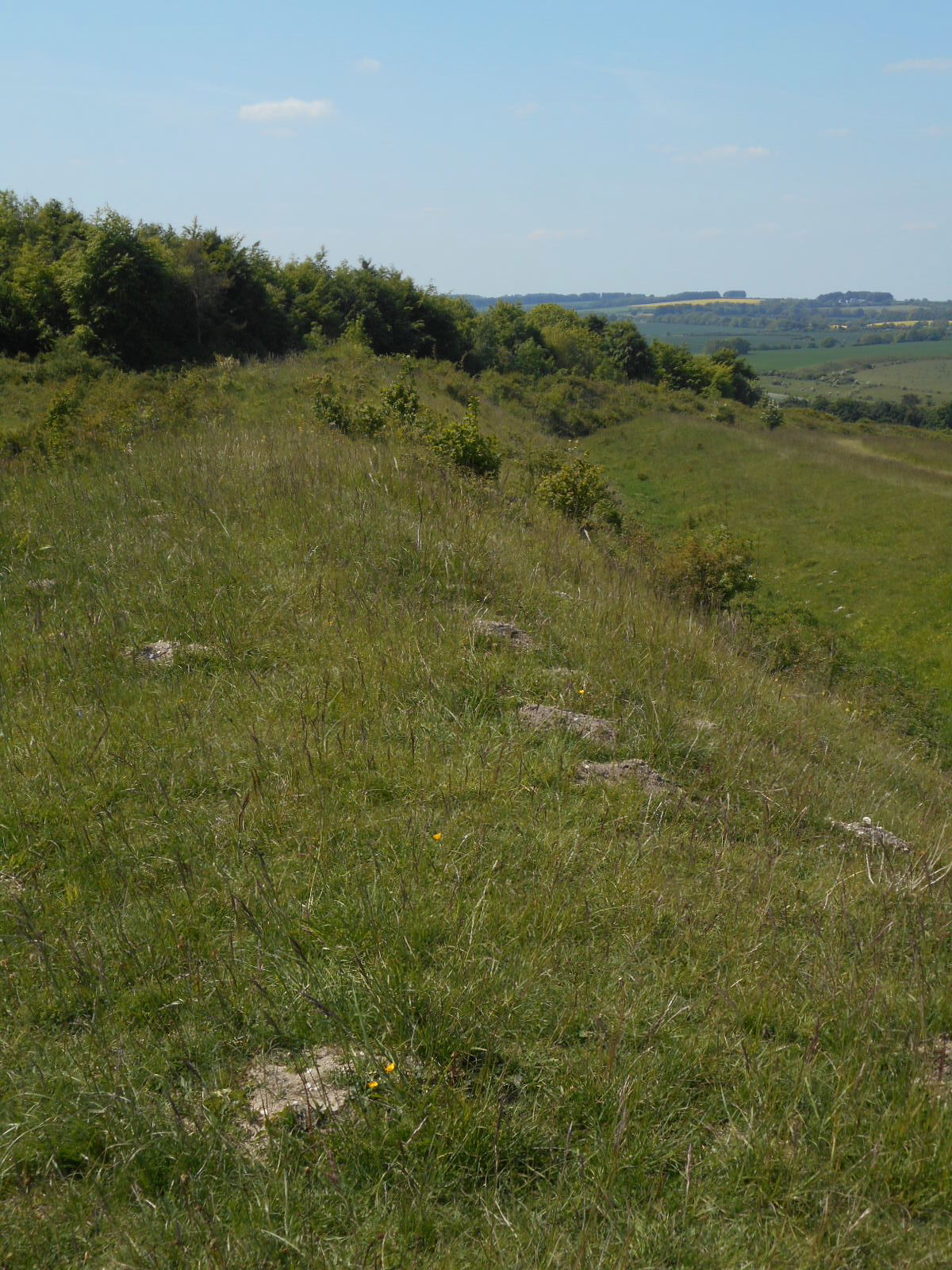 I walk all the way up to Grim’s Ditch which is either a bronze age or early iron age earthwork running for fourteen miles. And let me tell you, I feel like I’ve walked it all. There’s not a soul in sight but every time I think I’ll stop for a pee, around the corner comes a type muttering about bloody turtle doves or, just for a change, early orchids.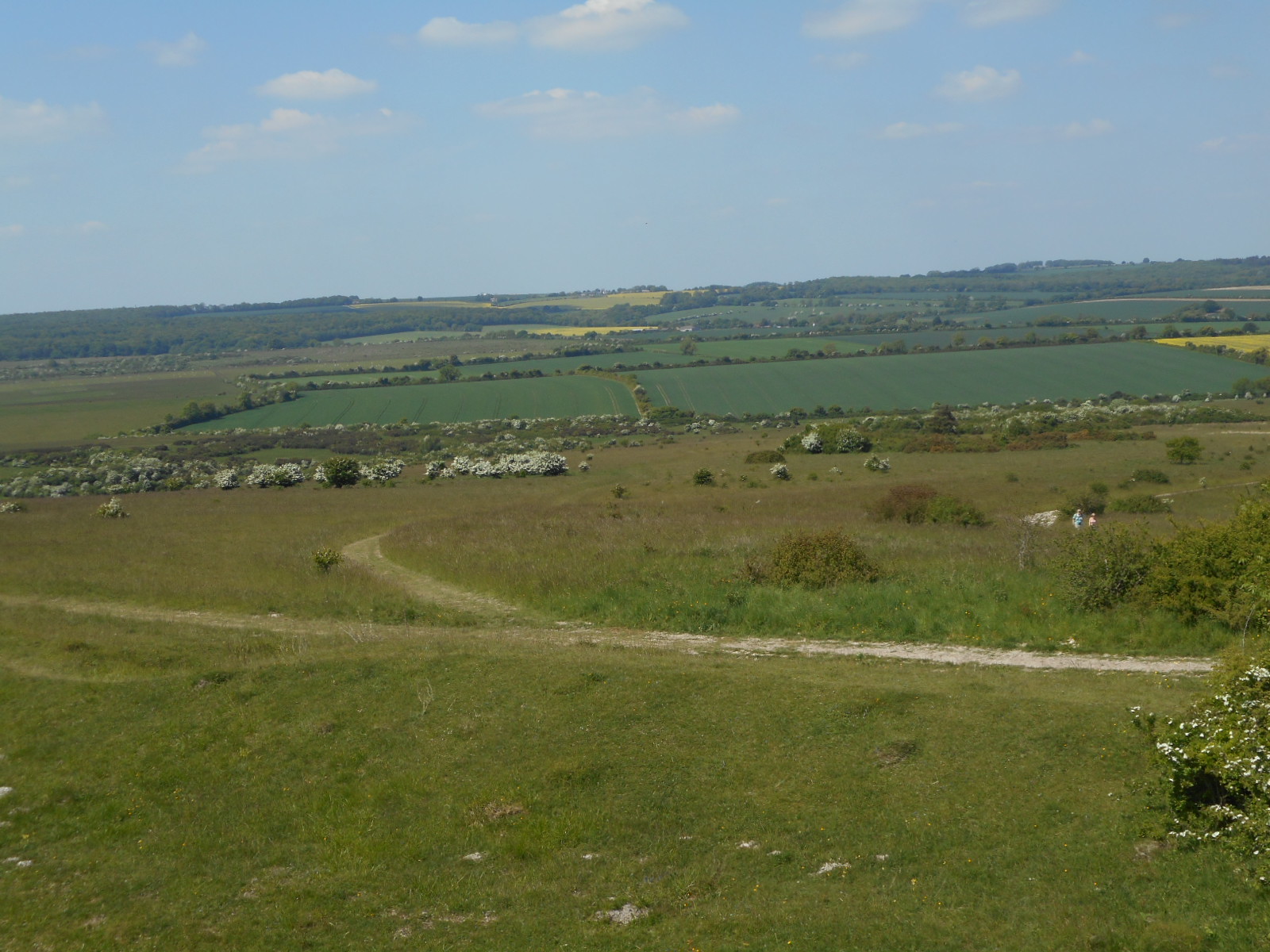
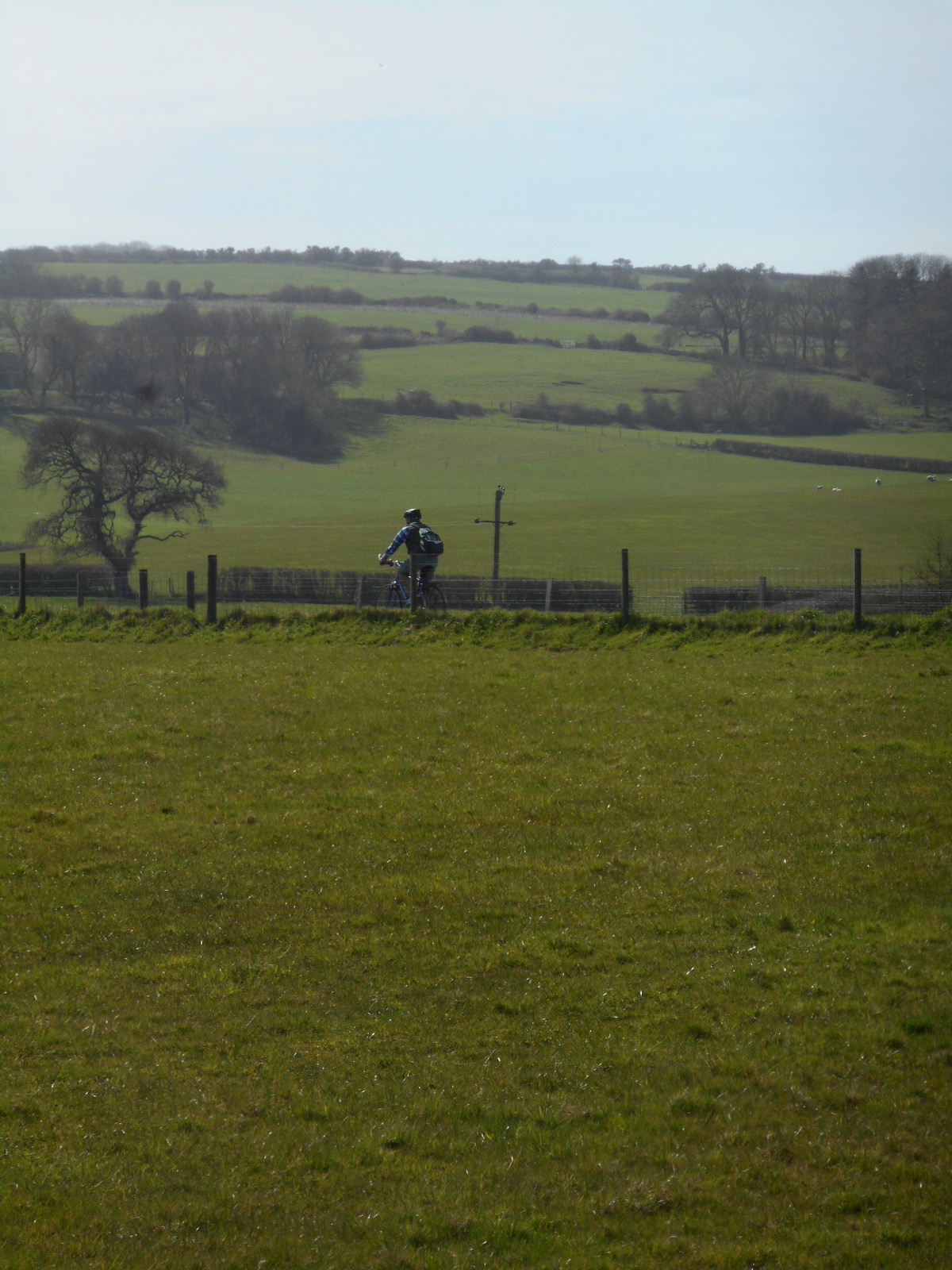
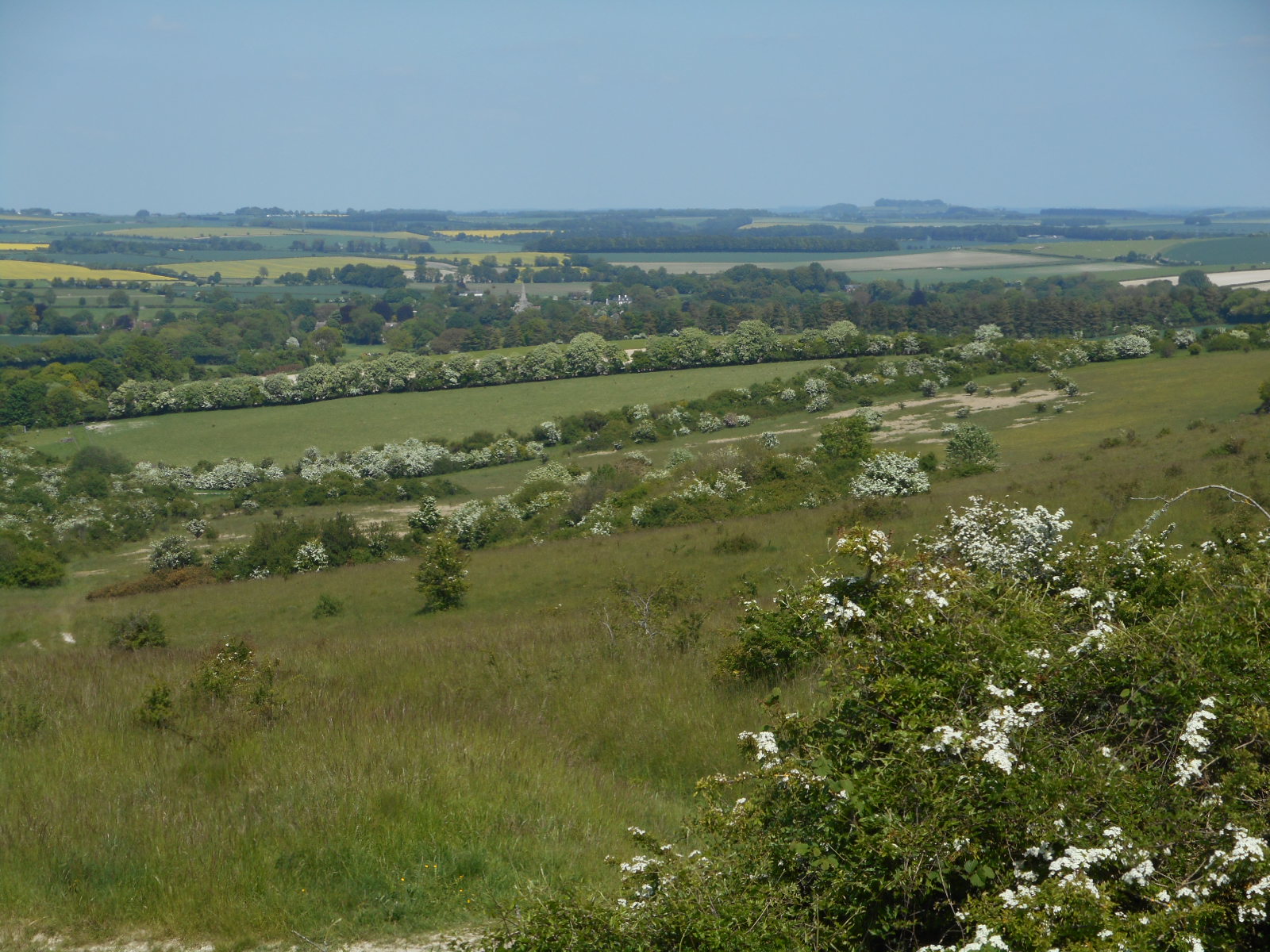 Mind you, the view up here, across the Wiltshire/Dorset/Hampshire countryside is pretty spectacular.
 Daughter number two texts at this point to say the wedding dress was simple and clean. Clean? Did she think it had been bought from a car boot sale? I finally find my way back to the car. From the instructions and the actual route and the state of my feet I calculate that I’ve probably walked at least eight miles. And let me tell you, I could think of worse places to be.






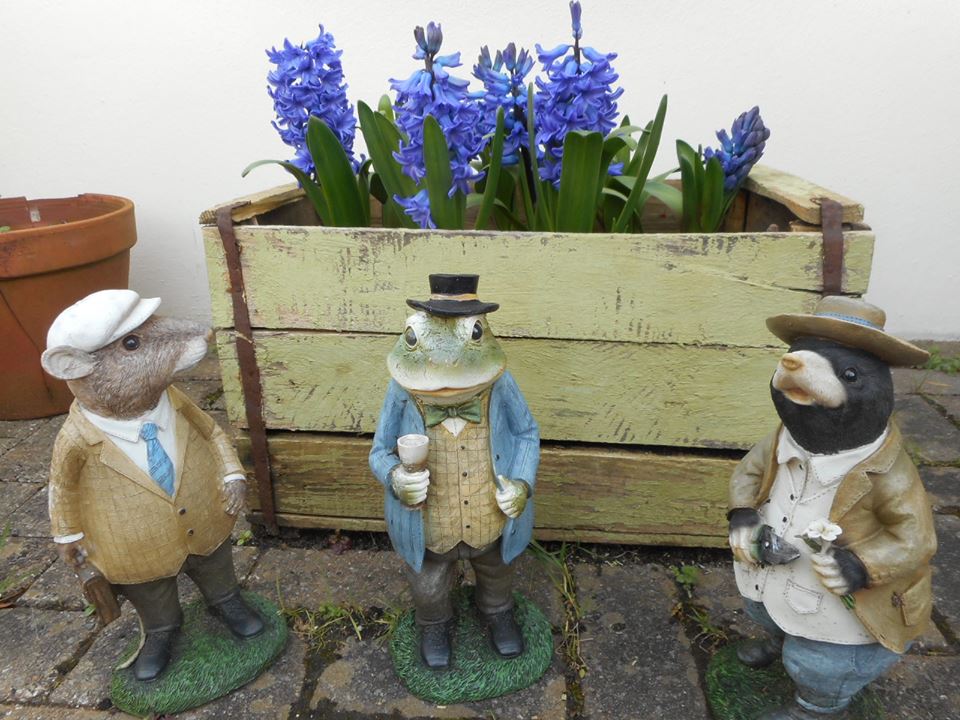
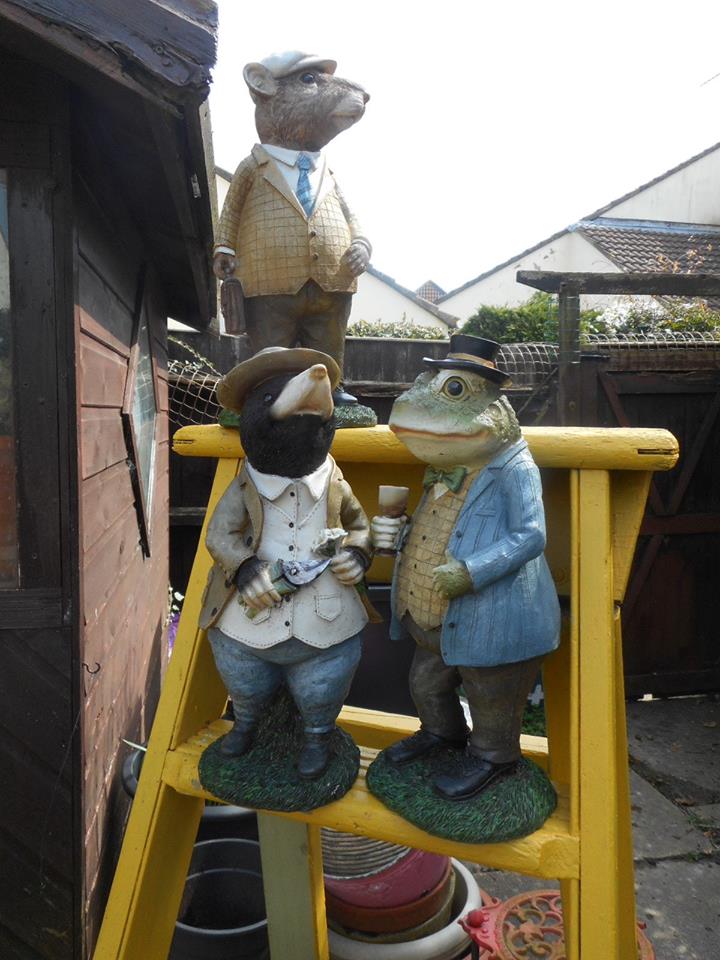 ‘What’s all the commotion’, asked Mole?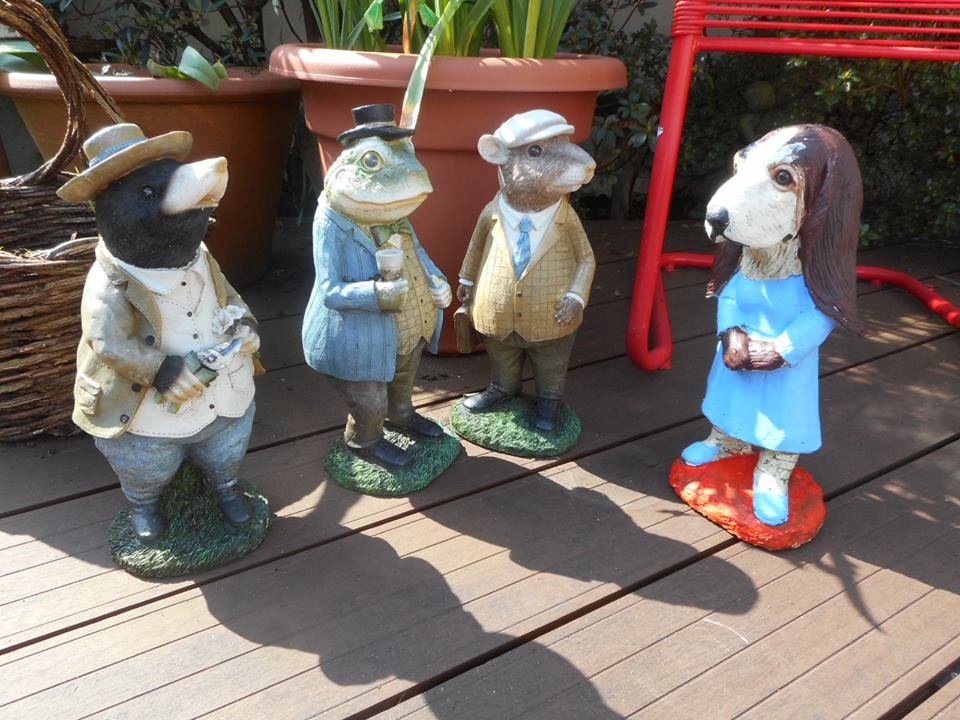
 Donald and the Weasels